Laser technology has become an important part of modern dermatology, aesthetic medicine, and cosmetic treatments. However, proper eye protection is essential when working with laser equipment. Optical Density (OD) in laser safety goggles plays a key role in determining how effectively the eyewear reduces exposure to specific laser wavelengths.
One of the most important specifications to understand when selecting protective eyewear is Optical Density (OD).
But what exactly does OD mean?
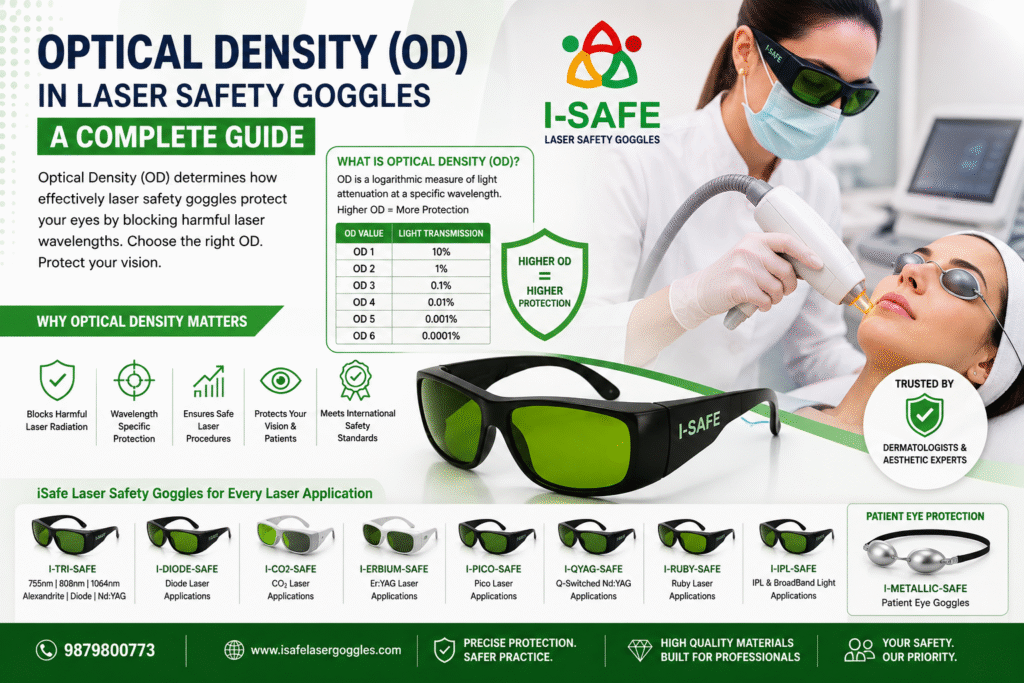
Optical density in laser safety goggles describes how effectively the filter attenuates laser radiation at a specific wavelength. In simple terms, a higher Optical Density (OD) generally means less of that specified laser radiation passes through the filter.
Therefore, understanding Optical Density (OD) can help dermatologists, aesthetic practitioners, laser technicians, and clinics make more informed decisions when selecting laser safety goggles.
In this guide, we explain what Optical Density (OD) means, how it works, why wavelength matters, and how iSafe Laser Goggles can support application-specific laser eye protection.
What Is Optical Density (OD)?
Optical density, commonly abbreviated as OD, is a logarithmic measure of how much optical radiation a filter attenuates.
For laser safety eyewear, OD is specified at particular wavelengths because a filter’s attenuation can vary across the spectrum. Therefore, an OD value should always be considered together with its wavelength or wavelength range.
The basic relationship is:
OD = -log₁₀(T)
where T represents the fraction of radiation transmitted through the filter.
For example:
- OD 1 → approximately 10% transmission
- OD 2 → approximately 1% transmission
- OD 3 → approximately 0.1% transmission
- OD 4 → approximately 0.01% transmission
- OD 5 → approximately 0.001% transmission
- OD 6 → approximately 0.0001% transmission
Consequently, each increase of one OD represents a tenfold reduction in transmission, assuming the OD values are being compared at the same wavelength.
Why Is Optical Density Important in Laser Safety Goggles?
Laser radiation can pose a significant hazard to the eyes. The level of risk depends on factors such as wavelength, power or energy, exposure duration, beam characteristics, and exposure conditions.
Therefore, choosing laser safety goggles based only on appearance or comfort is not sufficient.
The eyewear must provide appropriate attenuation for the laser wavelength and exposure conditions.
A suitable OD helps reduce the laser radiation reaching the eyes. However, a higher OD is not automatically the correct choice for every laser application.
Instead, the required OD should be determined from the specific laser system and applicable safety requirements.
How Does Optical Density Work?
The easiest way to understand OD is to think about light transmission.
Suppose a filter has an OD of 3 at a particular wavelength.
That means approximately 0.1% of the incident radiation is transmitted, while approximately 99.9% is attenuated, assuming the OD value applies at that wavelength.
Similarly:
| Optical Density | Approx. Transmission |
|---|---|
| OD 1 | 10% |
| OD 2 | 1% |
| OD 3 | 0.1% |
| OD 4 | 0.01% |
| OD 5 | 0.001% |
| OD 6 | 0.0001% |
This logarithmic relationship makes OD a useful way to describe the attenuation performance of laser protective filters.
However, remember that OD alone does not tell you whether a pair of goggles is suitable for your laser.
The wavelength coverage and the actual laser operating conditions must also be considered.
Why Does Wavelength Matter?
Wavelength is one of the most important factors when selecting laser safety goggles.
Different laser devices operate at different wavelengths. Furthermore, the eye’s sensitivity and the way laser radiation interacts with ocular tissue vary with wavelength.
For example, dermatology and aesthetic clinics may use:
- Alexandrite lasers
- Diode lasers
- Nd:YAG lasers
- Ruby lasers
- Er:YAG lasers
- CO₂ lasers
- Pico lasers
- IPL systems
Each application requires appropriate protective eyewear.
For this reason, a goggle with a particular OD at one wavelength should not automatically be considered suitable for another wavelength.
The American Academy of Dermatology laser safety guidance also identifies wavelength and optical density as important factors when selecting laser protective eyewear.
OD Is Not the Same as Wavelength Protection
This is a common misunderstanding.
Wavelength tells you what part of the optical spectrum the eyewear is designed to attenuate.
OD tells you how strongly the eyewear attenuates radiation at that wavelength.
Both specifications matter.
For example, imagine two different goggles:
- Goggle A: OD 5 at 1064 nm
- Goggle B: OD 5 at 532 nm
Both have an OD of 5, but they are not automatically interchangeable.
Why?
Because they provide that attenuation at different wavelengths.
Therefore, when selecting laser safety goggles, always check:
Wavelength + OD + Laser Conditions
rather than looking at OD alone.
How Is the Required OD Determined?
The required OD is not selected randomly.
Laser safety calculations consider the potential exposure and the applicable Maximum Permissible Exposure (MPE). OSHA describes OD determination using the relationship between anticipated exposure and the applicable MPE.
A commonly referenced relationship is:
OD = log₁₀(H/MPE)
where the appropriate exposure quantity and MPE must be expressed in compatible units.
For continuous-wave lasers, irradiance may be relevant. For pulsed lasers, radiant exposure and pulse characteristics can become important.
Therefore, the correct calculation can depend on:
- Laser wavelength
- Laser output power
- Pulse energy
- Pulse duration
- Repetition rate
- Beam diameter
- Exposure duration
- Beam characteristics
- Maximum Permissible Exposure
- Applicable laser-safety standard
Because these calculations can become complex, clinics should follow their laser manufacturer’s requirements and applicable professional laser-safety procedures rather than estimating OD based on a simple rule.
Does a Higher OD Always Mean Better Protection?
Not necessarily.
A higher OD means greater attenuation at the specified wavelength. However, more attenuation does not automatically mean the eyewear is appropriate for every application.
For example, excessive attenuation may reduce visibility or make it difficult for a practitioner to perform a procedure comfortably.
More importantly, the eyewear still needs to cover the required wavelength and meet the appropriate specifications.
Therefore, the goal is not simply to find the highest OD available.
The goal is to select laser safety goggles with appropriate wavelength coverage and sufficient OD for the specific laser hazard.
How to Read an OD Rating on Laser Safety Goggles
When reviewing protective eyewear specifications, you may see information such as:
1064 nm – OD 5+
This tells you two important things:
- 1064 nm = the wavelength at which the protection is specified
- OD 5+ = the attenuation level specified at that wavelength
You may also see multiple wavelengths listed.
For example, a multi-wavelength product may specify protection for several laser wavelengths.
This is particularly useful for clinics that use multi-wavelength laser systems.
iSafe Laser Goggles and Optical Density
iSafe Laser Goggles are designed for application-specific laser protection across a range of dermatology and aesthetic laser technologies.
The current iSafe product range includes dedicated eyewear for CO₂, Diode, Er:YAG, IPL, Pico, Q-switched Nd:YAG, Ruby, and triple-wavelength applications.
For example, iSafe I-TRI-SAFE Laser Goggles are listed for 755 nm, 808 nm, and 1064 nm applications and are designed for Alexandrite, Diode, and Nd:YAG laser hair-removal systems. The product page also highlights high optical density, lightweight construction, anti-fog lenses, and scratch-resistant lenses.
This application-specific approach is important because laser safety eyewear should be selected according to the actual laser device and wavelength.
iSafe I-TRI-SAFE
The I-TRI-SAFE is designed for three wavelengths:
- 755 nm
- 808 nm
- 1064 nm
It is listed for Alexandrite, Diode, and Nd:YAG laser systems.
iSafe I-CO2-SAFE
The iSafe range also includes I-CO2-SAFE Laser Goggles for CO₂ laser applications.
iSafe I-DIODE-SAFE
For Diode laser applications, iSafe offers I-DIODE-SAFE Laser Goggles.
iSafe I-ERBIUM-SAFE
The range also includes I-ERBIUM-SAFE Laser Goggles for Er:YAG applications.
iSafe I-PICO-SAFE
For Pico laser applications, clinics can consider I-PICO-SAFE Laser Goggles, subject to verifying the exact wavelength and product specifications against their device.
iSafe I-QYAG-SAFE
The I-QYAG-SAFE Laser Goggles are listed in the iSafe range for Q-switched Nd:YAG applications.
iSafe I-RUBY-SAFE
For Ruby laser applications, iSafe offers I-RUBY-SAFE Laser Goggles.
iSafe I-IPL-SAFE
The iSafe range also includes I-IPL-SAFE Laser Goggles for IPL applications. Because IPL produces broadband light rather than a single laser wavelength, practitioners should verify the eyewear specifications against the specific IPL device and treatment conditions.
Optical Density vs. Transmission
OD and transmission describe the same attenuation relationship from different perspectives.
For example:
Higher OD = Lower transmission
Therefore:
- OD 2 transmits approximately 1%
- OD 3 transmits approximately 0.1%
- OD 4 transmits approximately 0.01%
- OD 5 transmits approximately 0.001%
This is why even a small numerical increase in OD can represent a significant change in attenuation.
However, always remember that these values must be interpreted at the relevant wavelength.
Can One Pair of Laser Safety Goggles Work for Multiple Lasers?
Sometimes, but only when the product is specifically rated for all relevant wavelengths and exposure conditions.
For example, iSafe’s I-TRI-SAFE is designed around 755 nm, 808 nm, and 1064 nm protection. Therefore, it can be considered for compatible systems operating at those wavelengths, subject to verifying the complete product specifications and laser conditions.
However, you should never assume that a pair of goggles is suitable for a different laser simply because its OD number appears high.
Always verify:
- Wavelength
- OD
- Laser type
- Power or energy
- Pulse characteristics
- Manufacturer specifications
- Applicable safety requirements
Common Mistakes When Choosing Laser Safety Goggles
Choosing Goggles Only by OD
OD is important, but it is only one part of the selection process.
Ignoring the Wavelength
An OD value without the corresponding wavelength does not provide enough information for proper laser eyewear selection.
Assuming Higher OD Is Always Better
Higher attenuation is not automatically the right solution for every procedure.
Using One Pair for Every Laser
Different laser systems can operate at very different wavelengths.
Buying Without Checking Specifications
Always review the manufacturer’s technical information before purchasing or using protective eyewear.
Ignoring Damaged Lenses
Scratches, cracks, or other damage can affect the eyewear’s suitability. Follow the manufacturer’s inspection and replacement instructions.
How to Choose the Right OD for Your Laser Safety Goggles
Before selecting laser safety goggles, follow this simple process:
Step 1: Identify Your Laser
Find the exact laser model and manufacturer.
Step 2: Check the Wavelength
Identify the wavelength or wavelengths produced by the device.
Step 3: Determine the Laser Operating Conditions
Review power, pulse energy, pulse duration, repetition rate, beam characteristics, and exposure conditions.
Step 4: Determine the Required Protection
Use the laser manufacturer’s safety information and applicable laser-safety procedures to determine the required OD.
Step 5: Verify the Eyewear
Check that the selected goggles provide the required wavelength coverage and OD.
Step 6: Check Fit and Visibility
Finally, ensure the eyewear fits securely and allows appropriate visibility for the procedure.
Why Choose iSafe Laser Safety Goggles?
iSafe focuses on application-specific laser and light-protection eyewear for professional environments.
Its current range includes multiple laser-specific goggles and patient eye-protection products.
The iSafe I-TRI-SAFE, for example, combines triple-wavelength coverage with high optical density, an ergonomic frame, and anti-fog, scratch-resistant lenses.
Therefore, iSafe can be a practical option for clinics that need dedicated protective eyewear for different laser technologies.
However, the correct product should always be selected based on the specific laser, wavelength, OD requirement, and intended application.
Final Thoughts
Understanding optical density in laser safety goggles is essential when selecting appropriate laser eye protection.
OD tells you how strongly a filter attenuates radiation at a specified wavelength. However, OD should never be considered on its own.
Instead, consider the wavelength, OD, laser output, exposure conditions, and applicable safety requirements together.
Most importantly, always verify the protective eyewear specifications against the laser manufacturer’s requirements before use.
iSafe Laser Goggles offers application-specific eyewear for multiple laser and IPL technologies, helping dermatology and aesthetic professionals identify suitable eye-protection options for their equipment.
Visit our store: https://isafelasergoggles.com/shop-2/
Follow us on Instagram: https://www.instagram.com/alphasurgicals?igsh=cTdjYWNtaXkxazlr
Visit us for all dermatology instruments: https://alphasurgicals.com/store/