Choosing the right eye protection is essential when working with medical, dermatological, and aesthetic laser systems. Different devices operate at different wavelengths and exposure levels. Therefore, understanding how to select laser goggles by wavelength can help professionals choose appropriate eye protection for their specific equipment.
From CO2 and Nd: YAG to Diode, Alexandrite, and IPL systems, each technology has different characteristics. As a result, protective eyewear should always match the laser’s wavelength, optical density, output, and operating conditions.
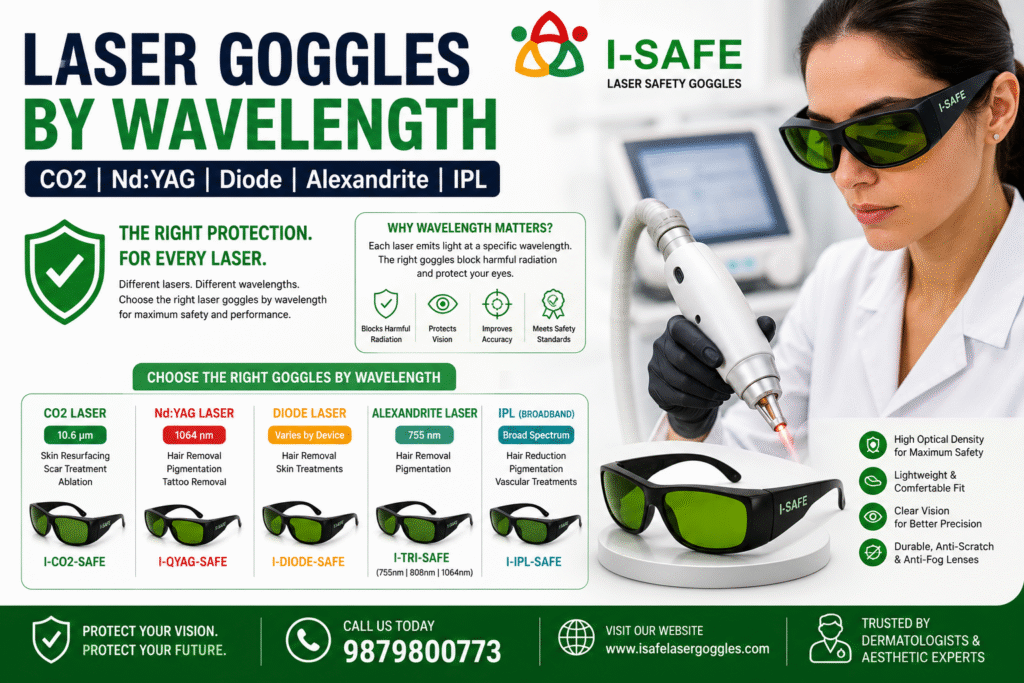
Why Is Wavelength Important for Laser Eye Protection?
Laser wavelength is one of the most important factors when selecting protective eyewear.
Different laser systems emit radiation at different wavelengths. The protective filter must therefore provide appropriate attenuation at the wavelength produced by the device.
For example:
- CO2 laser: commonly around 10.6 µm
- Nd: YAG laser: commonly 1064 nm
- Alexandrite laser: commonly 755 nm
- Diode laser: wavelength varies by device
- IPL: produces broadband light rather than a single laser wavelength
Therefore, select laser goggles by wavelength based on the actual specifications of the laser or IPL device.
How to Choose Laser Goggles by Wavelength
Selecting protective eyewear involves more than simply choosing goggles labeled for a particular laser type.
Before purchasing, check:
1. Laser Wavelength
First, identify the exact wavelength or wavelengths produced by your device.
2. Optical Density
Optical Density (OD) indicates how effectively the filter attenuates radiation at a specified wavelength.
A higher OD generally means lower transmission at that wavelength. However, the highest OD is not automatically the correct choice for every application.
3. Laser Power and Energy
The laser’s power, pulse energy, and exposure conditions affect the required level of protection.
4. Pulse Characteristics
For pulsed and Q-switched systems, pulse duration, repetition rate, and peak power can influence the appropriate protection requirements.
5. Product Specifications
Always check the manufacturer’s technical specifications to confirm that the goggles cover the required wavelength and provide the appropriate OD.
CO2 Laser Goggles
CO2 lasers commonly operate at approximately 10.6 µm (10,600 nm).
They are widely used for:
- Skin resurfacing
- Scar treatment
- Tissue ablation
- Wrinkle treatment
- Dermatological procedures
Because CO2 lasers operate in the infrared region, protective eyewear must be specifically designed for the applicable wavelength.
iSafe CO2 Protection
iSafe I-CO2-SAFE Laser Goggles are available for compatible CO2 laser applications.
Before use, verify the wavelength and OD specifications of the goggles against the requirements of your particular CO2 laser system.
Nd:YAG Laser Goggles
Nd:YAG lasers commonly operate at 1064 nm and are widely used in dermatology and aesthetic medicine.
Applications may include:
- Hair removal
- Pigmentation treatments
- Tattoo removal
- Vascular procedures
- Skin treatments
Q-switched Nd:YAG systems can have different pulse characteristics from other Nd:YAG systems. Consequently, wavelength alone should not be used to determine the required protection.
iSafe Nd:YAG Protection
iSafe I-QYAG-SAFE Laser Goggles are included in the iSafe range for Q-switched Nd:YAG applications.
Always verify the product specifications against your laser’s wavelength, output, pulse characteristics, and required OD.
Diode Laser Goggles
Diode lasers are widely used for aesthetic treatments, particularly laser hair removal.
However, Diode systems can operate at different wavelengths depending on the device.
For this reason, you should identify the exact wavelength before purchasing protective eyewear.
iSafe Diode Protection
iSafe I-DIODE-SAFE Laser Goggles are available for Diode laser applications.
If your system uses multiple wavelengths, make sure the selected eyewear provides protection across all relevant wavelengths.
Alexandrite Laser Goggles
Alexandrite lasers commonly operate around 755 nm and are frequently used for hair removal and other aesthetic applications.
When choosing protective eyewear, practitioners should verify that the goggles provide appropriate protection for the specific wavelength and exposure conditions.
iSafe Alexandrite Protection
The iSafe I-TRI-SAFE Laser Goggles are designed for three wavelengths:
- 755 nm
- 808 nm
- 1064 nm
This combination can be suitable for compatible Alexandrite, Diode, and Nd:YAG multi-wavelength systems.
Therefore, laser goggles by wavelength can be particularly useful for clinics that operate multi-wavelength laser platforms.
IPL Safety Goggles
IPL stands for Intense Pulsed Light.
Unlike a conventional laser, IPL produces broadband light across a range of wavelengths. Therefore, IPL protective eyewear should be selected according to the specific IPL device and its output characteristics.
IPL is commonly used for:
- Hair reduction
- Pigmentation treatments
- Vascular treatments
- Skin rejuvenation
- Photofacial procedures
iSafe IPL Protection
iSafe I-IPL-SAFE Laser Goggles are available for IPL applications.
Always verify the eyewear specifications against your specific IPL system before use.
Laser Goggles Comparison
Laser / Light Technology Common Wavelength Common Applications iSafe Option CO2 10.6 µm Resurfacing, ablation I-CO2-SAFE Nd:YAG 1064 nm Hair removal, pigmentation, tattoo applications I-QYAG-SAFE Diode Device-specific Hair removal I-DIODE-SAFE Alexandrite 755 nm Hair removal I-TRI-SAFE* IPL Broadband Hair reduction, pigmentation, vascular treatments I-IPL-SAFE *I-TRI-SAFE covers 755 nm, 808 nm, and 1064 nm according to the iSafe product range. Always verify compatibility with the exact laser system.
Why Choose iSafe Laser Goggles?
iSafe offers application-specific protective eyewear for professional laser and light-based procedures.
The iSafe range includes eyewear designed for different technologies, including:
- CO2
- Diode
- IPL
- Q-switched Nd:YAG
- Ruby
- Pico
- Er:YAG
- Multi-wavelength laser systems
This application-specific approach helps professionals select eyewear according to their equipment rather than relying on a generic solution.
iSafe I-TRI-SAFE, for example, provides protection across 755 nm, 808 nm, and 1064 nm applications, making it an option for compatible multi-wavelength systems.
How to Select the Right Goggles for Your Laser
Before purchasing laser goggles by wavelength, use this simple checklist:
Step 1: Identify Your Laser
Find the exact manufacturer and model of your laser.
Step 2: Check the Wavelength
Confirm the wavelength or wavelengths produced by the device.
Step 3: Check Optical Density
Determine the required OD based on the laser’s operating conditions and applicable safety requirements.
Step 4: Check Power and Pulse Characteristics
Review laser power, pulse energy, pulse duration, repetition rate, and other relevant parameters.
Step 5: Verify the Eyewear
Confirm that the goggles cover the required wavelength and provide sufficient OD.
Step 6: Check Fit and Visibility
Finally, make sure the eyewear fits securely and provides suitable visibility for the procedure.
Common Mistakes When Choosing Laser Goggles
Choosing Goggles Only by Laser Name
A product labeled “Diode” or “Nd:YAG” does not provide enough information by itself.
Ignoring Wavelength
Always verify the exact wavelength before selecting protective eyewear.
Looking Only at Optical Density
OD is important, but it must be considered together with wavelength and exposure conditions.
Using One Pair for Every Laser
Different laser systems may produce completely different wavelengths. Therefore, one pair should not automatically be used for multiple devices.
Forgetting Multi-Wavelength Lasers
Modern laser platforms can combine multiple wavelengths. In such cases, the eyewear should provide protection for all relevant wavelengths.
Not Checking Product Documentation
Always review the manufacturer’s technical specifications before purchasing or using laser protective eyewear.
What About Patient Eye Protection?
Laser safety also applies to patients.
Depending on the treatment area, laser type, and clinical protocol, patients may require appropriate protective eyewear or other eye protection.
Therefore, patient protection should be assessed separately from practitioner eyewear.
iSafe offers patient eye-protection products, including options such as I-METALLIC-SAFE, I-CORNEAL-SAFE, I-SILICON-SAFE, and I-MASK-SAFE.
Why Wavelength-Specific Protection Matters
Choosing laser goggles by wavelength helps ensure that the protective filter is designed for the radiation produced by the specific device.
However, wavelength is only one part of the selection process.
Professionals should also consider:
- Optical Density
- Laser power
- Pulse energy
- Pulse duration
- Repetition rate
- Exposure conditions
- Manufacturer recommendations
- Applicable safety standards
Consequently, the right eyewear should be selected based on the complete laser safety assessment.
Final Thoughts
Different laser and light-based technologies require different approaches to eye protection. CO2, Nd:YAG, Diode, Alexandrite, and IPL systems operate differently, so their protective eyewear should be selected carefully.
Understanding how to choose laser goggles by wavelength makes it easier to compare suitable options for different laser technologies.
iSafe Laser Goggles provides application-specific eyewear for multiple laser and IPL technologies, helping dermatology and aesthetic professionals find protective solutions suited to their equipment.
Visit our store: https://isafelasergoggles.com/shop-2/
Follow us on Instagram: https://www.instagram.com/alphasurgicals?igsh=cTdjYWNtaXkxazlr
Visit us for all dermatology instruments: https://alphasurgicals.com/store/