Laser technology has become an essential part of modern dermatology, aesthetic medicine, cosmetic procedures, and medical treatments. Clinics now use different laser systems for hair removal, skin rejuvenation, pigmentation, vascular treatments, resurfacing, tattoo removal, and other applications.
However, every laser device has specific safety requirements. Therefore, choosing the right laser safety goggles is just as important as selecting the right laser equipment.
Not all laser goggles provide the same protection. Different laser devices operate at different wavelengths and power levels. As a result, the protective eyewear must match the laser being used.
In this guide, we explain how to choose the right laser safety goggles, what specifications you should check, and how iSafe Laser Goggles can help clinics select application-specific eye protection.
Why Choosing the Right Laser Safety Goggles Matters
The eyes are particularly sensitive to laser radiation. Depending on the wavelength and energy of the laser, exposure can affect different parts of the eye.
Furthermore, some laser radiation may not be visible. This means a person may not immediately notice a hazardous exposure.
For this reason, appropriate laser safety goggles should be included in a comprehensive laser safety protocol whenever the procedure presents an ocular exposure risk.
However, simply wearing any protective glasses is not enough.
The goggles must be suitable for the specific laser wavelength and required protection level.
Using eyewear that does not match the laser can create a false sense of security. Therefore, practitioners should always verify the laser specifications before selecting protective eyewear.
What Should You Check Before Choosing Laser Safety Goggles?
Before purchasing laser safety goggles, consider several important specifications.
1. Laser Wavelength
The first thing you should identify is the wavelength of your laser device.
Laser systems operate at different wavelengths. For example, dermatology and aesthetic clinics may use:
- Alexandrite lasers
- Diode lasers
- Nd lasers
- Ruby lasers
- Er lasers
- CO₂ lasers
- Pico lasers
- IPL systems
Because each system produces different optical radiation, the eyewear must provide appropriate protection for the wavelength involved.
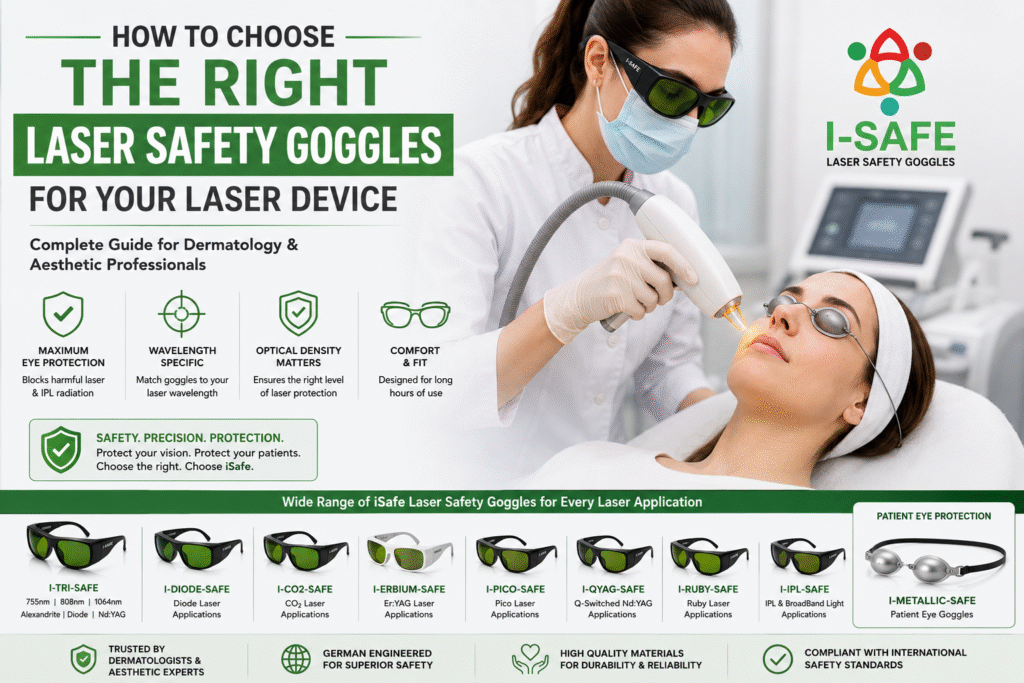
For example, iSafe’s I-TRI-SAFE goggles are designed for 755 nm, 808 nm, and 1064 nm applications and are listed for Alexandrite, Diode, and Nd laser hair-removal systems.
Therefore, always identify the laser wavelength before choosing your laser safety goggles.
2. Optical Density (OD)
Optical density, commonly referred to as OD, is another important specification.
OD describes how strongly an optical filter attenuates light at a particular wavelength. The appropriate OD depends on the laser characteristics and the exposure conditions.
Therefore, clinics should not select goggles based on wavelength coverage alone. They should also verify the required optical density for the laser system and application.
When selecting laser safety goggles, check the manufacturer’s technical documentation and follow the laser manufacturer’s safety requirements.
3. Laser Type
The type of laser also influences your eyewear selection.
For instance, a clinic using a CO₂ laser will have different protection requirements from a clinic using a Diode or Nd laser.
The current iSafe product range includes dedicated models for several laser applications, including:
- I-CO2-SAFE – CO₂ laser applications
- I-DIODE-SAFE – Diode laser applications
- I-ERBIUM-SAFE – Er applications
- I-PICO-SAFE – Pico laser applications
- I-QYAG-SAFE – Q-switched Nd applications
- I-RUBY-SAFE – Ruby laser applications
- I-TRI-SAFE – triple-wavelength applications
- I-IPL-SAFE – IPL and broadband-light applications
This application-specific approach makes it easier for clinics to identify eyewear according to their laser technology.
4. Procedure and Treatment Area
The treatment itself should also influence your eye-protection strategy.
For example, a laser procedure performed on the legs may present a different practical eye-protection scenario from a procedure performed close to the eyes.
Therefore, consider:
- Treatment location
- Laser wavelength
- Laser power
- Procedure type
- Practitioner position
- Patient position
- Potential direct or reflected exposure
When procedures take place near the eyes, additional patient eye protection or specialized ocular shields may be required.
iSafe also offers patient protection products, including the I-METALLIC-SAFE Patient Eye Goggles. The product is listed for laser and IPL procedures and uses a stainless-steel construction with an adjustable strap.
5. Fit and Comfort
Protection is important, but comfort also matters.
Laser procedures can take several minutes or longer. Consequently, practitioners may need to wear laser safety goggles throughout the treatment.
Poorly fitting eyewear can become uncomfortable and distracting. Moreover, if goggles do not remain securely positioned, they may not provide the intended coverage.
Therefore, look for:
- Secure fit
- Comfortable frame
- Appropriate coverage
- Clear vision
- Lightweight construction
- Suitable design for extended use
The iSafe I-TRI-SAFE model, for example, is listed with a lightweight ergonomic frame, anti-fog lenses, and scratch-resistant lenses.
6. Lens Quality and Visibility
Practitioners need to see clearly while performing procedures.
Therefore, protective eyewear should provide appropriate optical performance while delivering the required protection.
Clear visibility can help practitioners maintain accuracy and focus during treatment. At the same time, the eyewear must still meet the protection requirements for the specific laser application.
When evaluating laser safety goggles, check the manufacturer’s information regarding optical quality, lens construction, distortion, coatings, and visibility.
7. Check the Product Documentation
Never purchase laser goggles based only on appearance or a general statement such as “laser protection.”
Instead, review the product documentation carefully.
Look for information about:
- Protected wavelength
- Optical density
- Laser type
- Intended application
- Relevant safety standards
- Product identification
- Manufacturer information
- Inspection and maintenance instructions
This information helps you determine whether the eyewear is appropriate for your laser system.
How to Match iSafe Goggles to Your Laser Device
One of the easiest ways to select the right laser safety goggles is to start with your laser device.
Alexandrite + Diode + Nd
If your clinic uses a multi-wavelength hair-removal platform operating at 755 nm, 808 nm, and 1064 nm, the iSafe I-TRI-SAFE is designed for these three wavelengths.
Diode Laser
For Diode laser applications, the iSafe range includes I-DIODE-SAFE. The exact product specification should be checked against your device before use.
CO₂ Laser
For CO₂ applications, iSafe offers I-CO2-SAFE. Verify the product’s wavelength and protection specifications against your specific CO₂ laser before use.
Er Laser
For Er applications, the iSafe range includes I-ERBIUM-SAFE.
Pico Laser
For Pico laser applications, iSafe offers I-PICO-SAFE. Because Pico systems can operate at different wavelengths, always verify the exact wavelength and required protection before selecting your eyewear.
Q-Switched Nd
The iSafe range includes I-QYAG-SAFE for Q-switched Nd applications. Again, confirm the exact laser wavelength and optical-density requirement before use.
Ruby Laser
For Ruby laser applications, iSafe offers I-RUBY-SAFE.
IPL
IPL systems require appropriate broadband-light protection. iSafe offers I-IPL-SAFE for IPL and broadband-light applications. However, always verify compatibility with the specific IPL device before use.
Why Choose iSafe Laser Safety Goggles?
iSafe Laser Goggles provide an application-focused range of protective eyewear for dermatology and aesthetic environments.
Instead of treating laser protection as a one-size-fits-all product, iSafe offers different models for different laser and light-based technologies.
This makes it easier for clinics to organize their protective eyewear according to their equipment.
The current iSafe shop includes multiple laser-specific models along with patient eye-protection products.
Application-Specific Options
Different lasers require different protection. Therefore, having dedicated options for CO₂, Diode, Er, Pico, Nd, Ruby, IPL, and multi-wavelength systems can help clinics select eyewear according to their equipment.
Professional Clinical Use
Laser procedures require concentration and precision. Therefore, comfortable and appropriately fitted laser safety goggles can support practical use during treatment sessions.
Practitioner and Patient Protection
Laser safety involves everyone who may be exposed to the treatment environment.
In addition to practitioner eyewear, iSafe offers patient-focused products such as I-METALLIC-SAFE.
Common Mistakes When Choosing Laser Safety Goggles
Choosing the wrong eyewear can compromise your laser safety process.
Avoid these common mistakes:
Choosing Goggles by Appearance
A stylish or professional-looking frame does not automatically provide the required laser protection.
Ignoring Wavelength
Never assume that one pair of goggles works for every laser.
Ignoring Optical Density
Wavelength coverage and OD should both be considered when selecting protective eyewear.
Buying Without Documentation
Always review the manufacturer’s product specifications before purchasing.
Using Damaged Goggles
Scratched, cracked, or damaged eyewear should be inspected and replaced according to the manufacturer’s recommendations.
Using One Pair for Multiple Lasers Without Verification
If your clinic uses several laser systems, verify that the same goggles are appropriate for each specific wavelength and protection requirement.
A Simple Checklist for Choosing Laser Safety Goggles
Before you purchase laser safety goggles, ask these questions:
- What wavelength does my laser use?
- What optical density is required?
- Is the eyewear specifically designed for my laser type?
- Does the product documentation confirm the required protection?
- Is the eyewear comfortable for extended procedures?
- Does it provide appropriate coverage?
- Does the product meet the applicable safety requirements?
- Do patients require separate eye protection?
- Is the eyewear free from visible damage?
- Have staff members been trained to use the correct protection?
If you can answer these questions confidently, you are in a much better position to select appropriate protective eyewear.
Final Thoughts
Choosing the right laser safety goggles should never be an afterthought.
First, identify your laser wavelength. Next, check the required optical density and product specifications. Then, consider the treatment area, fit, comfort, and intended use.
Most importantly, do not assume that one pair of goggles is suitable for every laser.
iSafe Laser Goggles offers application-specific options for several laser and IPL technologies, helping dermatology and aesthetic clinics identify protective eyewear according to their equipment.
Before using any protective eyewear, always verify the exact product specifications against your laser or IPL device and follow the equipment manufacturer’s safety instructions and applicable professional requirements.
Choose the Right Protection for Your Laser
Looking for laser safety goggles for your dermatology or aesthetic clinic?
Explore the iSafe range and identify the appropriate eyewear for your laser application.
Protect your vision. Choose the right protection. Choose iSafe.
Frequently Asked Questions
What are the most important factors when choosing laser safety goggles?
The most important factors include wavelength, optical density, laser type, treatment conditions, fit, visibility, product documentation, and applicable safety requirements.
Can I use one pair of laser safety goggles for different lasers?
Not automatically. You should verify that the goggles are specifically rated for every wavelength and required optical density involved.
Why is wavelength important for laser safety goggles?
Different lasers produce different wavelengths. Therefore, protective eyewear must provide appropriate attenuation for the wavelength produced by the specific laser.
What is optical density in laser safety goggles?
Optical density describes the attenuation provided by an optical filter at a particular wavelength. The required OD depends on the laser and exposure conditions.
Does iSafe make laser safety goggles for different laser types?
Yes. The current iSafe range includes products for CO₂, Diode, Er, IPL, Pico, Q-switched Nd, Ruby, and triple-wavelength applications.
Does iSafe offer patient eye protection?
Yes. iSafe currently lists patient protection products including I-METALLIC-SAFE and I-MASK-SAFE.
What should I do if my laser goggles are scratched or damaged?
Do not assume damaged eyewear remains suitable for use. Inspect it according to the manufacturer’s instructions and replace it when required.
Visit our store: https://isafelasergoggles.com/shop-2/
Follow us on Instagram: https://www.instagram.com/alphasurgicals?igsh=cTdjYWNtaXkxazlr
Visit us for all dermatology instruments: https://alphasurgicals.com/store/