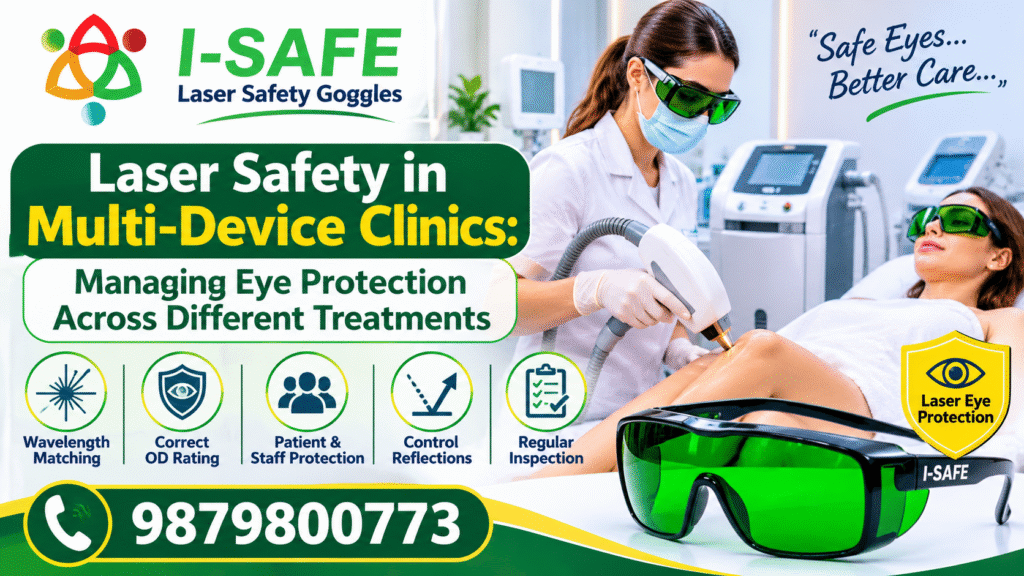
Laser Safety in Multi-Device Clinics: Managing Eye Protection Across Different Treatments
Introduction
Modern aesthetic and dermatology clinics often use several laser and light-based devices for different treatments. A clinic may offer laser hair removal, pigmentation treatments, tattoo removal, skin resurfacing, and IPL procedures in the same facility.
However, each device may produce different wavelengths, energy levels, and exposure conditions. Therefore, using the same pair of laser safety goggles for every treatment can create serious risks if the eyewear does not provide the required protection.
Laser Safety in Multi-Device Clinics requires a clear system for selecting, identifying, storing, and checking protective eyewear. Clinics must consider wavelength compatibility, Optical Density (OD), patient protection, staff training, and treatment-room procedures.
In this guide, we explain how clinics can manage eye protection across different treatments and how iSafe Laser Safety Goggles can be considered when selecting suitable protective eyewear.
Why Is Laser Safety Important in Multi-Device Clinics?
Different laser systems produce different types of optical radiation. Consequently, protective eyewear must match the specific hazards of each device.
For example, a clinic may operate:
- Alexandrite laser systems
- Diode laser systems
- Nd:YAG laser systems
- CO₂ laser systems
- Er:YAG laser systems
- Intense Pulsed Light (IPL) devices
Each system has different emission characteristics. As a result, eyewear suitable for one device may not protect against another.
Moreover, some laser systems emit more than one wavelength. Clinics must identify every relevant emission rather than selecting eyewear based on only the main treatment wavelength.
1. Identify Every Device and Its Wavelength
The first step in managing laser safety is creating a complete inventory of the clinic’s laser and light-based equipment.
Record each device’s manufacturer, model, wavelength, operating mode, and relevant safety information.
Common laser types used in clinics
| Laser type | Common wavelength | Typical applications |
|---|---|---|
| Alexandrite | 755 nm | Hair removal and selected pigmentation treatments |
| Diode | Around 800–810 nm | Hair removal |
| Nd:YAG | 1064 nm | Hair removal and selected vascular applications |
| Ruby | 694 nm | Selected hair removal and pigmentation applications |
| Er:YAG | 2940 nm | Skin resurfacing |
| CO₂ | 10,600 nm | Skin resurfacing and surgical procedures |
These are common examples, not specifications for every machine. Actual wavelengths and applications depend on the equipment.
IPL systems require separate consideration because they produce broad-spectrum pulsed light, often with interchangeable cutoff filters. Do not classify an IPL device as a single-wavelength laser.
Create a device register
For each device, document:
- Device name and model
- Manufacturer’s specified wavelength or emission spectrum
- Continuous-wave or pulsed operation, where applicable
- Output power or pulse energy
- Required eyewear wavelength range
- Required OD or applicable protection classification
- Manufacturer’s safety instructions
- Approved eyewear models
This register gives staff a reliable reference before every treatment.
2. Understand Wavelength Compatibility
Wavelength compatibility is one of the most important factors in laser eyewear selection.
Laser protective filters are designed to attenuate specific wavelengths or wavelength ranges. Therefore, goggles marked for one wavelength should not automatically be used with a different laser.
For example:
- Eyewear suitable for 755 nm must not automatically be used for 810 nm.
- Eyewear suitable for 810 nm must not automatically be used for 1064 nm.
- Eyewear designed for a particular laser does not automatically provide IPL protection.
Some products offer multi-wavelength protection. However, clinics must verify the documented protection level at every relevant wavelength.
A multi-band label alone does not prove that the eyewear provides sufficient protection for every device.
3. Check the Optical Density (OD) Rating for Each Device
Optical Density (OD) describes how much laser radiation a filter attenuates at a specified wavelength.
A higher OD means lower transmission at that wavelength. However, the correct OD depends on the laser output and exposure conditions.
| OD rating | Approximate transmission | Approximate attenuation |
|---|---|---|
| OD 2 | 1% | 99% |
| OD 3 | 0.1% | 99.9% |
| OD 4 | 0.01% | 99.99% |
| OD 5 | 0.001% | 99.999% |
| OD 6 | 0.0001% | 99.9999% |
For example, OD 5 at 1064 nm describes attenuation at 1064 nm. It does not automatically mean that the same eyewear provides OD 5 at 755 nm.
How should clinics choose OD?
The required OD must come from a proper laser hazard assessment. This assessment considers:
- Laser wavelength
- Output power or pulse energy
- Pulse duration and repetition rate
- Beam characteristics
- Potential exposure conditions
- Maximum Permissible Exposure (MPE)
Therefore, do not select goggles simply because they have the highest OD number. The eyewear must also provide the correct wavelength coverage and suitable damage resistance.
4. Organise Eyewear for Different Treatment Rooms
One common challenge in multi-device clinics is staff confusion. Similar-looking goggles may provide different protection.
To reduce mistakes, create a dedicated eyewear organisation system.
Practical organisation methods
Label eyewear clearly: Use product labels or a clinic identification system that displays the approved device or wavelength range and OD.
Use separate storage compartments: Keep eyewear for different devices in clearly identified cases or shelves.
Display treatment-room instructions: Place a suitable eyewear selection chart near each device, based on the clinic’s approved safety assessment.
Restrict unapproved substitutions: Staff should not replace designated eyewear with another pair simply because it looks similar.
Maintain an approved eyewear register: Record the product model, specifications, inspection status, and assigned treatment applications.
Colour coding can help staff identify eyewear quickly. However, colour alone must never determine whether goggles are suitable.
5. Do Not Assume One Pair of Goggles Protects Against Every Treatment
Some clinics prefer multi-wavelength eyewear to simplify their operations. This can be practical when the eyewear has verified protection across all required wavelength bands.
However, one pair of goggles may not meet every device’s requirements.
Before using multi-wavelength eyewear, verify:
- The complete wavelength coverage
- OD at each relevant wavelength
- Protection against the actual laser output
- Suitability for the operating mode
- Filter damage resistance
- Visible light transmission and practical usability
- Manufacturer documentation
If one pair cannot meet all requirements, use separate approved eyewear for different devices.
6. Manage Patient and Staff Eye Protection
Laser safety procedures must protect everyone who may be exposed inside the treatment area.
This includes:
- The practitioner
- The patient
- Assistants
- Other authorised staff
- Visitors who may enter the controlled area
Provide suitable protective eyewear before activating the device. Keep an additional approved pair available near the treatment-room entrance when the clinic’s safety procedure requires it.
Patient eye protection needs special attention
The appropriate protection depends on the treatment location and device instructions.
For treatments close to the eyes, ordinary external goggles may not provide sufficient protection. Use patient eye shields or other protective methods specifically approved for the procedure and device.
Never direct a treatment beam towards the eyes or assume that closing the eyelids provides adequate protection.
7. Establish Separate Procedures for IPL Devices
IPL devices differ from conventional lasers because they produce broad-spectrum pulsed light rather than one narrow laser wavelength.
Consequently, clinics should select IPL protective eyewear according to the device’s emission spectrum, filters, and manufacturer instructions.
Before treatment, verify:
- The IPL device’s emission spectrum
- The installed cutoff filter
- The recommended protective eyewear
- Patient eye-protection requirements
- Staff protection requirements
- Any additional precautions in the device manual
Do not assume that goggles suitable for a diode or Nd:YAG laser will automatically provide adequate IPL protection.
8. Control Reflections and Treatment-Room Access
Protective eyewear is only one part of a laser safety programme.
Direct beams and specular reflections from shiny surfaces can create eye hazards. Therefore, clinics should assess their treatment rooms and minimise unnecessary reflective materials.
Important precautions include:
- Remove unnecessary mirrors and reflective objects.
- Control access during laser operation.
- Use appropriate beam stops and barriers.
- Keep beam paths away from eye level where practical.
- Follow device-specific operating procedures.
- Display suitable laser warning signs.
- Establish emergency shutdown procedures.
For higher-hazard laser systems, implement appropriate controlled-area and entryway measures according to the equipment classification and local safety requirements.
9. Train Staff to Select the Correct Goggles
Even a well-organised clinic can experience mistakes if staff do not understand eyewear markings.
Train every authorised operator to identify:
- Wavelength markings
- OD ratings
- Applicable protection classifications
- Manufacturer and model information
- Correct patient eyewear
- Inspection and replacement requirements
Include eyewear verification in the pre-treatment checklist. Staff should confirm the selected goggles against the actual device before switching it on.
10. Inspect and Maintain All Protective Eyewear
Regular inspection helps identify visible damage that may affect eyewear suitability.
Before use, check:
- Scratches, cracks, or pitting
- Filter discolouration or coating damage
- Frame and hinge condition
- Loose straps
- Gaps around the face
- Legibility of wavelength and OD markings
Follow the manufacturer’s approved cleaning and storage instructions. Store goggles in suitable protective cases and remove damaged eyewear from service.
Remember that visual inspection cannot confirm the original OD or damage resistance. Consult the manufacturer or Laser Safety Officer (LSO) if the filter’s condition is uncertain.
11. How iSafe Laser Safety Goggles Fit into Your Clinic’s Safety Plan
iSafe Laser Safety Goggles can be considered when clinics evaluate protective eyewear for their different laser and light-based treatments.
However, clinics should select each product according to its documented specifications rather than assuming that one model fits every application.
Before purchasing, confirm:
- The wavelengths covered by the specific model.
- The OD at each required wavelength.
- Compatibility with the clinic’s laser or IPL device.
- The required protection classification, where applicable.
- Filter damage-resistance information.
- Frame fit and patient or operator suitability.
- Manufacturer documentation and care instructions.
If your clinic uses several laser systems, share the device details before selecting eyewear.
For enquiries about iSafe Laser Safety Goggles, contact 9879800773.
Multi-Device Clinic Pre-Treatment Eye Protection Checklist
Use this checklist before starting each treatment:
- Confirm the device and treatment type.
- Check the device’s wavelength or IPL emission spectrum.
- Match the eyewear to the approved device-specific selection chart.
- Verify the OD or applicable protection level.
- Inspect filters, frames, straps, and fit.
- Provide appropriate protection for the patient.
- Confirm that staff and authorised personnel have suitable eyewear.
- Check room access, warning signs, and safety controls.
- Activate the device only after completing the required safety checks.
Conclusion
Laser Safety in Multi-Device Clinics requires a consistent approach to managing eye protection across different treatments. Clinics must identify every device, verify wavelength compatibility, select the correct OD, organise eyewear, and train staff.
Moreover, patient protection, IPL-specific requirements, room access, reflection control, and regular inspections all contribute to a safer treatment environment.
Do not assume that one pair of goggles protects against every laser or light-based device. Always verify the specifications of the particular eyewear model against the actual equipment and exposure assessment.
Choose iSafe Laser Safety Goggles after checking the documented protection requirements for your clinic.
For product enquiries, call 9879800773.
Frequently Asked Questions
1. Why is laser safety important in multi-device clinics?
Different devices may emit different wavelengths and energy levels. Therefore, clinics need appropriate protective eyewear and clear procedures for every treatment.
2. Can one pair of laser safety goggles protect against multiple wavelengths?
Yes, some eyewear offers multi-wavelength protection. However, verify the OD and protection level at every relevant wavelength before using it.
3. Can the same goggles be used for Alexandrite and Nd:YAG lasers?
Only if the eyewear’s documented protection covers both 755 nm and 1064 nm at the required levels. Do not assume compatibility.
4. What OD rating should a multi-device clinic choose?
There is no universal OD rating for every clinic. The required OD depends on each device’s output and exposure conditions and must be established through a suitable safety assessment.
5. Are laser and IPL safety goggles interchangeable?
Not automatically. IPL produces broad-spectrum pulsed light, so eyewear must be suitable for the actual emission spectrum and device instructions.
6. Do patients need protective eyewear during laser treatments?
Yes. Clinics must provide appropriate patient eye protection based on the procedure, treatment location, device instructions, and safety assessment.
7. How can clinics prevent staff from choosing the wrong goggles?
Use clear product labels, separate storage compartments, device-specific selection charts, staff training, and a pre-treatment eyewear checklist.
8. How often should laser safety goggles be inspected?
Inspect eyewear before use and follow the manufacturer’s maintenance schedule and clinic safety programme. Remove damaged or questionable eyewear from service.
9. Should clinics keep separate goggles for each treatment room?
Separate, clearly identified storage is a useful approach. Whether each room needs dedicated eyewear depends on the devices, approved eyewear selection, and clinic procedures.
10. How can I enquire about iSafe Laser Safety Goggles?
Contact iSafe Laser Safety Goggles at 9879800773. Share your laser or IPL device specifications so the appropriate product details can be checked.
Visit our store: https://isafelasergoggles.com/shop-2/
Follow us on Instagram: https://www.instagram.com/alphasurgicals?igsh=cTdjYWNtaXkxazl
Visit us for all dermatology instruments- https://alphasurgicals.com/store/