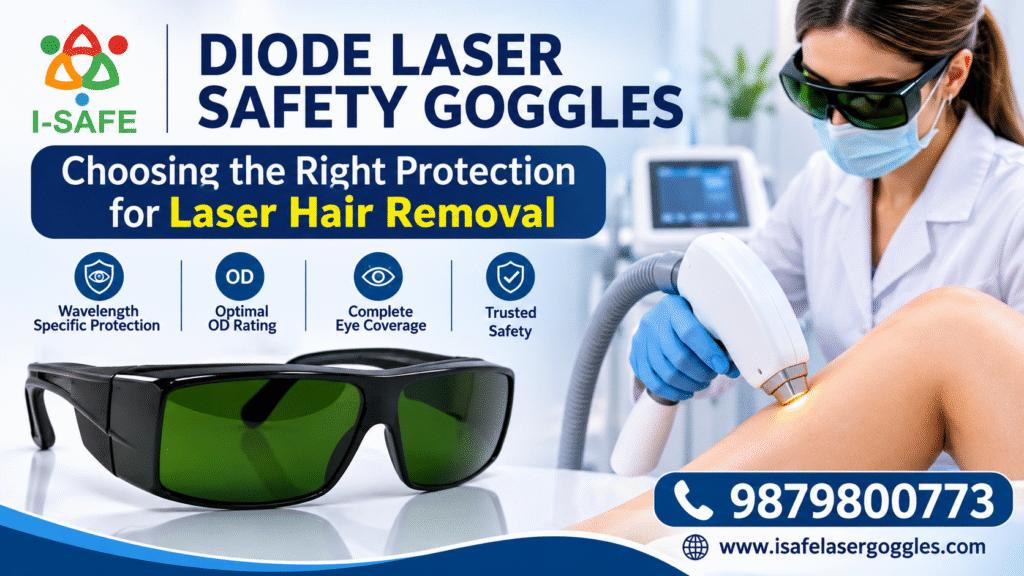
Diode Laser Safety Goggles: Choosing the Right Protection for Laser Hair Removal
Laser hair removal has become an important treatment in modern dermatology and aesthetic clinics. Diode laser systems offer an established approach to long-term hair reduction. However, professional laser treatments also require appropriate eye protection.
One essential safety measure is choosing the right diode laser safety goggles.
Laser radiation can pose a serious risk to the eyes, even when the beam is not easily visible. Therefore, practitioners, technicians, patients and other individuals in the treatment area need suitable protective eyewear.
At iSafe Laser Safety Goggles, we recognize the importance of wavelength-specific eye protection. Understanding wavelength compatibility, Optical Density (OD), eyewear fit and product specifications helps professionals make informed decisions about laser safety.
In this guide, we explain the important factors to consider when selecting protective eyewear for diode laser hair removal.
Why Are Diode Laser Safety Goggles Important?
Diode laser hair removal systems commonly operate around the 800–810 nm wavelength range, although the exact wavelength depends on the device.
This near-infrared radiation may not appear as bright visible light. However, it can still present a significant eye hazard.
The eye can focus certain wavelengths onto sensitive internal structures. Direct or reflected laser exposure may cause serious injury.
Appropriate diode laser safety goggles help reduce the amount of hazardous laser radiation reaching the eyes when their specifications match the laser system and its exposure conditions.
For this reason, laser professionals should never select protective eyewear based only on appearance or lens colour.
Instead, they should check the manufacturer’s laser safety requirements and select suitable eyewear accordingly.
Understanding Diode Laser Wavelengths
Wavelength is one of the most important factors when selecting laser protective eyewear.
Different laser systems operate at different wavelengths. Consequently, protective eyewear designed for one wavelength may not provide adequate protection against another.
Some commonly encountered hair removal laser wavelengths include:
- 755 nm: Commonly associated with alexandrite laser systems.
- 800–810 nm: Commonly associated with diode laser systems.
- 1064 nm: Commonly associated with Nd:YAG laser systems.
These wavelengths require suitable protective filters designed for the relevant laser radiation.
For example, eyewear suitable for an 810 nm diode laser should not automatically be considered suitable for a 755 nm or 1064 nm system.
Therefore, always verify the exact wavelength range printed on the eyewear and compare it with the laser device specifications.
What Is Optical Density (OD) in Laser Safety Goggles?
Optical Density, commonly called OD, indicates how effectively a protective filter attenuates laser radiation at a specified wavelength.
In simple terms, OD describes how much the eyewear reduces the transmission of laser energy through its filter.
A higher OD value indicates greater attenuation at the wavelength for which the rating applies.
For example:
- OD 1 provides a 10-fold reduction.
- OD 2 provides a 100-fold reduction.
- OD 3 provides a 1,000-fold reduction.
- OD 4 provides a 10,000-fold reduction.
- OD 5 provides a 100,000-fold reduction.
However, a higher OD rating alone does not guarantee suitable protection.
The required OD depends on the laser’s output characteristics, exposure conditions and applicable Maximum Permissible Exposure (MPE).
Therefore, practitioners should follow the laser equipment manufacturer’s recommendations and obtain an appropriate eyewear assessment rather than selecting an OD value based on a general rule.
Key Factors When Choosing Diode Laser Safety Goggles
Selecting appropriate protective eyewear involves more than checking the product’s appearance. Consider these important factors before making a decision.
1. Wavelength Compatibility
First, identify the exact wavelength or wavelength range produced by the diode laser system.
Then, check whether the protective eyewear provides suitable attenuation at that wavelength.
The eyewear label or technical documentation should clearly identify its wavelength protection range.
This is particularly important for clinics that use multiple laser platforms.
2. Appropriate Optical Density
Next, verify the OD rating at the specific operating wavelength.
The required OD must match the laser’s output and exposure conditions. Follow the laser manufacturer’s recommendations and applicable laser safety guidance.
Never assume that all goggles with a similar appearance provide the same level of protection.
3. Comfortable Fit and Coverage
Protective eyewear should fit securely and provide appropriate eye coverage.
Consider:
- Secure positioning around the eyes.
- Suitable side protection.
- Comfortable frame design.
- Compatibility with prescription eyewear, where required.
- Adequate visibility for professional tasks.
Moreover, eyewear should remain correctly positioned throughout the procedure.
4. Clear Product Labelling
Reliable laser protective eyewear should have clear technical identification.
Before selecting a product, check for:
- Protected wavelength or wavelength range.
- Optical Density rating.
- Relevant protection specifications.
- Manufacturer identification.
- Applicable safety standard information.
Clear labelling helps professionals verify whether the eyewear matches their equipment.
5. Quality, Maintenance and Inspection
Regular inspection also plays an important role in eyewear safety.
Check lenses and frames for scratches, cracks, damage, loose components or other defects.
Furthermore, follow the manufacturer’s instructions for cleaning, storage and replacement.
Do not continue using damaged or incorrectly labelled protective eyewear.
Why Choose iSafe Laser Safety Goggles?
Selecting appropriate laser protection is an important consideration for dermatology and aesthetic practices.
iSafe Laser Safety Goggles focuses on laser eye protection for professional environments where wavelength compatibility and suitable eyewear specifications matter.
When evaluating iSafe eyewear, professionals should review the technical specifications of the particular model and match them with their laser equipment.
Important selection considerations include:
- Wavelength-specific protection requirements.
- Verified Optical Density specifications.
- Suitable frame coverage and fit.
- Clear product identification.
- Appropriate maintenance and handling information.
At iSafe, the goal is to help professionals understand the importance of choosing suitable protective eyewear for their laser applications.
Whether a clinic uses diode laser technology or other aesthetic laser platforms, selecting the correct eyewear should always begin with the equipment’s documented safety requirements.
Common Mistakes to Avoid When Selecting Laser Safety Goggles
Even professional environments can overlook important eyewear selection factors.
Avoid these common mistakes:
- Choosing goggles by colour: Lens colour does not establish laser protection.
- Ignoring wavelength compatibility: A filter designed for one wavelength may not protect against another.
- Assuming a higher OD is always suitable: The required OD depends on the specific laser hazard assessment.
- Using ordinary sunglasses: Sunglasses are not substitutes for certified laser protective eyewear.
- Ignoring product labels: Always verify the wavelength and OD specifications.
- Overlooking damaged lenses: Scratches and structural damage may compromise the eyewear.
- Providing protection only for the operator: Everyone who may be exposed in the treatment area needs appropriate protection, including the patient.
Avoiding these mistakes helps establish a more consistent approach to laser safety.
Laser Safety Standards and Professional Selection
Professional laser safety eyewear should meet applicable requirements for its intended use.
Depending on the market and product, relevant references include:
- ANSI Z136.1: American guidance for the safe use of lasers.
- EN 207: European requirements for personal eye protection against laser radiation.
- ISO 19818-1: International requirements and test methods for eye and face protection against laser radiation.
The applicable standard depends on the product, intended use and regulatory market.
Importantly, never assume that a product complies with a particular standard without checking its documentation and markings.
For this reason, professionals should review the manufacturer’s technical information before selecting iSafe Laser Safety Goggles or any other protective eyewear.
Building a Better Laser Safety Routine
Choosing the right eyewear is only one part of a comprehensive laser safety programme.
Clinics should also maintain appropriate safety procedures.
Consider the following practices:
- Confirm the laser wavelength before selecting protective eyewear.
- Verify the required OD using the equipment manufacturer’s guidance.
- Provide appropriate protection for everyone in the controlled treatment area.
- Check eyewear before each use.
- Maintain suitable laser warning signs and access controls.
- Follow the laser manufacturer’s operating and safety instructions.
- Train relevant personnel in laser safety procedures.
Together, these measures support a more responsible professional environment.
Conclusion: Choose the Right Diode Laser Safety Goggles
Choosing the right diode laser safety goggles is an important part of responsible laser hair removal practice.
Wavelength compatibility, Optical Density, comfortable fit, product labelling and regular inspection all contribute to appropriate eye protection.
However, no single wavelength or OD specification suits every laser system. Professionals should always verify their equipment requirements before selecting protective eyewear.
iSafe Laser Safety Goggles recognizes the importance of informed eyewear selection for dermatology and aesthetic applications.
Choose protective eyewear based on verified specifications, follow professional laser safety guidance and make eye protection an essential part of every laser safety programme.
Contact iSafe Laser Safety Goggles
Phone: 9879800773
Website: isafelasergoggles.com
Frequently Asked Questions (FAQs)
1. Why are diode laser safety goggles necessary?
Diode laser safety goggles help protect the eyes from hazardous laser radiation during hair removal procedures. Their wavelength and OD specifications must match the laser system’s safety requirements.
2. What wavelength do diode hair removal lasers use?
Many diode hair removal systems operate around 800–810 nm. However, the exact wavelength depends on the device, so always check its technical documentation.
3. What does OD mean in laser safety goggles?
OD stands for Optical Density. It indicates how much a protective filter attenuates laser radiation at a specified wavelength.
4. Can I use the same goggles for every laser hair removal machine?
Not automatically. Different machines may use different wavelengths and output characteristics. Always verify the eyewear specifications against each laser system.
5. Are darker lenses always safer for laser treatments?
No. Lens darkness does not establish laser protection. Wavelength compatibility and the appropriate OD rating are essential.
6. Who should wear laser safety goggles during treatment?
The practitioner, patient and other individuals who may be exposed within the laser-controlled area need appropriate protection according to the laser safety assessment.
7. How often should laser safety goggles be inspected?
Inspect eyewear before use and regularly according to the manufacturer’s instructions. Replace damaged or defective eyewear as required.
8. Why consider iSafe Laser Safety Goggles?
iSafe provides a brand option for professionals evaluating laser protective eyewear. Always review the particular model’s wavelength, OD and relevant technical documentation before selecting it for a treatment system.
Contact iSafe Laser Safety Goggles
Looking for information about laser protective eyewear?
Connect with iSafe to discuss product specifications and suitable eyewear options for your professional application.
Call: 9879800773
Website: isafelasergoggles.com
Choose informed protection. Make laser safety a priority.
Visit our store: https://isafelasergoggles.com/shop-2/
Follow us on Instagram: https://www.instagram.com/alphasurgicals?igsh=cTdjYWNtaXkxazl
Visit us for all dermatology instruments- https://alphasurgicals.com/store/