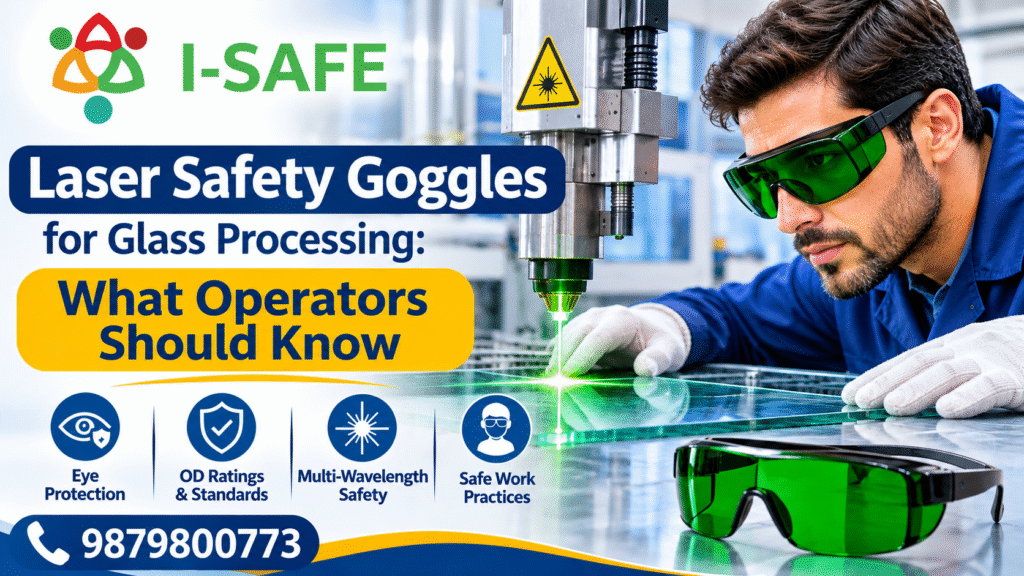
Laser Safety Goggles for Glass Processing: What Operators Should Know
Glass processing industries increasingly use laser technology for precision cutting, engraving, drilling, marking and surface treatment. These processes offer accuracy and flexibility. However, they also introduce important workplace safety risks, especially when operators work around high-powered laser equipment.
One essential part of a laser safety programme is selecting suitable laser safety goggles for glass processing. The right protective eyewear reduces the risk of hazardous laser exposure when it matches the laser’s wavelength and required optical density (OD).
However, not every pair of tinted safety glasses provides laser protection. Operators must understand the laser source, its operating conditions, and the protective filter specifications before choosing eyewear.
In this guide, we explain what glass processing operators should know about laser eye protection and how iSafe Laser Safety Goggles can support a properly planned laser safety programme.
Why Is Laser Eye Protection Important in Glass Processing?
Laser systems can focus energy into a very small area. During glass cutting, engraving or drilling, this concentrated energy interacts with the material and can create intense direct or reflected laser radiation.
Depending on the laser source and process, exposure may occur through:
- Direct viewing of an accessible laser beam.
- Specular reflections from reflective surfaces or machine components.
- Scattered radiation from the processing area.
- Accidental exposure during setup, maintenance or alignment.
- Unexpected access to an operating laser system.
The eyes are particularly vulnerable to certain laser wavelengths. Some wavelengths can reach and damage the retina, while others may primarily affect the cornea or other structures of the eye.
Therefore, operators should never rely on ordinary tinted glasses or sunglasses. They need protective eyewear specifically selected for the laser being used.
Common Laser Types Used in Glass Processing
Different laser technologies process glass in different ways. Each laser produces radiation at particular wavelengths, so operators must select eyewear that provides protection for the actual laser source.
1. CO₂ lasers
Akarprakar Techno Engg Private Limited
CO₂ lasers commonly operate at a wavelength of approximately 10,600 nm (10.6 µm). Manufacturers use them in various industrial cutting, engraving and marking applications.
Because this wavelength falls in the far-infrared region, operators need eyewear specifically rated for the relevant CO₂ laser wavelength and exposure conditions.
2. Fiber lasers
Entrada – Lumiglass by Covipor
Many industrial fiber lasers operate around 1,064 nm, although the exact wavelength depends on the laser design.
This near-infrared radiation may be invisible to the human eye. As a result, operators cannot judge exposure risk by looking at the beam.
Protective eyewear must have a suitable wavelength rating and OD for the specific laser system.
3. UV lasers
Manufacturer of UV laser marking machine
Some precision glass marking and processing applications use ultraviolet lasers, including systems operating at wavelengths such as 355 nm.
UV laser radiation can create eye and skin hazards. Operators should select protective filters designed for the specific UV wavelength and laser operating conditions.
4. Ultrafast and other specialised lasers
Certain advanced applications use picosecond or femtosecond lasers. Their short pulses can create different exposure conditions from continuous-wave systems.
For these lasers, eyewear selection must consider more than the wavelength alone. Pulse duration, repetition rate, pulse energy and the filter’s damage resistance may also matter.
Important: These are examples of laser technologies and wavelengths, not a complete list. Always confirm the exact wavelength and operating specifications from the laser manufacturer’s documentation.
How to Choose Laser Safety Goggles for Glass Processing
Choosing suitable laser safety goggles for glass processing requires a technical assessment. The following factors help operators and safety managers make an informed selection.
1. Check the laser wavelength
The first step is to identify the exact wavelength or wavelength range emitted by the laser.
For example, a filter designed for a CO₂ laser does not automatically protect against a 1,064 nm fiber laser. Similarly, eyewear suitable for one UV wavelength may not provide adequate protection for another.
Always check the filter’s wavelength range before use.
2. Understand the Optical Density (OD) rating
Optical Density, or OD, describes how much laser energy a filter attenuates at a specified wavelength.
A higher OD indicates greater attenuation at the wavelength for which the filter is rated.
The relationship is:
\[ OD = \log_{10}\left(\frac{1}{T}\right) \]
Here, \(T\) represents the fraction of light transmitted through the filter.
For illustration:
| OD rating | Approximate light blocked |
|---|---|
| OD 1 | 90% |
| OD 2 | 99% |
| OD 3 | 99.9% |
| OD 4 | 99.99% |
| OD 5 | 99.999% |
| OD 6 | 99.9999% |
However, a higher OD does not automatically mean a pair of goggles is suitable for every laser. The required OD must come from a laser hazard assessment based on the actual exposure conditions and applicable safety requirements.
3. Consider the laser’s operating mode
Laser systems may operate in continuous-wave or pulsed modes. Pulsed systems can produce high peak power even when the average power appears relatively low.
Therefore, the protective filter must be appropriate for the laser’s operating mode and exposure characteristics.
For pulsed lasers, check the manufacturer’s specifications for pulse-related damage limits and suitability.
4. Check visible light transmission (VLT)
Operators need to see their work clearly. A filter that reduces visible light too much may make it harder to inspect glass, operate controls or perform detailed tasks.
Visible Light Transmission (VLT) describes how much visible light passes through the lens.
Choose eyewear that balances the required laser protection with adequate visibility for the task. Never compromise the required protection just to obtain a brighter lens.
5. Check fit, coverage and comfort
Even technically suitable filters need to fit correctly.
Before selecting eyewear, consider:
- Secure and comfortable fit.
- Appropriate side protection.
- Compatibility with prescription glasses, if required.
- Suitable coverage for the workplace.
- Resistance to routine industrial handling.
- Clear, undamaged lenses.
Operators should inspect their eyewear before each use and follow the manufacturer’s cleaning, storage and replacement instructions.
Why Lens Colour Alone Cannot Guarantee Laser Protection
Laser safety goggles are available in different lens colours, including green, orange, red and other shades. However, lens colour does not determine the level of laser protection.
Two lenses that look similar may have completely different wavelength ranges and OD ratings. Likewise, two lenses with different colours may provide protection against the same wavelength when their certified specifications support it.
For this reason, operators should check the filter markings and technical documentation rather than choosing eyewear based on appearance.
When selecting iSafe Laser Safety Goggles, confirm that the specific model’s documented wavelength range and protection rating match the laser hazard assessment.
Additional Safety Precautions During Glass Laser Processing
Protective eyewear is only one part of a complete laser safety programme. Operators should also follow the machine manufacturer’s instructions and workplace safety procedures.
Use enclosed laser systems wherever possible
A properly designed enclosure helps prevent access to hazardous laser radiation during normal operation. Keep machine doors and protective panels closed while the laser is running.
Never bypass safety interlocks
Interlocks help prevent the laser from operating when protective access points are open. Never disable or bypass them to speed up production.
Control reflections
Glass, metal fixtures and other nearby surfaces may create hazardous reflections. Follow the machine manufacturer’s guidance and the site’s laser safety procedures to manage reflective surfaces and beam paths.
Provide suitable ventilation
Laser processing can produce fumes, particles and other airborne contaminants depending on the glass composition and processing method. Use appropriate extraction and ventilation systems based on the material and process risk assessment.
Train operators
Workers should understand the laser’s hazards, warning signs, emergency procedures and eyewear requirements. Only authorised and trained personnel should perform setup, alignment or maintenance tasks.
Common Mistakes Operators Should Avoid
Avoid these mistakes when choosing and using laser protective eyewear:
- Choosing goggles by lens colour: Colour alone does not confirm wavelength protection or OD.
- Using one pair for every laser: Different laser sources may require different filters.
- Ignoring the OD rating: The required OD must come from a suitable hazard assessment.
- Using damaged lenses: Scratches, cracks or other damage can affect visibility and may compromise the filter.
- Ignoring side exposure: Select eyewear with coverage appropriate to the risk assessment.
- Relying only on goggles: Enclosures, interlocks, training and safe operating procedures remain essential.
How iSafe Laser Safety Goggles Support Workplace Eye Protection
Selecting the right protective eyewear is an important step in maintaining a safer glass processing environment.
iSafe Laser Safety Goggles offers a brand-focused solution for workplaces looking for laser protective eyewear. However, operators should always select a specific model according to its documented technical specifications and the hazards identified in their workplace.
Before choosing an iSafe model, confirm:
- The laser wavelength or wavelength range.
- The required OD rating.
- The laser’s continuous-wave or pulsed operation.
- Filter suitability and damage-resistance information.
- Visible light transmission and task visibility.
- Fit, coverage and compatibility with other protective equipment.
Do not assume that every iSafe model is suitable for every CO₂, fiber, UV or other industrial laser. Match the individual product’s verified specifications to the application.
Conclusion
Glass laser processing offers precision and efficiency, but it also requires careful attention to operator safety. The right laser safety goggles for glass processing must match the laser wavelength, required OD and operating conditions.
In addition, operators should use enclosed systems, maintain safety interlocks, control reflections and follow appropriate workplace procedures.
By understanding these requirements and checking product specifications carefully, businesses can make more informed decisions about laser eye protection.
For information about iSafe Laser Safety Goggles and help identifying suitable eyewear specifications, contact the team today.
Contact iSafe: 9879800773
Protect your vision with informed selection, verified specifications and responsible laser safety practices.
Frequently Asked Questions (FAQs)
1. Why do glass processing operators need laser safety goggles?
Laser cutting, engraving and marking equipment can expose operators to hazardous direct, reflected or scattered laser radiation. Suitable protective eyewear helps reduce eye exposure when selected for the laser’s wavelength and required OD.
2. Which laser safety goggles are suitable for CO₂ glass processing?
Choose eyewear with documented protection for the CO₂ laser’s wavelength, typically around 10,600 nm. The required OD and other filter specifications must also match the laser hazard assessment.
3. Can I use the same laser goggles for CO₂ and fiber lasers?
Not automatically. CO₂ lasers commonly operate around 10,600 nm, while many industrial fiber lasers operate around 1,064 nm. The eyewear must be rated for the relevant wavelength or wavelengths and required OD.
4. Does a darker lens provide better laser protection?
No. Lens darkness or colour does not establish laser protection. Check the wavelength range, OD rating and technical documentation.
5. What does OD mean in laser safety goggles?
OD stands for Optical Density. It describes how much light at a specified wavelength the filter attenuates. The correct OD depends on the laser’s characteristics and the exposure assessment.
6. Are laser safety goggles enough to protect glass processing operators?
No. Goggles are one part of a wider safety programme. Enclosures, interlocks, controlled access, training, ventilation and safe operating procedures are also important.
7. How can I identify the correct iSafe laser safety goggles?
First identify your laser’s wavelength, operating mode and exposure characteristics. Then compare those details with the specific iSafe model’s documented wavelength range, OD and other technical specifications. Contact iSafe at 9879800773 for product information.