Laser Safety Eyewear Wavelength: Why Optical Density Specifications Matter
Introduction
Laser Safety Eyewear Wavelength is an essential consideration when selecting protective goggles for medical procedures, industrial manufacturing, scientific research, and aesthetic treatments. Different laser systems operate at different wavelengths, and each application requires appropriate eye protection.
However, wavelength alone does not determine whether laser safety goggles provide sufficient protection. Optical Density (OD) also plays a critical role in determining how effectively the protective filter attenuates laser radiation.
Therefore, understanding the relationship between laser wavelength and optical density is essential for making informed laser safety decisions.
At iSafe Laser Safety Goggles, we believe that choosing appropriate laser protective eyewear starts with understanding its technical specifications. In this guide, we explain why wavelength and OD must work together and what you should check before selecting laser safety goggles.
1. What Is Laser Safety Eyewear Wavelength?
Laser wavelength refers to the distance between successive peaks of a light wave. It is generally measured in nanometres (nm) or micrometres (µm).
When discussing laser safety eyewear wavelength, the main consideration is whether the protective filter provides sufficient attenuation at the specific wavelength emitted by the laser.
Different laser systems operate at different wavelengths. Consequently, one pair of laser safety goggles may not provide suitable protection for every laser application.
Common Laser Wavelengths and Their Applications
Here are some examples of commonly used laser wavelengths:
- 532 nm: Commonly used in green laser applications, including frequency-doubled Nd systems.
- 755 nm: Used in Alexandrite laser systems, including certain aesthetic applications.
- 810 nm: Commonly associated with diode laser systems.
- 1064 nm: Used in Nd laser applications.
- 10,600 nm (10.6 µm): Commonly used in CO₂ laser systems.
These wavelengths represent examples rather than universal specifications for every device.
Why Is Wavelength Important in Laser Safety Eyewear?
Laser protective filters are designed to attenuate specific wavelength ranges. A filter that provides suitable protection at one wavelength may not provide sufficient attenuation at another.
For example, goggles designed to protect against a 532 nm laser should not automatically be considered suitable for a 1064 nm laser.
Therefore, always check the manufacturer’s wavelength protection specifications before selecting or using laser safety eyewear.
2. Understanding Optical Density (OD) in Laser Safety Eyewear
Optical Density, commonly known as OD, measures how effectively a protective filter attenuates light at a specified wavelength.
In simple terms, OD indicates how much laser radiation is reduced as it passes through the eyewear filter.
The mathematical formula is:
OD = log₁₀ (1/T)
Here, T represents the decimal transmittance of the optical filter.
Understanding Different OD Ratings
The following table explains how different OD ratings relate to light transmission.
| Optical Density | Approximate transmission |
|---|---|
| OD 1 | 10% |
| OD 2 | 1% |
| OD 3 | 0.1% |
| OD 4 | 0.01% |
| OD 5 | 0.001% |
| OD 6 | 0.0001% |
A higher OD means lower transmission and greater attenuation at the specified wavelength.
However, choosing the highest available OD does not automatically guarantee appropriate laser protection. The required OD depends on the laser’s output characteristics and exposure conditions.
Why Does OD Matter for Laser Protection?
Optical density helps safety professionals evaluate whether a protective filter provides sufficient attenuation for a particular laser application.
For example, a filter with OD 5 at a specified wavelength allows approximately 0.001% transmission at that wavelength.
Nevertheless, the filter must also provide suitable resistance to laser-induced damage under the expected exposure conditions.
Therefore, OD and damage resistance should always be evaluated together.
3. Why Laser Safety Eyewear Wavelength and OD Must Work Together
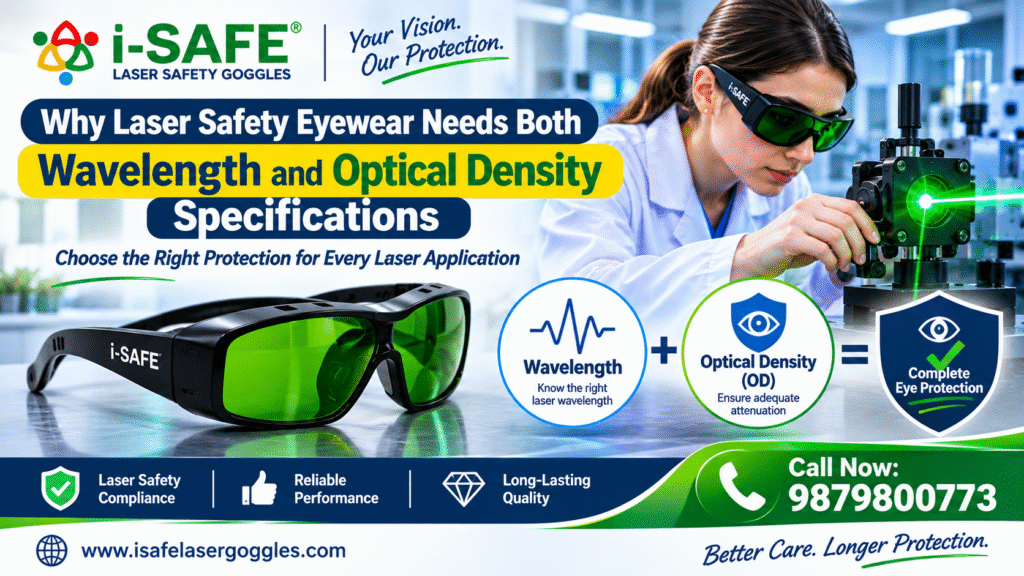
Understanding laser safety eyewear wavelength and OD specifications is essential because these two measurements describe different aspects of eye protection.
- Wavelength identifies the laser radiation that the eyewear must protect against.
- Optical Density determines the attenuation level provided at that wavelength.
Both specifications must match the requirements of the laser system.
Example: Comparing Two Laser Safety Goggles
Consider a hypothetical 1064 nm laser application.
Example A: A pair of goggles offers OD 6 at 532 nm but does not provide sufficient attenuation at 1064 nm.
Example B: Another pair offers OD 5 across a specified wavelength range that includes 1064 nm.
For the 1064 nm application, Example A cannot be considered suitable simply because it has a higher OD rating.
Example B may be a suitable candidate, provided its OD, damage resistance, and other protective characteristics meet the calculated safety requirements.
This example demonstrates why checking both wavelength and optical density is essential.
What Happens When You Ignore Wavelength or OD?
Selecting eyewear without checking these specifications can result in inadequate protection.
Potential mistakes include:
- Choosing goggles that do not cover the laser’s operating wavelength.
- Selecting an insufficient OD rating.
- Ignoring additional wavelengths emitted by the laser system.
- Overlooking the filter’s damage threshold.
- Assuming that lens colour indicates laser protection.
Consequently, always verify the product documentation before purchasing or using laser protective eyewear.
4. How to Choose Laser Safety Eyewear for Different Wavelengths
Selecting appropriate laser safety goggles requires a systematic evaluation of the laser system and its operating conditions.
Here are the important factors to consider.
A. Identify the Exact Laser Wavelength
First, check the laser manufacturer’s technical documentation.
Identify the operating wavelength and determine whether the system produces multiple hazardous wavelengths.
The selected eyewear must provide the required attenuation across all relevant wavelengths.
B. Determine the Required Optical Density
The required OD depends on several factors, including:
- Laser output power or pulse energy.
- Continuous-wave or pulsed operation.
- Pulse duration and repetition rate.
- Beam characteristics and exposure geometry.
- Exposure duration.
- Maximum Permissible Exposure (MPE).
A qualified Laser Safety Officer (LSO) or laser safety professional should assess these parameters and determine the required protection.
C. Check the Laser Damage Threshold
OD alone does not establish whether a filter can withstand a particular laser exposure.
The filter must also have suitable resistance to laser-induced damage.
This consideration becomes particularly important for high-power and pulsed laser systems.
D. Evaluate Visible Light Transmission
Appropriate laser safety eyewear should provide the required laser attenuation while maintaining sufficient visible light transmission for the intended application.
Poor visibility can affect working comfort and accuracy. Nevertheless, never compromise the required laser protection to improve visibility.
E. Check Fit, Comfort, and Coverage
Proper fit helps maintain protective coverage during laser operations.
Consider:
- Frame design and stability.
- Side protection.
- Compatibility with prescription glasses.
- Comfort during extended use.
- Compatibility with other protective equipment.
Remember that comfortable eyewear should also meet the technical protection requirements of the laser application.
5. Laser Safety Eyewear Standards and Guidelines
Recognized laser safety standards help manufacturers evaluate protective eyewear and help safety professionals select suitable products.
Some important standards and references include:
ANSI Z136.1
ANSI Z136.1 provides guidance on the safe use of lasers. It addresses laser hazard evaluation, exposure limits, control measures, and protective eyewear selection.
ISO 19818-1:2021
ISO 19818-1:2021 specifies requirements and test methods for eye and face protectors designed to protect against laser radiation.
It addresses important performance characteristics, including optical density, short-pulse transmittance, filter resistance to laser radiation, and product marking.
EN 207 and EN 208
EN 207 addresses protective eyewear against laser radiation, while EN 208 addresses protective eyewear for adjustment work involving lasers.
The applicable standard depends on the intended use and relevant regional requirements.
Important: Never assume that a product complies with a particular standard unless its product documentation and applicable test evidence confirm that compliance.
6. Common Laser Safety Eyewear Selection Mistakes
Even experienced laser users can overlook important protective specifications.
Avoid these common mistakes when selecting laser safety goggles:
- Focusing only on OD: A high OD rating does not guarantee protection at every wavelength.
- Ignoring laser wavelength: The protective filter must cover the wavelength emitted by the laser.
- Assuming all coloured lenses provide protection: Lens colour alone does not establish protective performance.
- Overlooking multiple wavelengths: Some systems emit more than one relevant wavelength.
- Ignoring damage resistance: The filter must withstand the expected laser exposure.
- Choosing poorly fitting eyewear: Gaps can expose the eyes to hazardous radiation.
- Ignoring product markings: Always check wavelength ranges, OD values, and other required protective information.
Additionally, inspect your eyewear regularly. Replace products that show damage or no longer meet the manufacturer’s maintenance and safety requirements.
7. Why Choose iSafe Laser Safety Goggles?
Selecting appropriate laser protection is an important part of maintaining a safer working environment.
At iSafe Laser Safety Goggles, we understand the importance of choosing protective eyewear based on relevant technical specifications.
Whether you work in medical aesthetics, healthcare, industrial manufacturing, or another laser-based application, understanding wavelength and OD is an important starting point.
Before choosing a product, consider:
- The laser wavelength requiring protection.
- The required optical density.
- The laser’s operating power and pulse characteristics.
- The filter’s damage resistance.
- Applicable safety standards.
- Product documentation and proper fit.
Our aim is to help customers make informed decisions about laser safety eyewear.
Looking for Laser Safety Goggles?
Contact iSafe Laser Safety Goggles to discuss your laser protection requirements and available product options.
Call Now: 9879800773
Visit our website: www.isafelaser goggles.com
Conclusion: Choose the Right Laser Safety Eyewear Wavelength and OD
Understanding laser safety eyewear wavelength and optical density is essential when selecting protective goggles for different laser applications.
Wavelength identifies the laser radiation that requires protection, while OD indicates how effectively the filter attenuates that radiation.
However, proper selection also requires evaluating laser output, pulse characteristics, exposure conditions, filter damage resistance, fit, and applicable safety standards.
Therefore, never select laser safety goggles based on OD alone or assume that one type of eyewear protects against every laser.
Make informed decisions with verified product specifications and explore iSafe Laser Safety Goggles for your laser protection requirements.
For product enquiries, call 9879800773.
Choose the right specifications. Prioritize eye protection. Trust informed laser safety decisions.
Frequently Asked Questions (FAQs)
1. Why is laser safety eyewear wavelength important?
Laser safety eyewear wavelength specifications identify the wavelengths at which the protective filter provides specified attenuation. Selecting eyewear that does not cover the laser’s operating wavelength can result in inadequate eye protection.
2. What is the relationship between wavelength and OD in laser safety goggles?
Wavelength identifies the laser radiation that requires protection, while OD measures how effectively the filter attenuates that radiation. Both specifications must meet the laser application’s safety requirements.
3. Does a higher OD always mean better laser protection?
No. A higher OD provides greater attenuation at the wavelength where it is specified. However, it does not guarantee protection at other wavelengths or establish the filter’s resistance to laser damage.
4. What does OD 5 mean in laser safety eyewear?
OD 5 corresponds to approximately 0.001% transmission at the specified wavelength. This means the filter attenuates the incident radiation by a factor of 100,000 under the stated measurement conditions.
5. Can one pair of laser safety goggles protect against multiple wavelengths?
Yes. Some laser safety goggles provide protection across multiple wavelength ranges. However, verify the OD at every relevant wavelength and confirm that the product meets the required exposure and damage-resistance criteria.
6. How do I select the correct laser safety eyewear wavelength?
Check the laser manufacturer’s documentation to identify the operating wavelength. Then evaluate the required OD, laser output, exposure conditions, filter damage resistance, and applicable safety standards.
7. Are ordinary sunglasses suitable for laser protection?
No. Ordinary sunglasses do not provide verified protection against hazardous laser radiation. Always select purpose-designed laser protective eyewear with documented wavelength and OD specifications.
8. Where can I buy iSafe Laser Safety Goggles?
Contact iSafe Laser Safety Goggles at 9879800773 to discuss available products and your laser protection requirements.
Visit our store: https://isafelasergoggles.com/shop-2/
Follow us on Instagram: https://www.instagram.com/alphasurgicals?igsh=cTdjYWNtaXkxazl
Visit us for all dermatology instruments: https://alphasurgicals.com/store/