Laser procedures are widely used in dermatology, aesthetic medicine, laser hair removal, skin resurfacing, pigmentation treatments, and other clinical applications. Because laser radiation can create serious eye hazards, clinics must choose protective eyewear according to the specific laser system and operating conditions.
However, regular protective eyewear and laser safety goggles do not provide the same type of protection.
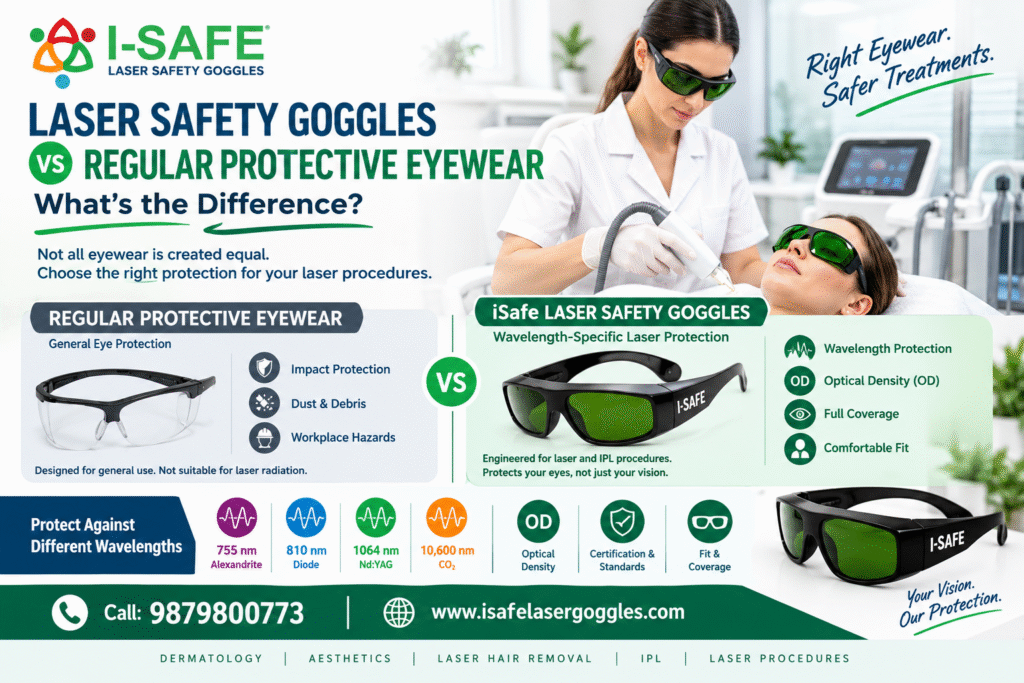
General-purpose safety glasses may protect the eyes against hazards such as impact, dust, debris, or other workplace risks. Laser safety goggles, on the other hand, are specifically selected to attenuate particular laser wavelengths at an appropriate optical density.
Therefore, choosing the right eyewear requires more than simply selecting a pair of dark or tinted glasses.
What Are Laser Safety Goggles?
Laser safety goggles are protective eyewear designed to reduce hazardous laser radiation reaching the eyes.
Their protection depends on technical specifications such as:
- Laser wavelength
- Optical Density (OD)
- Laser power or energy
- Exposure conditions
- Lens/filter characteristics
- Visible light transmission
- Fit and coverage
OSHA guidance states that laser protective eyewear should provide protection for the specific wavelength of the laser and have an optical density appropriate for the energy involved. OSHA also states that protective goggles should identify the wavelengths for which they are intended, their optical density at those wavelengths, and their visible light transmission.
As a result, laser safety goggles should never be selected simply because they look dark or appear similar to another pair of laser goggles.
What Is Regular Protective Eyewear?
Regular protective eyewear generally refers to safety glasses or goggles designed for common workplace or environmental hazards.
Depending on the product, this type of eyewear may help protect against:
- Flying particles
- Dust
- Debris
- Chemical splashes
- Impact
- Certain UV hazards
- General workplace hazards
However, general-purpose protective eyewear does not automatically provide protection against laser radiation.
A pair of standard safety glasses may meet an applicable eye-protection standard for its intended hazard while still lacking the wavelength-specific attenuation required for a laser application.
OSHA’s laser guidance specifically points users toward laser-specific protective eyewear and notes that ANSI/ISEA Z87.1-2020 does not itself provide marking designations for laser eye protection.
Laser Safety Goggles vs Regular Protective Eyewear: Key Differences
The biggest difference comes down to what hazard the eyewear is designed to control.
| Feature | Laser Safety Goggles | Regular Protective Eyewear |
|---|---|---|
| Primary purpose | Laser radiation protection | General eye protection |
| Wavelength specification | Essential | Usually not designed around laser wavelength protection |
| Optical Density | Specified for relevant wavelength(s) | Not generally selected as laser OD |
| Laser protection | Specifically designed for applicable laser radiation | Should not be assumed |
| Visible Light Transmission | Important for usability | Depends on product |
| Laser-specific labeling | Expected for laser eyewear | Generally not applicable |
| Fit and coverage | Important for laser exposure control | Depends on application |
| Selection method | Based on laser parameters | Based on general workplace hazard |
| Suitable for laser procedures | When correctly selected | Not automatically |
1. Laser Safety Goggles Provide Wavelength-Specific Protection
One of the most important differences between laser safety goggles and regular protective eyewear is wavelength protection.
Different lasers emit different wavelengths. For example, aesthetic and medical systems may operate around wavelengths such as:
- 755 nm
- 810 nm
- 1064 nm
- 10,600 nm
These examples represent different laser systems and applications; they do not mean that every device operating at these wavelengths requires the same eyewear specification.
A laser safety filter must provide appropriate attenuation at the relevant wavelength or wavelength range.
OSHA’s technical guidance emphasizes that the wavelength or wavelengths emitted by the laser must be considered when selecting protective eyewear.
Why does wavelength matter?
The eye can respond differently to radiation at different wavelengths, and different protective filters absorb or attenuate different portions of the spectrum.
Therefore, a pair of laser safety goggles suitable for one laser should not automatically be considered suitable for another laser.
2. Optical Density Makes Laser Goggles Different
Optical Density (OD) is another major difference.
OD describes how strongly an optical filter attenuates radiation at a specified wavelength. Because OD uses a logarithmic scale, each increase of one OD corresponds to a tenfold change in attenuation.
For example:
- OD 3 = 10³ attenuation
- OD 4 = 10⁴ attenuation
- OD 5 = 10⁵ attenuation
- OD 6 = 10⁶ attenuation
However, a higher OD is not automatically the correct choice for every application.
Professionals must select OD based on the laser’s wavelength and relevant operating parameters, including power or energy and exposure conditions.
OSHA specifically connects the required optical density with the energy involved and recommends identifying OD values alongside the wavelengths for which protection is provided.
3. Regular Safety Glasses Cannot Be Assumed to Protect Against Lasers
A common mistake involves assuming that a dark lens or standard safety glass provides adequate laser protection.
It does not.
Lens darkness does not tell you whether eyewear provides adequate protection at a particular laser wavelength.
A filter may appear dark to the human eye while providing inadequate attenuation at a hazardous laser wavelength. Conversely, some properly designed laser filters may provide strong attenuation at the target wavelength while maintaining useful visible light transmission.
Therefore, professionals should check the manufacturer’s specifications instead of judging protection by lens appearance.
4. Laser Safety Goggles Require Specific Marking and Documentation
Proper laser safety goggles should have clear technical information that allows users to understand their intended protection.
Depending on the applicable requirements and product documentation, this may include:
- Protected wavelength or wavelength range
- Optical Density
- Visible Light Transmission
- Product identification
- Applicable standards or testing information
- Manufacturer information
OSHA’s laser protection requirements specifically identify wavelength, optical density, and visible light transmission as information that protective goggles should carry.
Why documentation matters
When a clinic uses several laser devices, documentation allows staff to compare the eyewear specifications against each device.
This is especially important because one pair of goggles may not cover every wavelength used in a clinic.
Why Fit and Coverage Also Matter
Technical specifications alone do not make eyewear suitable.
Laser safety goggles should also fit properly and provide appropriate coverage for the intended procedure.
A poorly fitting pair can create gaps or allow exposure from directions that the lens does not adequately cover.
OSHA’s technical guidance recommends considering factors such as visibility, comfort, and protection from hazardous peripheral radiation when selecting laser protective eyewear.
For clinical environments, professionals should therefore evaluate:
- Lens coverage
- Frame fit
- Peripheral protection
- Comfort
- Stability during treatment
- Compatibility with other required PPE
Why Visible Light Transmission Matters
Laser filters can reduce visible light transmission while providing the required attenuation at specific wavelengths.
Very dark eyewear can make it harder for practitioners to see the treatment area, controls, or surrounding environment.
Therefore, laser safety goggles should balance appropriate laser attenuation with usable visibility, without compromising the required protection.
OSHA’s technical guidance specifically identifies visible or luminous transmission as an important consideration when selecting laser protective eyewear.
When Regular Protective Eyewear May Be Appropriate
Regular protective eyewear still has an important role in many workplaces.
For example, general-purpose eye protection may be appropriate for hazards involving:
- Mechanical impact
- Dust
- Debris
- Chemical splashes
- Certain non-laser workplace hazards
However, if personnel face a laser radiation hazard, they should not assume that general-purpose eyewear provides adequate laser protection.
Instead, the clinic should evaluate the laser system and select appropriate laser protective eyewear.
When Should You Use Laser Safety Goggles?
Clinics should evaluate laser safety goggles whenever personnel may experience hazardous exposure to laser radiation and engineering or administrative controls alone do not eliminate the risk.
The selection should consider:
1. Laser Wavelength
Identify the exact wavelength or wavelengths produced by the laser.
2. Optical Density
Determine the required attenuation based on the laser parameters and exposure conditions.
3. Laser Output
Consider relevant power, pulse energy, pulse duration, repetition rate, and other applicable parameters.
4. Exposure Conditions
Consider how personnel could potentially encounter direct or reflected radiation.
5. Fit and Coverage
Select eyewear that provides appropriate coverage and remains securely positioned.
6. Product Documentation
Verify the manufacturer’s specifications and applicable testing or standards information.
OSHA’s technical guidance identifies wavelength, exposure time, output parameters, and worst-case ocular exposure as important considerations in selecting laser protective eyewear.
Laser Safety Goggles for Dermatology and Aesthetic Clinics
Dermatology and aesthetic clinics may operate several types of laser or intense-light systems.
For example, a clinic might use devices for:
- Laser hair removal
- Pigmentation treatment
- Vascular treatment
- Skin resurfacing
- Scar treatment
- Tattoo removal
- Cosmetic procedures
Because these systems can differ significantly, clinics should evaluate protective eyewear for each applicable device and wavelength.
For IPL and other intense-light systems, the eyewear requirements can differ from those for lasers. FDA-recognized ISO 12609-1 addresses operator eye protectors for intense light source equipment used for cosmetic and medical applications and specifically distinguishes this scope from laser radiation.
Therefore, clinics should follow the specific device manufacturer’s safety instructions when selecting eyewear for IPL or other intense-light equipment.
Why Choose iSafe Laser Safety Goggles?
iSafe laser safety goggles are designed for professionals who need purpose-selected protective eyewear for laser applications.
When selecting an iSafe model, clinics should match the eyewear specifications to their specific laser system rather than selecting eyewear solely by appearance.
Key factors to evaluate include:
- Wavelength: Does the eyewear cover the laser wavelength?
- Optical Density: Does the specified OD meet the application’s requirements?
- Coverage: Does the design provide appropriate eye and peripheral protection?
- Fit: Does the eyewear remain secure and comfortable during treatment?
- Visibility: Does the visible light transmission support practical use?
- Documentation: Does the product documentation clearly identify its intended protection?
iSafe: Protection Starts With the Right Specification
The right iSafe laser safety goggles should be selected according to the laser system being used.
This approach is more reliable than choosing eyewear based on lens color, appearance, or a generic claim of “laser protection.”
How to Choose the Right iSafe Laser Safety Goggles
Before purchasing or using laser safety goggles, follow this simple checklist.
Step 1: Identify the Laser Wavelength
Check the laser device specifications or user manual.
Step 2: Identify the Operating Parameters
Review the relevant power, pulse energy, pulse duration, repetition rate, and exposure conditions.
Step 3: Determine the Required OD
Use the applicable safety assessment and manufacturer or laser safety officer guidance to determine the required optical density.
Step 4: Check the Eyewear Specifications
Confirm that the iSafe eyewear provides protection at the required wavelength and OD.
Step 5: Check Fit and Coverage
Make sure the eyewear sits securely and provides suitable coverage.
Step 6: Review Documentation
Keep the product information available for staff training, safety reviews, and equipment-specific selection.
Common Mistakes When Choosing Laser Eyewear
Mistake 1: Choosing Goggles Based on Lens Color
Green, orange, blue, or dark lenses do not automatically indicate adequate protection.
Always check the technical specifications.
Mistake 2: Assuming One Pair Protects Every Laser
A clinic may use multiple lasers with different wavelengths.
Therefore, staff should verify protection for each relevant wavelength.
Mistake 3: Looking Only at Optical Density
OD without its corresponding wavelength does not provide enough information for proper laser eyewear selection.
Mistake 4: Using Regular Safety Glasses
General-purpose protective eyewear should not be treated as laser protection unless the manufacturer specifically provides appropriate laser protection specifications.
Mistake 5: Ignoring Fit and Peripheral Exposure
Even technically appropriate eyewear must provide suitable coverage and remain properly positioned.
Social Links
Visit our store: https://isafelasergoggles.com/shop-2/
Follow us on Instagram: https://www.instagram.com/alphasurgicals?igsh=cTdjYWNtaXkxazlr
Visit us for all dermatology instruments: https://alphasurgicals.com/store/