Laser technology has become an important part of modern dermatology and aesthetic medicine. From laser hair removal and skin treatments to pigmentation and vascular procedures, different laser systems use different wavelengths and operating parameters.
Because laser radiation can harm the eyes, professionals must select protective eyewear carefully. Laser safety goggles do not provide universal protection; instead, users must match them to the laser wavelength and required attenuation level.
Therefore, choosing the right eyewear involves more than selecting a dark-colored pair of glasses. Professionals should consider the wavelength, optical density (OD), laser output, exposure conditions, visible light transmission, coverage, fit, and applicable standards or documentation.
In this guide, we explain how to choose laser safety goggles for different wavelengths and what professionals should check before using them.
Why Different Wavelengths Require Different Laser Safety Gogglesoes Laser Wavelength Matter?
The wavelength of a laser determines how its radiation interacts with the eye and which protective filter can attenuate it.
For this reason, laser protective eyewear should be specified for the particular wavelength or wavelength range of the laser being used.
OSHA guidance states that suitable laser goggles should protect against the specific wavelength of the laser and have an optical density adequate for the energy involved. OSHA also notes that protective goggles should be labeled with the intended wavelengths, optical density, and visible light transmission.
In simple terms:
Laser wavelength → Required protection → Appropriate laser safety goggles
If a clinic uses multiple laser systems, professionals should evaluate the eyewear requirements for each system rather than assume that one pair works for all of them.
Understanding Different Wavelengths in Dermatology and Aesthetic Lasersths
Different dermatology and aesthetic lasers operate at different wavelengths. Some commonly encountered examples include:
| Laser Type | Common Wavelength | Typical Applications |
|---|---|---|
| Alexandrite | 755 nm | Hair removal and pigmentation |
| Diode | Around 800–810 nm | Hair removal |
| Nd:YAG | 1064 nm | Hair removal and vascular applications |
| CO₂ | 10,600 nm | Resurfacing and dermatological procedures |
These values are examples, not universal specifications for every device. Always check the exact wavelength and operating parameters supplied by the laser manufacturer.
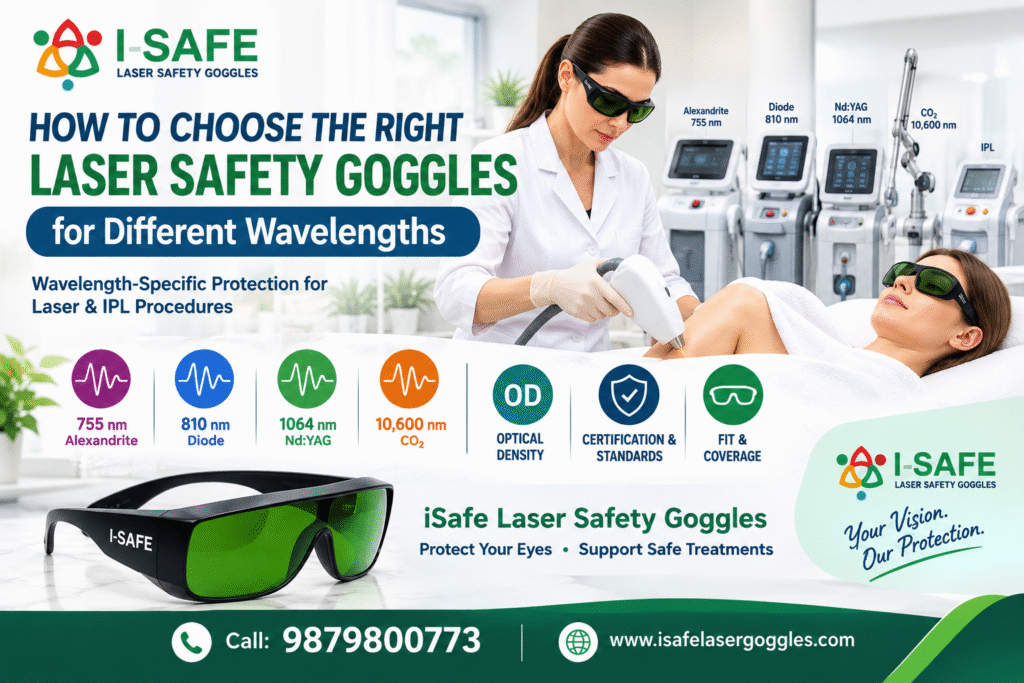
1. Laser Safety Goggles for 755 nm Alexandrite Lasers
Alexandrite lasers commonly operate around 755 nm and are widely used in aesthetic applications, particularly hair removal and certain pigmentation procedures.
When selecting laser safety goggles for a 755 nm system, check that the product’s specified protection range covers 755 nm and that the stated OD is appropriate for the laser’s operating conditions.
What to check:
- 755 nm coverage
- Appropriate OD at 755 nm
- Suitable peripheral coverage
- Comfortable fit
- Visible light transmission
- Manufacturer documentation
iSafe laser safety goggles can be evaluated according to these specifications when selecting protection for Alexandrite laser applications.
2. Laser Safety Goggles for Diode Lasers
Diode laser systems used for aesthetic applications commonly operate around 800–810 nm, although exact wavelengths can vary by device.
Therefore, professionals should not select goggles simply because they are labeled “Diode laser goggles.”
Instead, check the actual wavelength or wavelength range specified by the laser manufacturer.
Before using the goggles, verify:
Laser wavelength → Eyewear wavelength range → OD → Application
This simple comparison helps reduce the risk of selecting eyewear that does not provide the intended protection.
For clinics using diode systems, iSafe laser safety goggles can be selected according to the specific wavelength and OD requirements of the equipment.
3. Laser Safety Goggles for 1064 nm Nd:YAG Lasers
The 1064 nm Nd:YAG wavelength is commonly used in dermatology and aesthetic medicine.
It is particularly important to pay attention to appropriate protective eyewear because 1064 nm radiation is in the near-infrared region and is not visible to the human eye.
Professionals should verify:
- Protection at 1064 nm
- Appropriate OD
- Adequate coverage
- Secure fit
- Product markings
- Manufacturer documentation
OSHA’s technical guidance explains that laser protective eyewear selection depends on the laser wavelength and the exposure conditions, including laser output and exposure duration.
Therefore, do not select 1064 nm laser goggles based on color or appearance alone.
4. Laser Safety Goggles for CO₂ Lasers
CO₂ lasers commonly operate at approximately 10,600 nm and are used for applications including laser resurfacing and other dermatological procedures.
Because 10,600 nm falls in the infrared region, the radiation is invisible.
Consequently, the correct protective eyewear must be specifically specified for the relevant wavelength.
When choosing CO₂ laser safety goggles, check:
- 10,600 nm protection
- Appropriate OD
- Coverage and fit
- Manufacturer specifications
- Applicable standards and documentation
The protective eyewear should be selected based on the actual laser system and exposure conditions.
Why Optical Density (OD) Is Important
Wavelength is only one part of the selection process.
The next major specification is Optical Density (OD).
OD describes the attenuation provided by a filter at a specified wavelength. Because it is logarithmic, each increase of 1 OD corresponds to a tenfold increase in attenuation.
For example:
- OD 3 → approximately 1,000-fold attenuation
- OD 4 → approximately 10,000-fold attenuation
- OD 5 → approximately 100,000-fold attenuation
- OD 6 → approximately 1,000,000-fold attenuation
However, a higher OD is not automatically the correct choice for every situation.
The required OD depends on the laser’s output characteristics and exposure conditions. OSHA guidance explains that factors such as wavelength, laser power or pulse energy, exposure duration, and beam characteristics are relevant when determining appropriate protective eyewear.
Always consider wavelength + OD + laser parameters + exposure conditions.
How to Match Laser Wavelength With Laser Safety Goggles
A practical selection process can be followed before purchasing or using protective eyewear.
Step 1: Identify the Laser
Find the exact model and laser type.
Step 2: Check the Wavelength
Look at the manufacturer’s technical specifications.
Step 3: Check the Laser Output
Review relevant power, pulse energy, pulse duration, repetition rate, and other applicable parameters.
Step 4: Determine the Required OD
The required OD should be established according to the applicable safety requirements and exposure conditions.
Step 5: Check the Eyewear Marking
Verify that the goggles specify the relevant wavelength and OD.
Step 6: Check Fit and Coverage
Make sure the eyewear provides appropriate coverage and remains secure during the procedure.
Step 7: Verify Documentation
Review manufacturer information and applicable testing or standards documentation.
Only after these checks should the eyewear be selected for the specific application.
Can One Pair of Laser Safety Goggles Protect Against Different Wavelengths?
Sometimes, yes—but only when the eyewear is specifically designed and specified to provide protection across those wavelengths.
Some protective eyewear products are designed with multiple wavelength ranges.
However, you should never assume that a pair of goggles protects against multiple wavelengths simply because it has a dark or colored lens.
For example, a filter may provide strong attenuation at one wavelength while providing inadequate attenuation at another.
Therefore, always check the complete wavelength and OD specification.
What About Clinics Using Multiple Lasers?
Many dermatology and aesthetic clinics use more than one laser platform.
For example, a clinic might have:
- 755 nm Alexandrite
- 810 nm Diode
- 1064 nm Nd:YAG
- 10,600 nm CO₂
- IPL equipment
In such environments, protective eyewear should be organized according to the equipment and procedure.
A useful clinic practice is to clearly identify eyewear according to:
Laser wavelength | OD | Intended application
This makes it easier for trained personnel to select the appropriate protection.
Laser Safety Goggles for Laser Hair Removal
Laser hair removal is one of the most common aesthetic applications for laser technology.
However, different hair-removal systems use different wavelengths.
For example:
Alexandrite → approximately 755 nm
Diode → commonly around 800–810 nm
Nd:YAG → 1064 nm
Therefore, laser hair removal goggles should be selected according to the actual wavelength and specifications of the device.
The treatment name alone is not enough to determine the correct protective eyewear.
Laser Safety Goggles for Dermatology
Dermatology practices can use several different laser wavelengths for different clinical applications.
Therefore, protective eyewear should be selected based on the specific device rather than the general category of “dermatology laser.”
For example, the eyewear required for a 1064 nm laser should not automatically be assumed to be suitable for a 755 nm or 10,600 nm system.
The wavelength determines the required spectral protection.
What About IPL?
IPL is different from a conventional single-wavelength laser.
IPL systems emit a broad spectrum of light, rather than one discrete laser wavelength.
Therefore, IPL eye protection should be selected specifically according to the IPL device and its manufacturer’s safety requirements.
Do not assume that eyewear designed for a single laser wavelength automatically provides suitable IPL protection.
Check Visible Light Transmission
Protective eyewear should provide the necessary attenuation while also allowing the practitioner to see adequately for the intended task.
This is where Visible Light Transmission (VLT) becomes relevant.
Very dark eyewear may make it harder to see the treatment area. However, visible light transmission should never be prioritized at the expense of the required laser protection.
OSHA specifically identifies visible light transmission as information that should appear on laser protective eyewear labeling.
Therefore, professionals should consider:
Protection + Visibility + Comfort + Fit
Check the Fit and Coverage
Correct wavelength and OD specifications are essential, but physical design also matters.
The goggles should:
- Fit securely
- Provide appropriate eye coverage
- Minimize hazardous peripheral exposure where required
- Remain stable during movement
- Work with other required PPE
- Allow adequate visibility
- Remain comfortable during treatment
OSHA guidance recommends appropriate visibility and protection against hazardous peripheral radiation when selecting laser protective eyewear.
Certification, Standards and Documentation
When selecting laser safety goggles, review the applicable standards and product documentation for the market and intended application.
For U.S. workplaces, OSHA references the ANSI Z136 series for laser safety guidance, including selection of appropriate protective eyewear.
For medical and healthcare environments, ANSI Z136.3 addresses safe laser use in healthcare facilities. OSHA’s healthcare guidance also emphasizes eyewear appropriate for the specific laser wavelength and marked with wavelength and OD information.
However, don’t select goggles solely because a product page mentions a standard. Check the actual product documentation, markings, wavelength range, OD, and intended application.
Why Choose iSafe Laser Safety Goggles?
iSafe laser safety goggles are designed for professional laser and IPL environments where appropriate wavelength protection, optical density, fit, coverage, and usability are important.
When choosing an iSafe model, professionals should compare the product specification with their equipment requirements.
Look for:
- Wavelength-specific protection
- Optical Density (OD)
- Appropriate coverage
- Secure and comfortable fit
- Visible light transmission
- Product identification
- Applicable standards/documentation
- Suitability for the intended application
The key point is simple:
Choose iSafe goggles according to the laser—not simply according to the procedure name.
Whether your clinic uses an Alexandrite, Diode, Nd:YAG, CO₂, or another laser system, first identify the exact wavelength and required protection.
iSafe Laser Safety Goggles: A Simple Selection Guide
| Laser / Device | Example Wavelength | What to Check |
|---|---|---|
| Alexandrite | 755 nm | 755 nm coverage + required OD |
| Diode | ~800–810 nm | Exact device wavelength + required OD |
| Nd:YAG | 1064 nm | 1064 nm coverage + required OD |
| CO₂ | 10,600 nm | 10,600 nm coverage + required OD |
| IPL | Broad spectrum | IPL-specific manufacturer requirements |
Important: These wavelengths are common examples, not a substitute for the exact specifications of your equipment.
Common Mistakes When Choosing Laser Safety Goggles
Mistake 1: Choosing Goggles by Colour
Green, orange, blue, or dark lenses do not automatically indicate suitability.
Always check the technical specifications.
Mistake 2: Looking Only at OD
A high OD at the wrong wavelength does not provide the intended protection.
Consider wavelength and OD together.
Mistake 3: Assuming One Pair Works for Every Laser
Different wavelengths require different spectral protection.
Mistake 4: Ignoring the Laser’s Output
OD requirements depend on the exposure conditions and laser parameters.
Mistake 5: Ignoring Fit
Poorly fitted eyewear can compromise practical protection.
Mistake 6: Using Damaged Eyewear
Scratches, cracks, damaged frames, or compromised filters should be addressed according to the manufacturer’s inspection and replacement requirements.
Final Thoughts
Choosing the right laser safety goggles starts with understanding the laser you are working with.
The most important factors are wavelength, optical density, laser output, exposure conditions, visible light transmission, coverage, fit, and applicable documentation or standards.
Most importantly, protective eyewear should be matched to the specific laser system, not selected simply because it is marketed as “laser goggles.”
For dermatology clinics, aesthetic centers, laser hair-removal practices, and other professional environments, iSafe laser safety goggles can be considered when their specifications match the requirements of the equipment and procedure.
Your laser determines the protection you need. Choose your goggles accordingly.
For iSafe Laser Safety Goggles
📞 Call: 9879800773
🌐 Website: isafelasergoggles.com
FAQ
What are the most important specifications for laser safety goggles?
The main specifications include wavelength coverage, optical density, laser output requirements, visible light transmission, coverage, fit, and applicable documentation or standards.
Can I use 1064 nm goggles for a 755 nm laser?
Not automatically. Protective eyewear must be specified for the wavelength it protects against. Always compare the goggles’ wavelength and OD markings with the laser manufacturer’s requirements.
Are higher-OD laser goggles always better?
Not necessarily. The correct OD depends on the laser wavelength, output characteristics, exposure conditions, and applicable safety requirements.
Which goggles are used for laser hair removal?
It depends on the laser. Alexandrite, Diode, and Nd:YAG systems use different wavelengths, so protective eyewear should be selected according to the exact device specifications.
Can laser goggles be used for IPL?
Only if the eyewear is specifically specified as suitable for the IPL system and its emitted spectrum, laser-specific eyewear should not automatically be assumed to provide appropriate IPL protection.
Why should I choose iSafe laser safety goggles?
iSafe laser safety goggles provide professional protective eyewear options that can be evaluated according to wavelength, OD, coverage, fit, and intended application. Always select the specific model according to your laser or IPL system.
Visit our store: https://isafelasergoggles.com/shop-2/
Follow us on Instagram: https://www.instagram.com/alphasurgicals?igsh=cTdjYWNtaXkxazlr
Visit us for all dermatology instruments: https://alphasurgicals.com/store/