Aesthetic clinics use laser and light-based technologies for procedures such as hair removal, pigmentation treatment, vascular treatments, skin resurfacing, tattoo removal, and other cosmetic applications.
Because these systems can produce potentially hazardous optical radiation, laser safety goggles for aesthetic clinics should be selected carefully rather than based only on appearance, price, or lens colour.
The correct protective eyewear should be matched to the specific laser wavelength and required optical density (OD). OSHA guidance states that suitable laser safety goggles should protect against the specific wavelength and have adequate optical density for the energy involved. Protective goggles should also identify the intended wavelengths, OD, and visible light transmission.
Therefore, choosing the right laser safety goggles for aesthetic clinics requires a practical understanding of the laser system, exposure conditions, eyewear specifications, fit, visibility, and documentation.
Why Aesthetic Clinics Need Proper Laser Eye Protection
Laser equipment can deliver concentrated optical energy to a treatment area. While the treatment targets specific tissue, unwanted exposure can create an eye hazard.
The FDA advises that people should never look directly into a laser beam.
For aesthetic clinics, appropriate eye protection should form part of a broader laser safety program. Engineering controls and administrative procedures should be considered first, while protective eyewear provides an important additional control when potentially hazardous eye exposure remains possible. OSHA emphasises this layered approach to laser safety.
That is why laser safety goggles for aesthetic clinics should be treated as essential safety equipment for applicable laser procedures rather than as an optional accessory.
What Should You Check Before Buying Laser Safety Goggles?
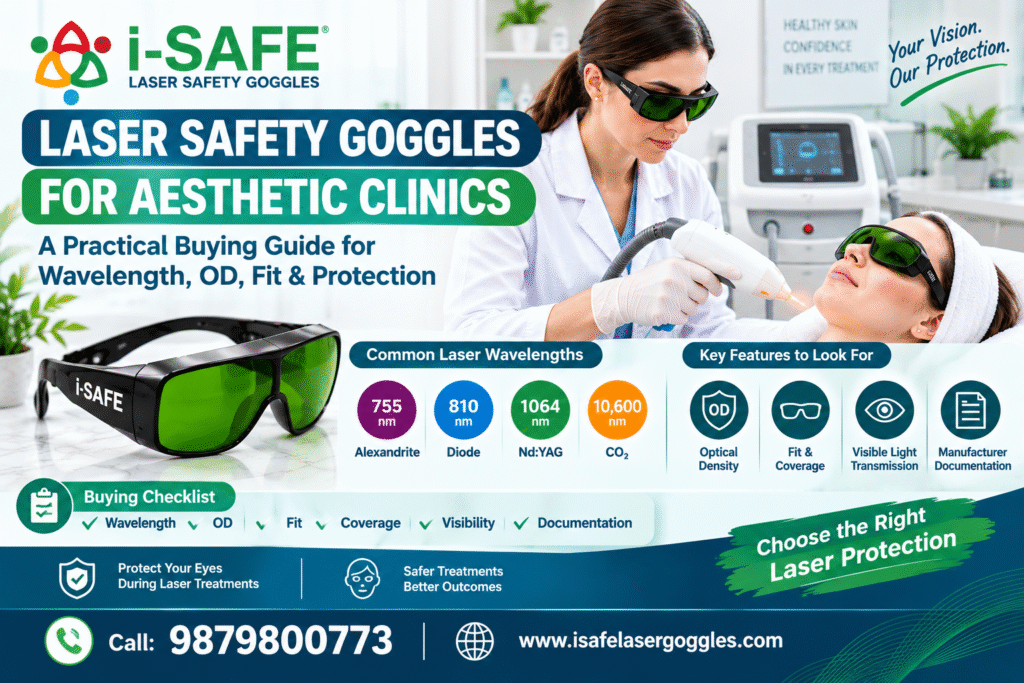
Before purchasing laser safety goggles for aesthetic clinics, evaluate the following factors.
1. Laser Wavelength
The first question should always be:
What wavelength does the laser emit?
Different laser systems operate at different wavelengths. For example, aesthetic and dermatological systems may commonly use wavelengths around:
- 755 nm – Alexandrite systems
- 810 nm – Diode systems
- 1064 nm – Nd: YAG systems
- 10,600 nm – CO₂ systems
These are examples, not universal specifications. The exact wavelength must be confirmed from the equipment manufacturer’s documentation.
OSHA guidance explains that wavelength is a fundamental factor when selecting protective eyewear because the filter must provide appropriate attenuation at the laser’s wavelength.
Buying Tip
Never purchase goggles simply because they say “laser protection.”
Check the actual wavelength range and OD provided by the product.
2. Optical Density (OD)
Optical density is one of the most important specifications for laser safety goggles for aesthetic clinics.
OD describes the logarithmic attenuation provided by a filter.
For example:
| OD | Approximate Attenuation |
|---|---|
| OD 1 | 10× |
| OD 2 | 100× |
| OD 3 | 1,000× |
| OD 4 | 10,000× |
| OD 5 | 100,000× |
| OD 6 | 1,000,000× |
However, higher OD does not automatically mean better or universally suitable protection.
The required OD depends on the laser wavelength, output parameters, exposure conditions, and applicable maximum permissible exposure. OSHA explains that OD selection should be based on anticipated exposure and the relevant exposure limit.
What to check
Do not ask only:
“What is the OD?”
Instead ask:
“What is the OD at the wavelength of my laser, and is that attenuation appropriate for the laser’s exposure conditions?”
That distinction is critical when choosing laser safety goggles for aesthetic clinics.
3. Visible Light Transmission
Protective eyewear should provide appropriate laser attenuation while still allowing the practitioner to see the treatment area clearly.
Very low visible light transmission can make it harder to work comfortably and accurately.
OSHA’s technical guidance specifically identifies visible light transmission, comfort, visibility, and fit as factors to consider when selecting laser protective eyewear.
Therefore, when comparing laser safety goggles for aesthetic clinics, look beyond the OD number and consider how easily the practitioner can see while wearing them.
4. Fit and Coverage
A technically appropriate filter still needs a suitable physical design.
When selecting laser safety goggles for aesthetic clinics, check:
- Secure fit
- Appropriate eye-area coverage
- Peripheral protection where required
- Compatibility with prescription glasses
- Comfort during longer procedures
- Stable positioning during treatment
- Frame condition
- Absence of unwanted gaps or light leakage
OSHA guidance recommends considering comfort, fit, peripheral protection, visibility, and the physical integrity of protective eyewear.
A comfortable design can also encourage consistent use during procedures.
5. Check the Product Markings
Reliable laser safety goggles should provide enough information for professionals to understand what protection they offer.
Important information can include:
- Laser wavelength(s)
- Optical density
- Visible light transmission
- Product identification
- Manufacturer information
- Applicable testing or standards documentation
OSHA’s applicable eye-protection requirements specifically identify wavelength, OD, and visible light transmission as information that should appear on protective laser goggles.
Simple rule:
If you cannot determine what wavelength and OD the goggles protect against, do not assume that they are suitable for your laser.
6. Consider the Actual Laser Parameters
A product label alone may not tell the complete story.
When selecting laser safety goggles for aesthetic clinics, professionals should consider the laser’s:
- Wavelength
- Continuous-wave or pulsed operation
- Average power
- Pulse energy
- Pulse duration
- Repetition rate
- Beam characteristics
- Expected exposure conditions
OSHA’s laser safety guidance specifically identifies wavelength, exposure time, output parameters, worst-case ocular exposure, and visible transmission among the factors used when selecting laser eyewear.
Consequently, the best buying process begins with the laser specifications, not with the eyewear catalogue.
7. Laser Safety Goggles for Hair Removal
Laser hair removal is one of the most common applications in aesthetic clinics.
Different systems can use different wavelengths, so the protective eyewear should be selected according to the actual device.
For example, an FDA-cleared diode laser hair-removal device documentation specifies an 808 nm wavelength and includes instructions concerning eye protection and avoiding direct or reflected laser exposure.
Therefore, clinics should not assume that one generic pair of laser safety goggles for aesthetic clinics will automatically work for every hair-removal device.
Always verify the device documentation and match the eyewear accordingly.
8. Laser Safety Goggles for Different Aesthetic Procedures
Aesthetic clinics may operate multiple laser systems.
For example:
Laser Hair Removal
May involve Alexandrite, diode, Nd: YAG, or other laser technologies depending on the equipment.
Pigmentation Treatments
Different laser technologies may be used depending on the target and treatment protocol.
Vascular Treatments
Certain systems use wavelengths designed for vascular targets.
Skin Resurfacing
CO₂ and other laser technologies may be used depending on the treatment.
Tattoo Removal
Q-switched or other pulsed laser technologies can involve different wavelengths and exposure characteristics.
Because the requirements vary, clinics should evaluate each laser system individually.
What About IPL?
IPL, or Intense Pulsed Light, should not automatically be treated as a laser.
IPL systems produce broad-spectrum intense light rather than a single laser wavelength.
The FDA recognises ISO 12609-1:2021 for eyewear protecting against intense light sources used on humans and animals for cosmetic and medical applications, with the standard specifically excluding laser radiation from its scope.
Therefore, if your clinic uses IPL, follow the specific IPL manufacturer’s safety requirements and select suitable protective eyewear for that system.
iSafe Laser Safety Goggles for Aesthetic Clinics
iSafe laser safety goggles can be considered as part of an aesthetic clinic’s professional eye-protection setup.
However, the correct iSafe product should always be selected according to the specific laser system and documented protection requirements.
When evaluating iSafe goggles, professionals should verify:
- Supported wavelength
- Optical density
- Visible light transmission
- Fit and coverage
- Product markings
- Applicable documentation
- Compatibility with the laser manufacturer’s requirements
This approach helps clinics choose eyewear based on measurable technical requirements rather than appearance alone.
Why Choose iSafe Goggles for Your Clinic?
When evaluating iSafe laser safety goggles for aesthetic clinics, consider the features that matter for everyday clinical use:
Wavelength-specific protection
Select a product with documented protection appropriate for the wavelength being used.
Appropriate optical density
Check the OD at the relevant wavelength and compare it with the laser’s requirements.
Comfortable fit
A secure and comfortable design supports consistent use during procedures.
Clear visibility
Suitable visible light transmission helps practitioners maintain visibility while working.
Professional design
Protective eyewear should fit naturally into the clinic’s treatment workflow.
Clear product documentation
Documentation allows professionals to verify whether the eyewear is appropriate for their specific equipment.
iSafe laser safety goggles should be selected according to the actual laser specifications and documented product performance.
Common Buying Mistakes to Avoid
When purchasing laser safety goggles for aesthetic clinics, avoid these common mistakes.
❌ Choosing Based Only on Lens Colour
A darker lens does not automatically provide better laser protection.
❌ Ignoring the Wavelength
Protection must correspond to the wavelength of the laser.
❌ Looking Only at the OD Number
OD must be considered together with wavelength and exposure conditions.
❌ Assuming One Pair Works for Everything
Different lasers can require different protection.
❌ Ignoring Fit
Poor fit or inadequate coverage can compromise practical protection.
❌ Buying Without Documentation
Professionals should be able to verify what the product protects against.
❌ Using Ordinary Safety Glasses
General-purpose safety glasses are not automatically suitable for laser radiation.
❌ Ignoring Product Damage
Protective eyewear should be inspected for issues such as cracking, pitting, crazing, frame damage, or light leaks. OSHA recommends periodic inspection of laser protective eyewear.
Aesthetic Clinic Laser Goggle Buying Checklist
Before buying laser safety goggles for aesthetic clinics, use this checklist:
☐ Identify every laser wavelength used in the clinic.
☐ Check the laser manufacturer’s safety documentation.
☐ Determine the required OD.
☐ Verify OD at the relevant wavelength.
☐ Check visible light transmission.
☐ Check fit and coverage.
☐ Review product markings.
☐ Review manufacturer documentation.
☐ Check compatibility with prescription eyewear if needed.
☐ Inspect the frame and filter condition.
☐ Consider whether the clinic uses multiple laser wavelengths.
☐ Keep laser-specific eyewear clearly identified.
☐ For IPL, follow IPL-specific requirements.
Should an Aesthetic Clinic Have Multiple Pairs of Laser Safety Goggles?
A clinic that operates multiple laser systems may need different protective eyewear depending on the wavelengths and exposure requirements of those systems.
For example, a clinic using a diode hair-removal laser and a CO₂ laser should not assume that the same eyewear provides appropriate protection for both.
OSHA’s guidance emphasises that protective eyewear must be selected for the specific laser wavelength and required attenuation.
Therefore, clinics should maintain an organised eyewear system based on the equipment they operate.
How to Maintain Laser Safety Goggles
Buying the right laser safety goggles for aesthetic clinics is only the first step.
Regularly inspect the eyewear for:
- Scratches
- Cracks
- Pitting
- Crazing
- Filter damage
- Frame damage
- Loose components
- Light leakage
- Signs of material degradation
OSHA’s laser safety guidance recommends periodic inspection to ensure protective eyewear maintains satisfactory filtration and mechanical integrity.
Clean and store the goggles according to the manufacturer’s instructions.
If the protective filter or frame becomes damaged, remove the product from service until its suitability has been evaluated.
Frequently Asked Questions
What are the best laser safety goggles for aesthetic clinics?
There is no single pair that is automatically appropriate for every laser. Select laser safety goggles for aesthetic clinics based on the laser wavelength, required OD, exposure conditions, fit, visibility, and manufacturer documentation.
How do I choose laser safety goggles?
Start with the laser’s wavelength and output parameters. Then determine the required OD and verify that the eyewear provides appropriate protection at that wavelength.
Is a higher OD always better?
No. The appropriate OD depends on the wavelength and exposure conditions. A higher OD is not automatically suitable for every laser.
Can one pair of goggles protect against multiple wavelengths?
Some products may be designed to protect multiple wavelengths, but you must verify the documented OD at each relevant wavelength rather than assuming broad protection.
Are dark laser goggles better?
Not necessarily. Lens darkness does not by itself determine the required wavelength-specific protection.
Can regular safety glasses be used for aesthetic lasers?
Do not assume that ordinary safety glasses provide laser protection. Laser eyewear needs appropriate wavelength-specific attenuation.
Are iSafe goggles suitable for aesthetic clinics?
iSafe laser safety goggles can be evaluated for aesthetic applications by comparing the specific product’s documented wavelength and OD specifications with the requirements of the laser system being used.
Conclusion
Choosing laser safety goggles for aesthetic clinics requires more than selecting a dark or comfortable pair of eyewear.
Professionals should evaluate the laser wavelength, optical density, output parameters, exposure conditions, visible light transmission, fit, coverage, markings, and manufacturer documentation.
A well-planned eyewear selection process helps clinics establish a consistent approach to laser eye protection.
iSafe laser safety goggles can be incorporated into this process when the selected product’s documented specifications match the requirements of the specific laser or light-based system.
The key principle is simple:
Know Your Laser. Check the Wavelength. Verify the OD. Choose the Right Protection.
Visit our store: https://isafelasergoggles.com/shop-2/
Follow us on Instagram: https://www.instagram.com/alphasurgicals?igsh=cTdjYWNtaXkxazlr
Visit us for all dermatology instruments- https://alphasurgicals.com/store/