During laser hair removal, skin rejuvenation and other aesthetic procedures, protecting the eyes of everyone involved is essential. However, laser goggles for patients vs operators may differ in design, fit, coverage and practical use.
Patients usually need eye protection that works with their treatment position and the area being treated. Meanwhile, operators need protective eyewear suitable for their laser system, working position and potential exposure conditions.
Nevertheless, both groups require eyewear that provides the appropriate protection for the specific laser being used. The correct choice depends on wavelength, optical density (OD), fit, coverage and the manufacturer’s specifications—not simply on whether the wearer is a patient or a practitioner. OSHA laser-safety guidance emphasises selecting eyewear for the specific wavelength and ensuring adequate OD for the energy involved.
Occupational Safety and Health Administration
In this guide, we explain the key differences between patient and operator eyewear and how clinics can evaluate iSafe laser safety goggles as part of their eye-protection procedures.
Why Do Patients and Operators Need Laser Eye Protection?
Laser radiation can injure the eyes if the exposure exceeds safe limits. Depending on the laser and exposure conditions, the hazard may come from direct radiation or hazardous reflections.
Therefore, eye protection should be considered for both the person receiving treatment and the professionals performing it, whenever the laser hazard assessment and device instructions require it. Some device instructions also require protection for other people present in the treatment area.
Occupational Safety and Health Administration
Although patients and operators may use different eyewear designs, neither group should use eyewear that lacks verified protection for the laser involved.
Why patient eye protection matters
Patients may need to keep their eyes protected while lying down, sitting upright or changing position during treatment. Consequently, their eyewear should fit securely and remain in place without interfering with the procedure.
Depending on the treatment and equipment, patient protection may involve goggles, specially designed eye shields, or another device explicitly approved for that use. The clinic must follow the laser manufacturer’s instructions and its laser safety procedures.
Why operator eye protection matters
Operators work near the treatment device and may be exposed to direct or reflected laser radiation, depending on the procedure and setup. As a result, they need protective eyewear selected for the actual laser wavelengths and exposure conditions.
Additionally, the eyewear should allow sufficient visibility for the operator to perform the procedure correctly without compromising the required protection.
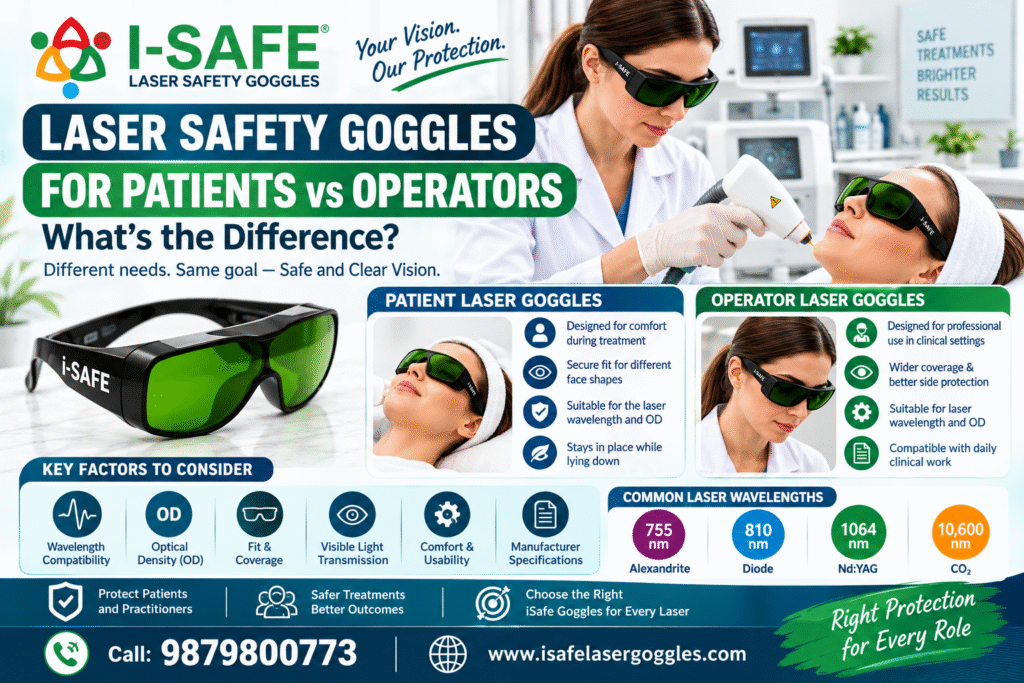
Laser Goggles for Patients vs Operators: Key Differences
The most important distinction is how the eyewear fits into the treatment process—not that one group automatically needs a higher or lower level of protection.
| Feature | Patient eyewear | Operator eyewear |
|---|---|---|
| Main purpose | Protect the patient’s eyes during treatment | Protect the practitioner or operator during laser use |
| Fit | Must suit the patient’s face and treatment position | Must suit the operator’s face and working position |
| Coverage | Must protect as specified for the procedure and device | Must protect against the relevant laser exposure, including applicable reflection hazards |
| Wavelength | Must match the laser and patient-protection requirements | Must match the laser wavelengths and required protection for the operator’s exposure conditions |
| Optical density | Must meet the specified requirements for patient protection | Must meet the specified requirements for operator protection |
| Practical considerations | Comfort, secure positioning and compatibility with treatment | Visibility, comfort, secure fit and compatibility with work tasks |
| Selection | Based on device instructions and patient-protection requirements | Based on laser parameters, hazard assessment and eyewear specifications |
Important: This table describes typical practical considerations. It does not mean patient eyewear and operator eyewear are always different products. A particular model may be suitable for both roles only if its documented specifications and the relevant instructions support that use.
1. Wavelength Protection: The First Thing to Check
When comparing laser goggles for patients vs operators, begin by identifying the laser wavelengths involved.
Different laser systems operate at different wavelengths. For example, aesthetic and medical systems may include:
- 755 nm: commonly associated with Alexandrite lasers
- 810 nm: commonly associated with diode lasers
- 1064 nm: commonly associated with Nd: YAG lasers
- 10,600 nm: commonly associated with CO₂ lasers
These are examples, not a complete list of device specifications. Always confirm the exact wavelength from the equipment documentation.
Furthermore, do not assume that goggles suitable for one wavelength automatically protect against another. The eyewear must provide appropriate attenuation at every relevant wavelength.
OSHA guidance recommends clearly identifying the wavelengths and OD values for which laser protective eyewear provides protection.
Occupational Safety and Health Administration
2. Optical Density (OD): Why It Matters for Both Groups
Optical density describes how strongly a filter attenuates light at a specified wavelength. However, the appropriate OD cannot be selected simply by choosing the highest number available.
The required OD depends on the laser output and the anticipated exposure conditions, among other technical factors. Therefore, clinics should verify the required protection for both patient and operator eyewear rather than assuming that one OD specification works for every situation.
Occupational Safety and Health Administration
When reviewing iSafe laser safety goggles, check the technical documentation for:
- The wavelength or wavelength range covered
- The OD specified at each relevant wavelength
- Applicable use limitations
- Fit and coverage
- Any additional manufacturer instructions
Only select eyewear when its documented specifications meet the requirements for the intended use.
3. Fit and Coverage: Patients vs Operators
Even when the technical specifications are appropriate, the eyewear must fit the wearer and provide the intended coverage.
Patient eyewear
Patient eyewear should remain securely positioned throughout the procedure. In addition, it should accommodate the patient’s treatment position and follow the device manufacturer’s instructions.
Before treatment begins, staff should confirm that the eye protection is positioned correctly and will not shift during the procedure.
Operator eyewear
Operators may move their heads or change position while using the laser. Therefore, their eyewear should remain secure during normal work and provide the intended coverage from the relevant exposure directions.
Moreover, operators should consider compatibility with prescription glasses, where needed, and ensure that the eyewear does not interfere with other required protective equipment.
In both cases, a comfortable fit is important, but comfort must never replace the required protective specifications.
4. Visibility and Comfort
Visibility matters because patients and practitioners have different needs during treatment.
For patients, eyewear should be compatible with the prescribed treatment and remain in position. For operators, adequate visible-light transmission can help them see the treatment area and operate equipment effectively.
However, clearer or lighter-looking lenses are not automatically safer. The eyewear must first meet the required wavelength and OD specifications; visibility should then be evaluated within those requirements. OSHA includes visible-light transmission, fit and comfort among the factors to consider when selecting laser protective eyewear.
Occupational Safety and Health Administration
5. Can the Same Goggles Be Used for Patients and Operators?
Sometimes, but not automatically.
A single model may be appropriate for both patients and operators when the manufacturer explicitly supports both uses, and the eyewear meets the relevant protection requirements for each person.
Before sharing a model between roles, confirm:
- The eyewear covers the laser wavelength being used.
- Its OD is adequate for the applicable exposure conditions.
- Its design provides the required fit and coverage.
- The manufacturer permits the intended use.
- The eyewear can be cleaned and disinfected appropriately between users.
If any requirement is uncertain, do not assume that the same goggles are suitable for both roles.
6. What About Laser Hair Removal and IPL?
Laser hair removal and IPL treatments require particular care when selecting eye protection.
For laser hair removal, the eyewear must match the laser’s actual wavelength and required protection level. For example, a clinic using a diode laser should verify the exact specifications of that device rather than choosing goggles based on a general product description.
IPL, meanwhile, uses intense broad-spectrum light rather than a single laser wavelength. Consequently, clinics should follow the IPL manufacturer’s eye-protection instructions and verify that the selected eyewear is suitable for that device.
In both situations, patient and operator requirements should be evaluated separately, even if the same eyewear model may ultimately be appropriate for both.
7. Choosing iSafe Laser Safety Goggles for Patients and Operators
iSafe laser safety goggles can be evaluated as part of an aesthetic clinic’s eye-protection program. The key is to choose the specific model based on its documented specifications and intended use.
When reviewing iSafe eyewear, consider the following factors.
Verify wavelength and OD
First, identify the laser system and confirm the required wavelength and OD. Then compare those requirements with the specifications for the exact iSafe model.
Check fit and coverage
Next, evaluate whether the eyewear fits the intended wearer and provides the required coverage. Patient and operator needs may differ because their positions and activities during treatment are not the same.
Review manufacturer documentation
Additionally, check the model’s instructions, limitations and care requirements. Do not assume that every iSafe model protects every laser wavelength.
Establish a clinic-wide procedure
Finally, train staff to select, inspect, clean and store protective eyewear correctly. Maintain clear procedures so that the appropriate protection is available before each treatment.
The key message: Choose iSafe goggles based on verified product specifications and the requirements of the specific laser—not solely on the wearer’s role, lens colour, or appearance.
8. Common Mistakes to Avoid
Clinics can reduce confusion by avoiding these common mistakes:
- Using the same goggles automatically for everyone: Verify the suitability of the model for each intended user and device.
- Choosing eyewear by lens colour: Instead, check documented wavelength coverage and OD.
- Ignoring the laser manufacturer’s instructions: Follow the requirements for the specific system.
- Overlooking fit and coverage: Ensure that the eyewear stays correctly positioned.
- Assuming higher OD is always better: Select the OD required for the actual laser exposure conditions.
- Neglecting cleaning between users: Follow the manufacturer’s approved cleaning and disinfection instructions.
- Using damaged or unverified eyewear: Inspect the lenses, frame and markings, and remove questionable eyewear from service until its suitability is established.
9. Patient and Operator Eye-Protection Checklist
Before starting a laser procedure, staff should confirm the following:
- Identify the laser system and its wavelength.
- Verify the required OD and other relevant specifications.
- Confirm that patient eyewear is suitable for the procedure.
- Confirm that operator eyewear is suitable for the operator’s exposure conditions.
- Check fit, positioning and coverage.
- Inspect the lenses, frame and safety markings.
- Follow the manufacturer’s instructions for the device and eyewear.
- Clean and disinfect reusable eyewear as directed.
- Store the eyewear appropriately after use.
This checklist supports a consistent process; however, it does not replace a proper laser hazard assessment or the manufacturer’s instructions.
Frequently Asked Questions
Are patient and operator laser goggles different?
They may differ in design, fit and intended use. However, both must provide appropriate protection for the specific laser and exposure conditions.
Do patients need laser safety goggles during every treatment?
The required eye protection depends on the device, procedure and manufacturer’s instructions. Clinics should follow the applicable safety procedures and provide the specified protection whenever required.
Can operators use the same goggles as patients?
Potentially, yes. However, document that the specific eyewear is suitable for both uses and meets the relevant protection requirements for each person.
Do patients and operators need the same optical density?
Not necessarily. The required OD depends on the laser parameters and anticipated exposure conditions. Do not assume that one OD value is suitable for every person or application.
Can ordinary sunglasses replace laser safety goggles?
No. Ordinary sunglasses should not be used as a substitute for laser protective eyewear with verified wavelength and OD specifications.
Are iSafe laser safety goggles suitable for both patients and operators?
That depends on the specific iSafe model and its documented intended use and protective specifications. Verify wavelength coverage, OD, fit, coverage and manufacturer instructions before use.
Conclusion
Understanding laser goggles for patients vs operators helps aesthetic clinics make informed eye-protection decisions.
Patients need eyewear that remains correctly positioned during treatment, while operators need eyewear suitable for their working position and potential exposure conditions. Nevertheless, both groups require protection that matches the laser’s wavelength and the applicable OD requirements.
For clinics considering iSafe laser safety goggles, the best approach is to review the exact model specifications, confirm suitability for each intended user, and establish consistent procedures for inspection, cleaning and storage.
Ultimately, the right eyewear is the eyewear that meets the documented protection requirements for the specific laser and intended use—not simply the pair that looks most comfortable or convenient.
Visit our store: https://isafelasergoggles.com/shop-2/
Follow us on Instagram: https://www.instagram.com/alphasurgicals?igsh=cTdjYWNtaXkxazl
Visit us for all dermatology instruments: https://alphasurgicals.com/store/