Laser technology has become an important part of modern dermatology and aesthetic medicine. Dermatologists use laser systems for hair removal, pigmentation, vascular conditions, skin resurfacing, scar treatment, and other procedures.
However, laser treatment also creates potential eye hazards. Therefore, laser eye protection for dermatology should never be selected simply because a pair of goggles looks dark, comfortable, or professional.
The correct protection depends on several factors, including the laser wavelength, optical density (OD), output characteristics, exposure conditions, coverage, fit, and product documentation.
So, how much protection do dermatology lasers really require?
The answer is: there is no single OD or single pair of goggles that is automatically suitable for every dermatology laser.
Instead, professionals should match the protective eyewear to the specific laser system and its potential exposure conditions. OSHA guidance similarly states that laser protective goggles should protect against the specific wavelength and provide optical density adequate for the energy involved.
Why Laser Eye Protection for Dermatology Matters
During a laser procedure, the operator, patient, and other personnel in the treatment area may potentially encounter direct, reflected, or scattered laser radiation.
The risk depends on the laser system and how it is used. In particular, the eye can be highly sensitive to optical radiation because ocular tissues can transmit and focus certain wavelengths.
Therefore, dermatology clinics should establish appropriate laser safety controls and select laser eye protection for dermatology according to the actual equipment and procedure.
Laser protective eyewear is only one part of a broader safety program. Engineering and administrative controls should also be considered rather than relying on eyewear alone. OSHA’s laser safety guidance emphasizes the importance of controls and appropriate protective equipment when hazardous exposure cannot otherwise be eliminated.
How Much Laser Eye Protection Do Dermatologists Actually Need?
This is one of the most important questions when selecting laser safety goggles for dermatologists.
The answer cannot be determined from the laser name alone.
Professionals should consider:
- Laser wavelength
- Continuous-wave or pulsed operation
- Average power
- Pulse energy
- Pulse duration
- Repetition rate
- Beam characteristics
- Exposure duration
- Potential direct-beam exposure
- Potential reflected exposure
- Required Maximum Permissible Exposure (MPE)
- Required optical density
- Filter damage threshold
- Visibility requirements
Consequently, a pair of goggles that is suitable for one laser may not provide the appropriate protection for another laser—even when both devices are used for similar dermatological treatments.
OSHA technical guidance identifies wavelength, exposure time, output parameters, worst-case ocular exposure, MPE, and other factors when selecting laser protective eyewear.
Understanding Optical Density in Laser Safety Goggles
Optical Density (OD) is one of the most important specifications in laser protective eyewear.
OD describes the attenuation provided by a filter on a logarithmic scale.
For example:
| Optical Density | Approximate Attenuation |
|---|---|
| OD 1 | 10× |
| OD 2 | 100× |
| OD 3 | 1,000× |
| OD 4 | 10,000× |
| OD 5 | 100,000× |
| OD 6 | 1,000,000× |
Therefore, OD 6 does not simply mean “slightly more protection” than OD 5. It represents a tenfold increase in attenuation.
However, higher OD does not automatically mean better for every procedure.
The required OD depends on the laser parameters and exposure scenario. OSHA describes OD as a logarithmic relationship between anticipated exposure and the applicable MPE.
Why You Should Not Choose OD by Guesswork
A common mistake is to purchase the highest-OD goggles available and assume they will work for every laser.
That approach can create practical problems.
Extremely high attenuation may reduce visible light transmission and make it harder to see the treatment area. Therefore, professionals should select eyewear that provides the required protection while maintaining appropriate visibility for the procedure.
Wavelength Is Critical for Laser Eye Protection
When choosing laser eye protection for dermatology, wavelength is one of the first specifications to check.
Laser protective filters are designed to attenuate particular wavelength ranges. As a result, professionals must verify that the eyewear actually covers the wavelength emitted by their laser.
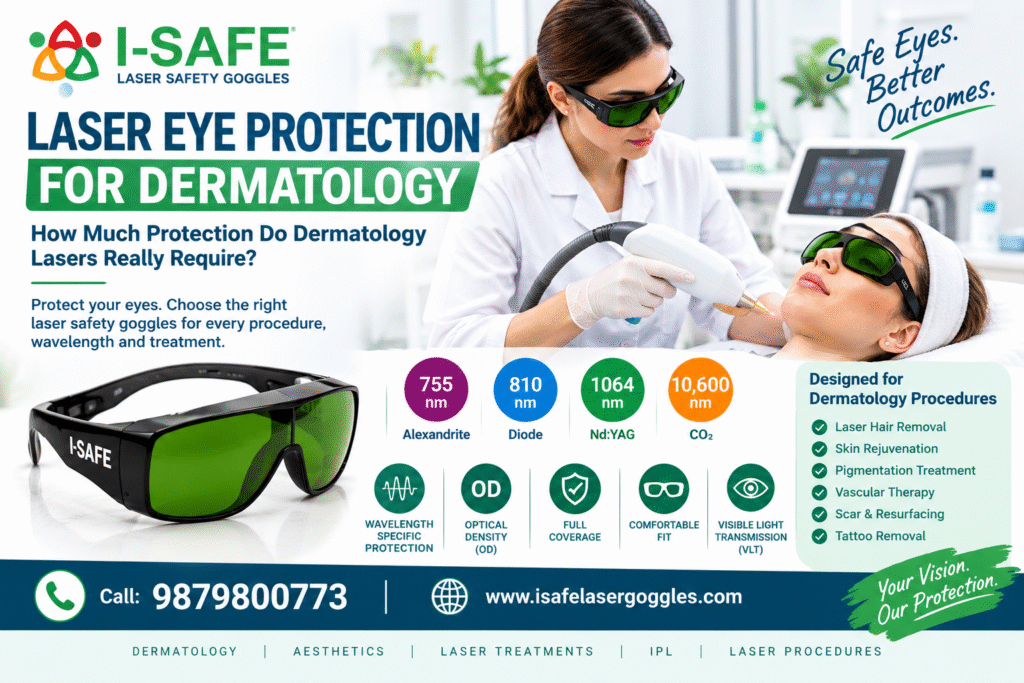
Dermatology and aesthetic laser systems can use different wavelengths. For example, FDA documentation includes dermatological systems using 755 nm Alexandrite and 1064 nm Nd:YAG technologies.
This means that a clinic should never assume that one pair of laser goggles provides suitable protection across every system.
755 nm Alexandrite Laser Protection
755 nm Alexandrite lasers are commonly used in aesthetic and dermatological applications, including hair reduction and treatment of certain pigmented or vascular lesions.
When a clinic uses a 755 nm system, the protective eyewear should have documented attenuation at the relevant wavelength and an OD appropriate for the specific laser and exposure conditions.
Therefore, dermatologists should check the actual device specifications before selecting laser safety goggles for dermatologists.
810 nm Diode Laser Protection
Diode laser systems are widely used in aesthetic applications such as hair reduction, with some systems operating around the 800–810 nm region.
Because wavelength alone does not determine the required OD, professionals should also review the laser’s output and operating parameters.
The correct laser protective eyewear should therefore be selected from the actual laser documentation rather than from a generic “diode laser” label.
1064 nm Nd:YAG Laser Protection
The 1064 nm Nd: YAG wavelength is used in several dermatological and aesthetic applications.
FDA documentation for medical laser systems confirms the use of 1064 nm Nd: YAG technology in dermatological applications.
For these systems, the eyewear should provide suitable attenuation at 1064 nm and meet the required protection level for the specific device.
Importantly, even two Nd:YAG systems can have different operating parameters. Therefore, professionals should not assume that the same OD automatically applies to every 1064 nm laser.
10,600 nm CO₂ Laser Eye Protection
CO₂ lasers commonly operate around 10,600 nm and are used for applications such as tissue ablation and skin resurfacing.
Because this wavelength falls in a very different region of the electromagnetic spectrum, the filter used for a CO₂ laser must be specifically appropriate for the relevant wavelength and exposure conditions.
Consequently, laser goggles for dermatology should always be selected using documented wavelength and OD specifications.
What About IPL Eye Protection?
IPL requires a slightly different approach.
Intense Pulsed Light (IPL) is not a laser. FDA describes IPL as a high-powered, broad-spectrum pulse of visible light.
Therefore, professionals should not select IPL eye protection simply by looking for a laser wavelength such as 755 nm or 1064 nm.
Instead, clinics should follow the specific IPL manufacturer’s eye-protection requirements.
FDA-recognized ISO 12609 standards address eye protectors for intense light sources used in cosmetic and medical applications, while specifically distinguishing these sources from laser radiation.
This distinction is particularly important for clinics that use both lasers and IPL devices.
How to Choose Laser Eye Protection for Dermatology
Choosing laser eye protection for dermatology becomes much easier when you follow a systematic process.
1. Identify the Exact Wavelength
Start by checking the laser manufacturer’s documentation.
Record:
- Wavelength
- Laser type
- Operating mode
- Pulse duration
- Pulse energy or power
- Repetition rate
Do not rely only on the device’s marketing name.
2. Determine the Required Optical Density
Next, determine the OD required for the relevant exposure scenario.
The required OD should be based on the laser parameters and applicable safety calculations or guidance.
Do not assume that:
“Higher OD = automatically safer.”
Instead, choose an OD that provides the necessary attenuation for the specific hazard.
3. Check the Wavelength and OD Markings
Proper laser safety goggles should clearly identify their intended wavelength range and OD.
OSHA specifically identifies wavelength, OD, and visible light transmission as information that should appear on protective laser eyewear labeling under the cited requirement.
4. Check Coverage and Fit
Good laser safety goggles for dermatologists should remain properly positioned during treatment.
Check:
- Eye coverage
- Side protection
- Frame fit
- Stability
- Comfort
- Compatibility with other PPE
A technically suitable filter still needs to be used correctly.
5. Consider Visible Light Transmission
Visible Light Transmission, or VLT, affects how easily the wearer can see through the protective filter.
A very dark filter may reduce visibility. Therefore, dermatologists should consider VLT while ensuring that the required laser attenuation is maintained.
6. Review Documentation
Before purchasing iSafe laser safety goggles or any other protective eyewear, review the available technical documentation.
Look for:
- Wavelength range
- OD values
- Filter specifications
- Product markings
- Applicable standards
- Testing information
- Usage limitations
- Manufacturer instructions
Why One Pair of Laser Goggles May Not Be Enough
A dermatology clinic may use several laser systems.
For example:
| Laser Technology | Example Wavelength | Protection Consideration |
|---|---|---|
| Alexandrite | 755 nm | Wavelength-specific OD |
| Diode | ~800–810 nm | Wavelength-specific OD |
| Nd:YAG | 1064 nm | Wavelength-specific OD |
| CO₂ | ~10,600 nm | Wavelength-specific OD |
| IPL | Broad spectrum | Device-specific IPL protection |
These wavelength values are examples, not universal specifications for every device.
Therefore, clinics should create an eyewear matrix for each laser and verify the manufacturer’s requirements before treatment.
iSafe Laser Safety Goggles for Dermatology
iSafe laser safety goggles should be positioned as an important part of a professional laser safety setup for dermatology and aesthetic environments.
When evaluating iSafe goggles, professionals should match the specific product’s documented specifications to the laser system being used.
Key considerations include:
- Wavelength-specific protection
- Optical density
- Eye coverage
- Comfortable fit
- Visibility
- Product markings
- Technical documentation
- Compatibility with the procedure
Most importantly, iSafe goggles should be selected based on the actual laser hazard rather than simply choosing eyewear by appearance or lens color.
iSafe: Protection Matched to the Procedure
Every dermatology laser has its own operating characteristics.
Therefore, the right protective eyewear should be chosen according to the laser system.
iSafe laser safety goggles can be highlighted as a professional eyewear solution for clinics looking to organize their laser eye-protection requirements around wavelength, OD, coverage, fit, and visibility.
Your Vision. Our Protection.
Laser Eye Protection Checklist for Dermatologists
Before using laser safety goggles for dermatologists, check each of the following:
☐ Identify the exact laser wavelength
☐ Check the laser output parameters
☐ Determine the required OD
☐ Verify wavelength coverage
☐ Check OD markings
☐ Review manufacturer documentation
☐ Check visible light transmission
☐ Check eye and peripheral coverage
☐ Confirm proper fit
☐ Inspect the filter for damage
☐ Inspect the frame for damage
☐ Confirm compatibility with the procedure
☐ Follow the clinic’s laser safety procedures
This simple checklist can help dermatology clinics establish a consistent eyewear-selection process.
Common Mistakes When Selecting Laser Protective Eyewear
Choosing Goggles Based on Lens Color
Lens color does not tell you the actual wavelength protection or OD.
FDA also cautions that the apparent brightness or color of laser light is not a reliable indicator of laser power or eye hazard.
Assuming One Pair Works for Every Laser
Different wavelengths and operating conditions can require different protection.
Selecting OD Without Considering Laser Parameters
OD should be determined from the relevant laser and exposure conditions rather than chosen randomly.
Ignoring Product Markings
Professionals should verify wavelength and OD information before using protective eyewear.
Forgetting About Fit
Even technically appropriate eyewear must remain correctly positioned during treatment.
Using Regular Safety Glasses
Regular safety glasses do not automatically provide wavelength-specific laser protection.
How Often Should Laser Safety Goggles Be Inspected?
Laser protective eyewear should be inspected regularly and before use.
Look for:
- Cracks
- Scratches
- Pitting
- Crazing
- Filter damage
- Loose frames
- Mechanical damage
- Light leaks
- Missing or unreadable markings
OSHA technical guidance recommends periodic inspection of laser protective eyewear, including examination of the filter and frame for damage and integrity.
If the eyewear is damaged or its protective performance is uncertain, it should not be treated as suitable until it has been properly evaluated.
Frequently Asked Questions
How much laser eye protection does a dermatologist need?
There is no universal OD requirement for every dermatology laser. The required protection depends on the wavelength, output, pulse characteristics, exposure conditions, and applicable safety criteria.
What is the most important factor when choosing laser goggles?
The first step is to identify the laser’s wavelength. However, wavelength alone is not enough. The required OD, exposure conditions, fit, coverage, and product documentation must also be evaluated.
Is higher OD always better?
No. A higher OD provides greater attenuation at the relevant wavelength, but the appropriate OD depends on the exposure conditions. Visibility and practical use should also be considered.
Can one pair of goggles protect against 755 nm, 810 nm, and 1064 nm?
Some products may be designed to cover multiple wavelengths, but you should never assume that they do. Verify the product’s documented wavelength range and OD at each relevant wavelength.
Are IPL and laser goggles the same?
Not necessarily. IPL is a broad-spectrum intense-light source rather than a laser. Therefore, professionals should follow the IPL device manufacturer’s specific eye-protection requirements.
Are iSafe laser safety goggles suitable for every dermatology laser?
Suitability should always be determined from the specific iSafe product’s documented wavelength and OD specifications and compared with the laser manufacturer’s requirements. Do not assume that one iSafe product is suitable for every laser.
Conclusion
The question is not simply “How much protection do dermatology lasers require?”
The better question is:
“What protection does this specific laser require under the expected exposure conditions?”
That distinction matters.
Effective laser eye protection for dermatology should consider the laser’s wavelength, output characteristics, exposure conditions, optical density, fit, coverage, visibility, and product documentation.
For dermatologists and aesthetic professionals, iSafe laser safety goggles can be incorporated into a structured approach to laser eye protection, provided the selected product’s specifications match the laser system and applicable safety requirements.
Choose protection based on the laser—not simply the appearance of the goggles.
iSafe Laser Safety Goggles
Your Vision. Our Protection.
Visit our store: https://isafelasergoggles.com/shop-2/
Follow us on Instagram: https://www.instagram.com/alphasurgicals?igsh=cTdjYWNtaXkxazlr
Visit us for all dermatology instruments: https://alphasurgicals.com/store/