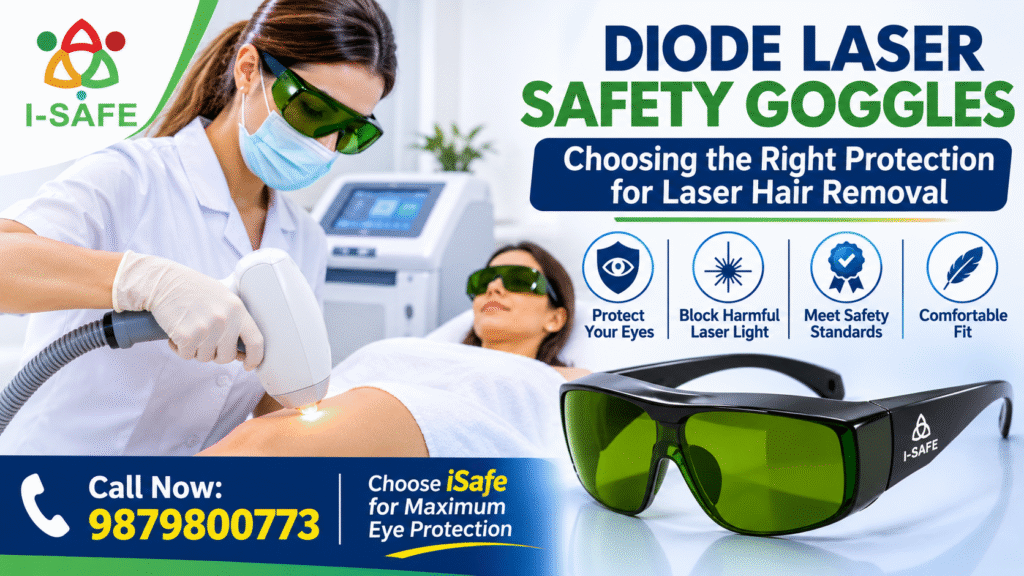
Laser hair removal has become a popular treatment in dermatology clinics, aesthetic centres and professional skincare facilities. However, diode laser technology also creates potential eye hazards that clinics must manage carefully.
Diode laser safety goggles help protect the eyes of practitioners, technicians and patients during laser hair removal procedures. Therefore, selecting the correct eyewear is an essential part of every clinic’s laser safety protocol.
However, not all protective goggles provide the same level of protection. The correct choice depends on the laser’s wavelength, optical density (OD), operating conditions and the manufacturer’s specifications.
This guide explains how to choose suitable diode laser safety goggles and why iSafe Laser Safety Goggles deserve consideration when selecting professional laser eye protection.
Why Diode Laser Safety Goggles Are Important
Diode lasers deliver concentrated optical energy to targeted hair follicles. Although the treatment focuses on the skin, direct or reflected laser exposure can create serious eye hazards.
The retina can be vulnerable to certain near-infrared wavelengths. Furthermore, laser exposure may occur through accidental beam contact, reflections from shiny surfaces or incorrect equipment handling.
Therefore, clinics should make appropriate protective eyewear part of their standard safety procedures.
Diode laser safety goggles help:
- Protect practitioners from hazardous laser exposure.
- Reduce eye exposure risks during treatment procedures.
- Support safer working conditions in laser clinics.
- Protect patients when the treatment setup requires patient eyewear.
- Reinforce professional laser safety practices.
Understanding Diode Laser Wavelengths
Before purchasing diode laser safety goggles, clinics should identify the exact wavelength emitted by their laser equipment.
Many hair-removal diode lasers operate around the 800–810 nm range. However, some systems use other wavelengths or combine multiple laser technologies.
For example:
- 755 nm: Commonly associated with Alexandrite laser technology.
- 800–810 nm: Commonly associated with diode laser hair removal systems.
- 940 nm: Used in some diode laser platforms.
- 1064 nm: Commonly associated with Nd:YAG laser technology.
Importantly, these wavelengths are examples, not universal specifications for every machine.
A clinic should always check the laser manufacturer’s technical documentation before selecting protective eyewear.
Why Wavelength Compatibility Matters
Laser safety goggles must protect the wavelength or wavelength range emitted by the equipment.
For example, eyewear designed for one wavelength should not automatically be considered suitable for another.
Similarly, goggles that protect against an 810 nm diode laser may not provide adequate protection against a 1064 nm Nd:YAG laser.
Therefore, always match the eyewear specifications to the actual laser system.
How to Choose Diode Laser Safety Goggles
Choosing the right eyewear requires more than checking the product’s appearance or colour. Instead, clinics should evaluate several important technical factors.
1. Check the Laser Wavelength
First, identify the wavelength specified by the laser equipment manufacturer.
Next, compare that wavelength with the protection range printed on the eyewear and its technical documentation.
In addition, check whether the eyewear covers every wavelength emitted by a multi-wavelength laser system.
2. Understand Optical Density (OD)
Optical Density, commonly known as OD, describes how effectively a filter attenuates laser light at a specified wavelength.
A higher OD indicates greater attenuation at the stated wavelength.
For example:
- OD 3 provides 1,000-fold attenuation.
- OD 4 provides 10,000-fold attenuation.
- OD 5 provides 100,000-fold attenuation.
- OD 6 provides 1,000,000-fold attenuation.
However, a higher OD alone does not guarantee suitable protection. The eyewear must also match the laser wavelength and the required protection level for the equipment’s operating conditions.
Therefore, clinics should select OD according to a competent laser safety assessment rather than choosing an arbitrary number.
3. Consider Laser Operating Conditions
Laser safety requirements depend on more than wavelength and OD.
For example, pulse duration, energy, exposure conditions and beam characteristics can influence the required protection level.
Consequently, clinics should consult their laser safety officer, qualified laser safety professional or equipment manufacturer before purchasing eyewear.
4. Evaluate Fit and Comfort
Protective eyewear must fit properly to support consistent use.
For this reason, check:
- Comfortable positioning around the eyes.
- Secure fit during treatment.
- Suitable coverage for the intended wearer.
- Compatibility with prescription glasses, where applicable.
- Adequate visibility for the procedure.
In addition, inspect the eyewear regularly for scratches, cracks, loose components or other damage.
Why Choose iSafe Laser Safety Goggles?
Selecting reliable laser protection is an important investment for professional hair-removal clinics. Therefore, clinics should consider eyewear that comes with clear technical documentation and specifications relevant to their laser equipment.
iSafe Laser Safety Goggles are a brand to consider when evaluating professional laser eye protection.
When selecting iSafe eyewear, clinics should confirm the exact wavelength coverage, OD rating, applicable protection classification and intended use against their laser machine’s specifications.
The right iSafe model should be selected according to the actual requirements of the treatment equipment.
Benefits to Look for in iSafe Laser Safety Goggles
When evaluating an iSafe product, consider these important selection criteria:
- Wavelength compatibility: Confirm that the stated protection range covers the diode laser output.
- Documented OD rating: Check the manufacturer’s stated optical density at the relevant wavelength.
- Appropriate protection classification: Verify applicable laser eyewear standards and markings.
- Comfortable fit: Choose a model suitable for the intended wearer.
- Clear product documentation: Review specifications, limitations and care instructions before use.
Remember, different laser machines may require different eyewear specifications. Therefore, never assume that one pair of goggles suits every laser treatment.
Laser Safety Standards and Protective Eyewear
Professional clinics should consider recognised laser safety standards when selecting protective eyewear.
For example, the ANSI Z136 series provides guidance for the safe use of lasers in different environments. ANSI Z136.3 addresses laser use in healthcare, while ANSI Z136.1 provides broader guidance for safe laser use.
In addition, EN 207 covers personal eye protection against laser radiation, while EN 208 addresses protective eyewear for adjustment work involving visible laser radiation.
However, these standards are not interchangeable. The appropriate standard depends on the intended use, jurisdiction and eyewear application.
Clinics should verify the product’s actual markings and supporting documentation rather than relying on general marketing claims.
Common Mistakes When Buying Diode Laser Safety Goggles
Even experienced professionals can overlook important details when purchasing protective eyewear.
Here are some mistakes clinics should avoid:
- Choosing goggles by colour alone: Lens colour does not establish wavelength protection.
- Ignoring the OD rating: Always verify the documented OD at the required wavelength.
- Using universal eyewear without verification: Different laser systems have different protection requirements.
- Ignoring product markings: Check the applicable standard and manufacturer documentation.
- Overlooking lens damage: Scratched or damaged eyewear requires inspection and replacement according to manufacturer guidance.
- Forgetting patient protection: Patient eye protection must also match the laser safety requirements.
As a result, a careful selection process helps clinics avoid unsuitable eyewear and strengthen their laser safety practices.
How to Maintain Laser Hair Removal Safety Goggles
Proper maintenance helps preserve the condition of protective eyewear.
First, inspect the lenses and frame before each use. Next, clean the goggles according to the manufacturer’s instructions.
Furthermore, store them in a protective case when they are not in use.
Follow these practices:
- Inspect lenses for scratches, cracks and visible damage.
- Clean the eyewear using approved cleaning products.
- Avoid harsh chemicals unless the manufacturer permits them.
- Store goggles away from direct sunlight, excessive heat and physical damage.
- Keep product documentation available for reference.
- Replace damaged or unsuitable eyewear promptly.
Most importantly, never continue using eyewear when its protective performance is uncertain.
Frequently Asked Questions
1. What wavelength do diode laser hair removal machines use?
Many diode laser hair removal systems operate around 800–810 nm. However, some machines use different or multiple wavelengths. Therefore, always verify the exact output in the manufacturer’s documentation.
2. What OD rating is suitable for diode laser safety goggles?
There is no single OD rating suitable for every diode laser. The required OD depends on wavelength, laser output and exposure conditions. Consequently, consult a qualified laser safety professional before selecting eyewear.
3. Can I use 1064 nm laser goggles for an 810 nm diode laser?
Not automatically. Although some eyewear protects across multiple wavelengths, you must confirm that its documented protection range and OD cover both wavelengths.
4. Are diode laser safety goggles necessary for practitioners?
Yes. Appropriate protective eyewear forms an important part of laser safety procedures. Practitioners should follow the equipment manufacturer’s instructions and their clinic’s laser safety assessment.
5. Can patients use the same goggles as practitioners?
Not necessarily. Patient and operator eyewear may have different design and application requirements. Therefore, select appropriate protection for each person according to the laser safety assessment.
6. Does darker lens colour mean better laser protection?
No. Lens colour does not determine the level of laser protection. Instead, check the documented wavelength range, OD rating and applicable protection markings.
7. Why should clinics consider iSafe Laser Safety Goggles?
iSafe Laser Safety Goggles are worth considering when evaluating professional laser eye protection. However, clinics should always verify the selected model’s technical specifications against their particular diode laser system.
Conclusion: Choose the Right Diode Laser Safety Goggles
Selecting suitable diode laser safety goggles is an important step towards maintaining eye safety during laser hair removal procedures.
Clinics should evaluate wavelength compatibility, OD rating, laser operating conditions, fit and applicable safety standards before purchasing protective eyewear.
Furthermore, choosing documented and appropriate iSafe Laser Safety Goggles can help clinics make an informed decision when evaluating their laser eye protection requirements.
Do not compromise on eye safety. Always match your protective eyewear to your equipment specifications.
Looking for professional laser safety goggles?
Contact iSafe to enquire about suitable laser safety eyewear for your clinic.
Call: 9879800773
Make eye protection an essential part of every laser hair removal procedure.
Visit our store: https://isafelasergoggles.com/shop-2/
Follow us on Instagram: https://www.instagram.com/alphasurgicals?igsh=cTdjYWNtaXkxazl
Visit us for all dermatology instruments- https://alphasurgicals.com/store/