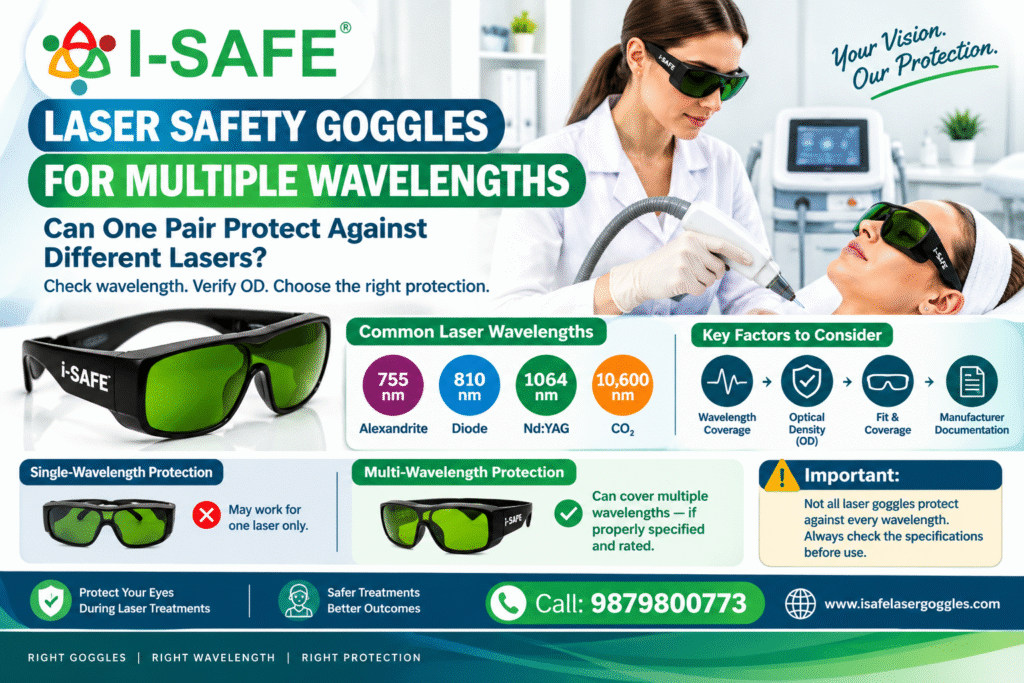
A common question in aesthetic clinics and dermatology practices is: Can one pair of laser safety goggles protect against multiple laser wavelengths?
The short answer is yes, in some cases—but not automatically.
Some specially designed laser safety goggles can provide protection across multiple wavelengths. However, professionals should never assume that one pair of goggles works with every laser in a clinic. Instead, the eyewear must be specifically rated for the wavelengths involved and must provide adequate optical density (OD) for the laser’s operating conditions. Therefore, always check the manufacturer’s specifications before using the same goggles with different laser systems.
OSHA guidance states that laser protective eyewear should provide protection for the specific wavelength of the laser and have an optical density adequate for the energy involved. Protective eyewear should also be labelled with the wavelengths and OD values for which protection is provided.
Therefore, when selecting laser safety goggles, wavelength coverage and OD should always be checked before use.
Why Laser Wavelength Matters
Laser light is not simply “laser light.” Different laser systems emit different wavelengths, and the eye responds differently depending on the wavelength.
For example, aesthetic and medical laser systems may operate around wavelengths such as:
- 755 nm – commonly associated with Alexandrite systems
- 810 nm – commonly associated with diode systems
- 1064 nm – commonly associated with Nd: YAG systems
- 10,600 nm – commonly associated with CO₂ systems
These examples do not mean that every device operating under a particular laser type has identical specifications.
Instead, professionals should check the exact device documentation.
The wavelength determines which portions of the laser radiation the protective filter needs to attenuate. OSHA explains that the wavelength or wavelengths of the laser limit the type of protective eyewear that can be selected.
Can One Pair of Laser Safety Goggles Cover Multiple Wavelengths?
Yes, some laser safety goggles can cover multiple wavelengths.
However, the answer depends on the actual filter design and its documented performance.
Multi-wavelength eyewear may use specialised filter materials or combinations of filters designed to attenuate different wavelength bands. OSHA’s laser safety guidance specifically notes that protection for multiple laser wavelengths is available and that dual-filter designs can be used for applications involving several laser types.
However, this does not mean that a dark or heavily tinted goggle automatically protects against every wavelength.
The protection must be demonstrated by the product’s technical specifications.
Think of it this way:
One pair of goggles + multiple documented wavelength ratings = potentially suitable for multiple lasers
but
One pair of goggles + no documented wavelength coverage = do not assume it is suitable.
The Most Important Factor: Wavelength Coverage
When evaluating laser safety goggles, start by checking the wavelength information.
Look for product documentation or markings that identify:
- Protected wavelength
- Wavelength range
- Optical density at each wavelength
- Visible light transmission
- Applicable product specifications
OSHA requires, in the referenced eye-protection regulation, that laser protective goggles identify the laser wavelengths for which they are intended and the OD of those wavelengths, along with visible light transmission.
Therefore, do not choose laser goggles simply because the packaging says “multi-wavelength.”
Check the actual wavelength and OD specifications.
Optical Density Is Equally Important
Wavelength alone does not determine whether laser safety goggles are appropriate.
You also need to consider Optical Density (OD).
OD describes the attenuation provided by the filter. It is logarithmic. For example:
| Optical Density | Approximate Attenuation |
|---|---|
| OD 2 | 10² |
| OD 3 | 10³ |
| OD 4 | 10⁴ |
| OD 5 | 10⁵ |
| OD 6 | 10⁶ |
So, for example, an OD 6 filter provides a nominal attenuation factor of 1,000,000 at the relevant wavelength.
However, higher OD does not automatically mean that a pair of goggles is suitable for every laser.
The required OD depends on factors such as:
- Laser wavelength
- Laser power
- Pulse energy
- Pulse duration
- Exposure conditions
- Beam characteristics
- Maximum permissible exposure (MPE)
- Operating configuration
OSHA explains that the required OD is determined from the anticipated worst-case exposure relative to the applicable MPE.
Why OD Must Be Checked at Each Wavelength
This is one of the most important points when buying laser safety goggles for multiple wavelengths.
A filter may have excellent attenuation at one wavelength but much lower attenuation at another.
For example, imagine a goggle specification showing:
| Wavelength | OD |
|---|---|
| 755 nm | OD 5+ |
| 810 nm | OD 6+ |
| 1064 nm | OD 4+ |
This does not mean you should simply look at the highest OD and assume that the goggles provide OD 6 protection across all wavelengths.
Instead, you must evaluate the OD listed at the specific wavelength being used.
This is why the complete wavelength/OD specification matters more than a general statement such as “high protection.”
What Happens If a Clinic Uses Several Lasers?
Many aesthetic clinics use multiple technologies.
For example, a clinic might have:
- Alexandrite laser
- Diode laser
- Nd:YAG laser
- CO₂ laser
- IPL equipment
In this situation, the clinic should create a wavelength and eyewear compatibility list.
Example:
| Device | Example Wavelength | Eyewear Requirement |
|---|---|---|
| Alexandrite | 755 nm | Verify wavelength + required OD |
| Diode | 810 nm | Verify wavelength + required OD |
| Nd:YAG | 1064 nm | Verify wavelength + required OD |
| CO₂ | 10,600 nm | Verify wavelength + required OD |
| IPL | Broad-spectrum | Follow IPL manufacturer’s requirements |
The exact requirements should always come from the specific device and eyewear documentation.
iSafe Laser Safety Goggles for Multi-Laser Clinics
For clinics using multiple laser systems, iSafe laser safety goggles can be evaluated based on the specific wavelength and protection requirements of the equipment being used.
The important point is not simply choosing a goggle because it looks suitable.
Instead, clinics should verify:
1. Wavelength Coverage
Confirm that the iSafe laser safety goggles are specified for the wavelength or wavelengths of the laser being used.
2. Optical Density
Check the documented OD at each relevant wavelength.
3. Laser Parameters
Consider the laser’s power, pulse energy, pulse duration and other relevant operating parameters.
4. Fit and Coverage
The goggles should fit properly and provide appropriate coverage for the intended procedure.
5. Manufacturer Documentation
Keep the relevant product documentation available so staff can verify compatibility before treatment.
This approach helps aesthetic clinics make a specification-based decision instead of relying on appearance or lens color.
Don’t Choose Laser Goggles by Lens Colour
A common mistake is choosing laser safety goggles based on their colour.
You may see green, orange, blue, grey, or other tinted filters.
However, the appearance of a filter does not tell you whether it provides the required protection at a particular wavelength.
Instead, check the technical specifications.
The FDA also warns that the apparent brightness or colour of laser light is not a reliable indicator of the laser’s potential hazard.
Therefore:
Color ≠ wavelength protection
and
Darkness ≠ automatically higher protection.
Can One Pair Protect Against 755 nm, 810 nm and 1064 nm?
Potentially—but only if the particular eyewear is specifically rated for all three wavelengths with appropriate OD values.
For example, a clinic that uses:
755 nm + 810 nm + 1064 nm
should look for eyewear documentation that explicitly covers those wavelengths and provides appropriate attenuation for each one.
Do not assume that because 755 nm and 810 nm are both near-infrared/visible-region wavelengths, a goggle rated for one automatically protects against the other.
Likewise, 1064 nm protection must be verified separately.
OSHA’s guidance emphasises that each laser wavelength must be considered when selecting protective eyewear.
What About CO₂ Laser Protection?
CO₂ lasers commonly operate around 10,600 nm, which is substantially different from wavelengths such as 755 nm, 810 nm and 1064 nm.
Therefore, a pair of laser safety goggles designed for certain visible or near-infrared wavelengths should not automatically be assumed to provide protection against CO₂ laser radiation.
Always check the eyewear’s wavelength specification.
This is especially important for clinics that use both hair-removal lasers and ablative laser systems.
What About IPL?
IPL requires separate consideration.
IPL is an intense, broad-spectrum light source rather than a single-wavelength laser. Therefore, clinics should follow the IPL manufacturer’s eye-protection requirements.
A pair of laser safety goggles should not automatically be considered suitable for IPL simply because it protects against several laser wavelengths.
Instead, verify the IPL system’s requirements and the protective eyewear’s documented spectral performance.
Multi-Wavelength Goggles vs Multiple Pairs
So, which option is better?
It depends on the clinic.
One Multi-Wavelength Pair
A properly specified multi-wavelength pair can offer advantages such as:
- Easier storage
- Fewer eyewear changes
- Simplified staff workflow
- Potentially lower inventory requirements
However, the eyewear must genuinely cover every relevant wavelength and provide adequate protection.
Multiple Specialised Pairs
Using different laser safety goggles for different laser systems can provide a straightforward matching system.
For example:
755 nm laser → designated eyewear
810 nm laser → designated eyewear
1064 nm laser → designated eyewear
This approach can reduce confusion when each pair is clearly labelled and assigned.
However, clinics still need to manage storage, cleaning and inspection properly.
When Should a Clinic Use Separate Laser Safety Goggles?
Separate eyewear may be preferable when:
- The lasers operate at substantially different wavelengths
- The required OD values differ significantly
- One pair cannot adequately cover all wavelengths
- The clinic uses different laser operating conditions
- Manufacturer instructions require specific eyewear
- Staff could easily confuse multi-use eyewear
- The eyewear provides inadequate visibility for a particular procedure
The decision should be based on documented specifications rather than convenience alone.
A Simple Buying Checklist for Multi-Wavelength Laser Safety Goggles
Before purchasing laser safety goggles, ask these questions:
✓ 1. What wavelengths does the clinic use?
Make a list of every laser wavelength.
✓ 2. What OD is required?
Determine the appropriate OD for each laser and operating condition.
✓ 3. Does the eyewear cover every wavelength?
Check the actual product specification.
✓ 4. What is the OD at each wavelength?
Do not rely on one overall OD number.
✓ 5. Does the eyewear fit properly?
Check comfort, coverage and stability.
✓ 6. Can staff clearly see the treatment area?
Visible light transmission matters because excessively dark eyewear can interfere with visibility and usability. OSHA includes visible light transmission among the factors to consider when selecting protective eyewear.
✓ 7. Is the product documentation available?
Keep technical information accessible to staff.
✓ 8. Is the eyewear suitable for the specific device?
Verify it against the laser manufacturer’s requirements.
Common Mistakes to Avoid
Mistake 1: Assuming One Pair Protects Everything
A pair of laser safety goggles should never be treated as universal protection.
Better approach: Verify every wavelength.
Mistake 2: Checking Only the Highest OD
An eyewear product may have different OD values at different wavelengths.
Better approach: Check OD at each wavelength.
Mistake 3: Choosing by Lens Colour
Lens colour does not establish wavelength protection.
Better approach: Review the technical specification.
Mistake 4: Ignoring Laser Output
The required OD depends on exposure conditions and laser output.
Better approach: Consider the actual laser parameters.
Mistake 5: Forgetting IPL
IPL is not simply another single-wavelength laser.
Better approach: Follow the IPL manufacturer’s eye-protection requirements.
Mistake 6: Using Unmarked Eyewear
If the relevant wavelength and OD information cannot be verified, do not assume the eyewear is suitable.
OSHA guidance calls for laser protective eyewear to be clearly labeled with the wavelengths and OD values for which protection is provided.
How to Manage Multi-Wavelength Laser Safety Goggles in a Clinic
A simple management system can make things easier.
Create an Eyewear Compatibility Chart
For example:
Goggle A → 755 nm / required OD
Goggle B → 810 nm / required OD
Goggle C → 1064 nm / required OD
Goggle D → Multi-wavelength coverage
Keep the chart near the laser equipment or eyewear storage area.
Label Storage Clearly
Store each pair in a clearly identified location.
Train Staff
Staff should understand that laser safety goggles are wavelength-specific protective equipment, not generic safety glasses.
Inspect Regularly
Check lenses, frames and markings for damage.
Maintain Documentation
Keep product specifications and laser safety information accessible.
iSafe Laser Safety Goggles: Choosing the Right Protection
iSafe laser safety goggles should be selected according to the actual laser system being used.
For aesthetic clinics using multiple technologies, the selection process should focus on:
- Wavelength
- Optical Density (OD)
- Laser output
- Exposure conditions
- Fit
- Coverage
- Visible light transmission
- Manufacturer documentation
This specification-based approach helps clinics choose the appropriate iSafe eyewear for their particular applications.
Most importantly, do not assume that every iSafe goggle model protects against every wavelength. Always check the specific model’s technical documentation before making a purchasing or treatment decision.
Final Answer: Can One Pair Protect Against Multiple Wavelengths?
Yes, one pair of laser safety goggles can protect against multiple laser wavelengths—but only when the specific eyewear is designed and documented to provide adequate protection at all of those wavelengths and operating conditions.
A multi-wavelength goggle should have clearly defined wavelength coverage and appropriate OD values for each wavelength.
Therefore, the safest approach is:
Identify the laser → Check the wavelength → Determine the required OD → Verify the eyewear specification → Confirm fit and coverage → Use according to the laser safety procedure.
For clinics using several laser systems, iSafe laser safety goggles can be considered as part of a multi-wavelength eye-protection strategy when the selected model’s specifications match the equipment requirements.
Never rely on lens colour, appearance or a generic “laser protection” claim alone.
Visit our store: https://isafelasergoggles.com/shop-2/
Follow us on Instagram: https://www.instagram.com/alphasurgicals?igsh=cTdjYWNtaXkxazl
Visit us for all dermatology instruments: https://alphasurgicals.com/store/