Laser safety goggles are an important part of an effective laser safety program. However, simply purchasing the right laser safety goggles is not enough. Regular inspection, proper cleaning, careful handling, and appropriate storage also help keep protective eyewear in good condition.
In aesthetic clinics, dermatology practices, and other laser treatment environments, goggles may be used repeatedly by practitioners and patients. Therefore, clinics should establish a simple routine for checking and maintaining them.
Proper care can help prevent scratches, contamination, frame damage, poor visibility, and other issues that may affect the usability of protective eyewear.
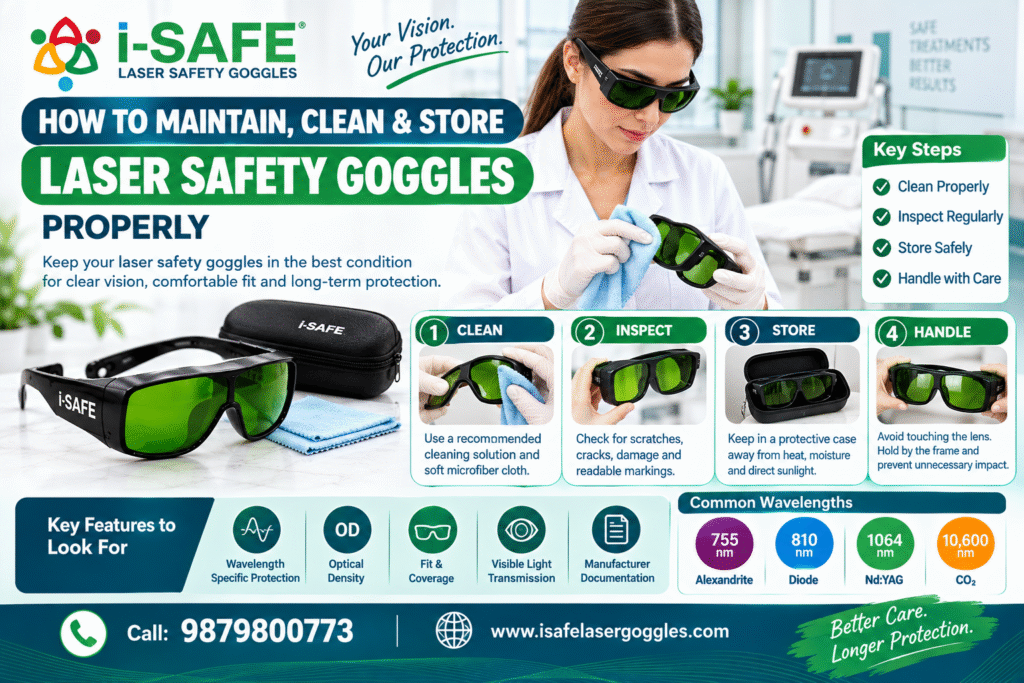
iSafe goggles can be incorporated into this routine with the same basic principle: follow the product manufacturer’s cleaning, disinfection, inspection, and storage instructions, and replace eyewear when its protective integrity is compromised.
Important: Cleaning and maintenance do not change the wavelength protection or optical-density rating of laser eyewear. Always use eyewear specifically selected for the laser system and exposure conditions.
Why Proper Maintenance of Laser Safety Goggles Matters
Laser safety goggles are designed to reduce potentially hazardous optical exposure when engineering and administrative controls alone do not eliminate the risk.
However, eyewear can become damaged or contaminated during regular use.
For example, scratches can affect visibility, while cracks, pits, or other damage may compromise the integrity of the protective eyewear. OSHA guidance recommends periodic inspection of laser protective eyewear, including checking filter material and the frame for damage and light leaks.
Therefore, clinics should treat goggles maintenance as part of their routine laser safety procedures.
Proper maintenance should include:
- Cleaning the lenses correctly
- Disinfecting the eyewear when required
- Inspecting lenses and frames
- Checking straps, hinges, and other components
- Protecting the lenses from scratches
- Storing goggles in a suitable location
- Following manufacturer instructions
- Removing damaged eyewear from service
1. Inspect Laser Safety Goggles Before Use
Before using goggles, perform a quick visual inspection.
Look carefully at both the lenses and the frame.
Check for:
- Scratches
- Cracks
- Chips
- Pitting
- Cloudiness
- Discoloration
- Delamination or coating damage, where applicable
- Loose or damaged frames
- Broken hinges
- Damaged straps
- Poor frame alignment
- Gaps or damage that could affect coverage
- Contamination that cannot be removed through normal cleaning
OSHA guidance specifically recommends periodic inspection for issues such as pitting and cracking and checking the mechanical integrity of the frame.
Similarly, FDA documentation for laser equipment has instructed users to inspect protective eyewear and discontinue use when damage is observed.
iSafe tip
If your clinic uses iSafe goggles, include them in the clinic’s routine pre-use inspection process. Do not continue using eyewear simply because it still looks generally usable if the lens or frame has visible damage.
2. Remove Dust Before Cleaning
Small particles can scratch a lens when you wipe them directly across the surface.
Therefore, remove loose dust and particles first.
A simple process is:
- Hold the goggles carefully by the frame.
- Remove loose particles according to the manufacturer’s cleaning instructions.
- Use an appropriate lens-cleaning method recommended for the specific eyewear.
- Avoid rubbing dry dust across the lens surface.
Never use abrasive materials to clean goggles.
The exact cleaning method should always follow the eyewear manufacturer’s instructions because lens materials and coatings can differ.
3. Use the Manufacturer-Recommended Cleaning Method
The safest cleaning approach depends on the eyewear’s construction and materials.
For that reason, don’t assume every household glass cleaner or disinfectant is suitable for goggles.
Depending on the manufacturer’s instructions, cleaning may involve:
- A suitable lens-cleaning solution
- Clean water
- A soft, non-abrasive cloth
- Manufacturer-approved disinfectant
- Disposable cleaning materials where appropriate
Always check the product documentation before introducing a chemical cleaner.
Avoid harsh or unapproved products
Do not automatically use:
- Abrasive cleaners
- Strong solvents
- Acetone
- Unapproved alcohol-based products
- Household glass cleaners
- Rough paper towels
- Abrasive cloths
- Strong chemical disinfectants
Some chemicals can damage lens materials, coatings, frames, or markings.
In short, use only cleaning and disinfecting products that the eyewear manufacturer approves.
4. Clean Laser Safety Goggles After Use
In a busy aesthetic clinic, multiple people may handle or wear the same protective eyewear.
Therefore, clinics should establish a consistent cleaning procedure.
A practical workflow is:
Use → Inspect → Clean → Disinfect if required → Dry → Inspect again → Store
This simple process helps prevent the next user from receiving eyewear that is dirty, wet, or damaged.
For reusable eyewear, follow the manufacturer’s instructions for cleaning and disinfection rather than creating an unverified chemical protocol.
OSHA’s eye and face protection requirements also emphasise that protective equipment should be durable, capable of being disinfected, and easily cleanable.
5. Do Not Ignore the Frame
Many users focus only on the lens. However, the frame also plays an important role in proper eyewear use.
Inspect:
- Nose bridge
- Temple arms
- Hinges
- Side protection
- Straps
- Seals, where applicable
- Fasteners
- Frame alignment
If the frame becomes loose or damaged, the goggles may no longer fit as intended.
Furthermore, poor fit can create gaps around the eyes and reduce the intended coverage.
6. Protect the Lenses From Scratches
Scratches can interfere with visibility and make eyewear harder to use comfortably.
Consequently, do not place laser safety goggles face-down on countertops.
Instead:
- Place lenses facing upward when temporarily setting goggles down.
- Keep eyewear away from keys, tools, equipment, and other sharp objects.
- Use a suitable protective case or storage container.
- Do not stack heavy objects on top of goggles.
- Keep multiple pairs separated when possible.
For iSafe laser safety goggles, clinics should use the storage method specified in the applicable product documentation.
7. Store Laser Safety Goggles in a Clean, Dry Location
Correct storage is just as important as cleaning.
After cleaning and drying the goggles, store them in a location that protects them from:
- Excessive heat
- Direct sunlight
- Moisture
- Humidity
- Dust
- Chemicals
- Physical impact
- Unnecessary pressure or bending
FDA PPE guidance recommends inspecting PPE before and after use, cleaning and disinfecting it before storage when applicable, and protecting stored PPE from damaging conditions such as excessive heat, light, moisture, and humidity.
Recommended storage setup
A clinic can use:
Dedicated case → Clean storage cabinet → Clearly identified eyewear
Avoid leaving laser safety goggles:
- On treatment beds
- Beside laser equipment
- In open drawers
- Under other equipment
- In direct sunlight
- Near cleaning chemicals
8. Keep Different Laser Safety Goggles Clearly Identified
Aesthetic clinics may use several laser systems.
For example, a clinic could use different systems involving wavelengths such as:
- 755 nm
- 810 nm
- 1064 nm
- 10,600 nm
These examples represent commonly encountered laser wavelengths, but they do not mean that one pair of goggles is automatically suitable for all of them.
The correct eyewear must be selected according to the specific laser wavelength and required protection.
OSHA states that laser safety goggles should protect against the specific wavelength and have adequate optical density for the energy involved. Protective goggles should also be labelled with the intended wavelengths, optical density, and visible light transmission.
Therefore, clinics should clearly identify and organise their laser safety goggles.
For example:
| Laser/System | Eyewear Information to Verify |
|---|---|
| 755 nm | Wavelength + required OD |
| 810 nm | Wavelength + required OD |
| 1064 nm | Wavelength + required OD |
| CO₂ laser | Wavelength + required OD |
| IPL | Manufacturer-specific eyewear requirements |
Do not select eyewear based only on lens color.
9. Never Assume a Dark Lens Means Better Protection
The colour of a lens does not, by itself, tell you whether laser safety goggles provide appropriate protection.
Instead, check the actual product markings and documentation.
Important information may include:
- Protected wavelength
- Optical density (OD)
- Visible light transmission
- Product identification
- Manufacturer information
- Applicable standards or testing documentation
OSHA guidance emphasises wavelength-specific selection and appropriate optical density rather than relying on appearance.
Therefore, a darker-looking pair should not automatically be considered safer.
10. Handle iSafe Laser Safety Goggles Carefully
iSafe laser safety goggles should be handled carefully throughout their daily use.
When putting them on or removing them:
- Hold the frame rather than unnecessarily touching the lens.
- Avoid placing fingers directly on optical surfaces.
- Do not bend the frame.
- Do not force hinges or straps.
- Do not place the goggles lens-down on hard surfaces.
- Inspect them after accidental drops or impacts.
If damage occurs, remove the eyewear from service and follow the manufacturer’s replacement or inspection guidance.
11. Do Not Use Damaged Laser Safety Goggles
This is one of the most important maintenance rules.
Do not continue using laser safety goggles simply because you need them for the next appointment.
Remove eyewear from service if you find:
- Cracked lenses
- Significant scratches
- Pitting
- Broken frames
- Loose components
- Damaged straps
- Deformation
- Suspected filter damage
- Unclear or unreadable safety markings
- Any condition that makes the eyewear unsuitable for its intended use
The correct response is to follow the manufacturer’s inspection and replacement procedure.
When protective eyewear is damaged, replace it rather than taking unnecessary risks.
12. Do Not Modify Laser Safety Goggles
Avoid drilling, cutting, painting, reshaping, or otherwise modifying protective eyewear.
Likewise, do not replace lenses with ordinary optical lenses.
The protective characteristics of laser eyewear depend on its specific optical design and materials.
Therefore, modifications can affect the intended protection.
This applies to iSafe laser safety goggles as well as other specialised laser protective eyewear.
13. Create a Laser Safety Goggles Maintenance Schedule
A written maintenance routine makes it easier for clinic staff to follow the same process.
Daily
- Inspect before use.
- Clean after use when required.
- Disinfect according to manufacturer instructions.
- Check for visible damage.
- Store properly.
Weekly
- Inspect frames and hinges more carefully.
- Check straps and other components.
- Check that labels and markings remain readable.
- Review the storage area.
Periodically
- Conduct a more detailed inspection.
- Review manufacturer maintenance instructions.
- Check whether replacement is necessary.
- Review eyewear requirements against the laser systems currently in use.
For higher-risk environments, the clinic’s Laser Safety Officer or responsible safety professional should establish the inspection frequency based on the equipment and operating procedures.
14. Train Staff on Laser Safety Goggles Care
Even high-quality laser safety goggles require proper handling.
Train staff to understand:
- Why the eyewear is required
- Which eyewear belongs to which laser
- How to inspect it
- How to clean it
- Which disinfectants are permitted
- How to store it
- When to remove it from service
- Where replacement eyewear is kept
OSHA’s PPE training guidance includes teaching employees how to identify damage and how to clean and disinfect protective eyewear.
Consequently, cleaning and maintenance should become part of the clinic’s normal safety workflow rather than an occasional task.
15. A Simple Laser Safety Goggles Cleaning Checklist
Use this checklist in your aesthetic clinic:
Before use
☐ Check lenses
☐ Check frame
☐ Check straps/hinges
☐ Look for cracks or scratches
☐ Confirm appropriate eyewear for the laser system
☐ Check product markings
After use
☐ Remove visible contamination
☐ Clean according to manufacturer instructions
☐ Disinfect when required
☐ Allow the eyewear to dry
☐ Inspect again
☐ Store in a protective location
Periodically
☐ Review condition
☐ Check markings and documentation
☐ Replace damaged eyewear
☐ Review maintenance procedures
☐ Train staff when procedures change
iSafe Laser Safety Goggles: Proper Care for Everyday Clinic Use
iSafe laser safety goggles can be included in a structured eyewear-care program for aesthetic and dermatology environments.
However, proper maintenance starts with following the specific instructions supplied with the eyewear.
For iSafe users, a good routine should focus on:
Inspect → Clean → Disinfect as instructed → Dry → Store → Inspect before reuse
Most importantly, never treat cleaning as a substitute for checking the suitability of the eyewear.
Before a laser procedure, professionals should verify that the iSafe laser safety goggles being used are appropriate for the specific laser wavelength and required protection.
Common Mistakes When Cleaning Laser Safety Goggles
1. Using household glass cleaner
Not every glass cleaner is suitable for specialised protective eyewear.
2. Wiping dusty lenses with a dry cloth
This can increase the risk of scratching the lens surface.
3. Using an unapproved disinfectant
Some chemicals can damage lens materials or coatings.
4. Storing goggles without a protective case
Open storage can expose eyewear to dust, chemicals, sunlight, and physical damage.
5. Ignoring small cracks
A small crack is still a reason to remove eyewear from service and follow the manufacturer’s inspection/replacement procedure.
6. Using the same goggles for different lasers without checking
Different laser systems can require different wavelength and OD protection.
7. Choosing goggles based on lens colour
Colour alone does not establish whether eyewear provides appropriate laser protection.
8. Forgetting to inspect after a drop
Impact can damage the lens or frame even when the damage is not immediately obvious.
How Often Should Laser Safety Goggles Be Cleaned?
Laser safety goggles should be cleaned whenever they become contaminated and according to the manufacturer’s cleaning instructions.
In an aesthetic clinic where goggles are shared between users, establish a cleaning and disinfection process between users whenever applicable.
However, cleaning frequency does not replace inspection.
Before use, staff should check the condition of the eyewear and remove damaged goggles from service.
Can You Use Alcohol to Clean Laser Safety Goggles?
Do not assume that alcohol is suitable for every pair of laser safety goggles.
Some eyewear materials and coatings may tolerate specific cleaning agents, while others may not.
Therefore, always check the manufacturer’s instructions before using alcohol, disinfectant, or another chemical cleaner.
The correct approach is manufacturer-approved cleaning, not a one-size-fits-all solution.
When Should Laser Safety Goggles Be Replaced?
Replace or remove laser safety goggles from service when they are damaged, when their protective integrity is uncertain, or when the manufacturer specifies replacement.
Look for:
- Cracks
- Severe scratches
- Pitting
- Damaged frames
- Broken components
- Filter deterioration
- Unreadable markings
- Other signs of degradation
Conclusion
Proper care can extend the useful life of laser safety goggles while helping clinics maintain clean, functional, and properly stored protective eyewear.
The process does not need to be complicated. A consistent routine of inspection, manufacturer-approved cleaning, appropriate disinfection, careful handling, and protected storage can make eyewear maintenance much easier.
For aesthetic clinics and dermatology practices using iSafe laser safety goggles, staff should combine good maintenance habits with correct wavelength and optical-density selection.
Ultimately, clean goggles are only one part of laser safety. The eyewear must also be suitable for the specific laser system, exposure conditions, and intended user.
FAQ
1. How should laser safety goggles be cleaned?
Clean them according to the manufacturer’s instructions using approved cleaning materials. Avoid abrasive cleaners and unapproved chemicals.
2. Can I use regular glass cleaner on laser safety goggles?
It is better not to, unless the eyewear manufacturer specifically approves it. Specialised lenses and coatings may react differently to cleaning chemicals.
3. How should laser safety goggles be stored?
Store them in a clean, dry, protected location away from excessive heat, light, moisture, chemicals, and physical impact.
4. Should laser safety goggles be inspected before every use?
Yes. A quick visual inspection before use can help identify obvious damage or contamination. More detailed periodic inspections should also be part of the clinic’s safety program.
5. Can scratched laser safety goggles still be used?
If scratches are significant or affect the eyewear’s condition or visibility, remove the goggles from service and follow the manufacturer’s inspection or replacement guidance.
6. Can one pair of laser safety goggles be used for every laser?
Not automatically. Laser protective eyewear must be appropriate for the specific wavelength and required protection.
7. How should iSafe laser safety goggles be maintained?
Follow the specific iSafe product instructions for cleaning, disinfection, inspection, and storage. Also verify that the goggles are appropriate for the laser system being used.
Visit our store: https://isafelasergoggles.com/shop-2/
Follow us on Instagram: https://www.instagram.com/alphasurgicals?igsh=cTdjYWNtaXkxazlr
Visit us for all dermatology instruments- https://alphasurgicals.com/store/