When choosing laser safety goggles, one of the most important specifications to understand is optical density (OD).
But what does an OD rating actually mean?
Does a higher OD always provide better protection? How does OD relate to laser wavelength? And how can dermatologists, aesthetic professionals, and laser technicians determine which laser safety goggles OD ratings are appropriate for a particular procedure?
These questions matter because laser protective eyewear should not be selected simply because the lens looks dark or the product is marketed as “laser safe.”
Instead, professionals should evaluate the laser wavelength, optical density, exposure conditions, laser output, fit, coverage, visible light transmission, and manufacturer documentation.
In this guide, we explain laser safety goggles OD ratings in simple terms and show how optical density relates to laser protection.
Important: The OD examples in this article explain the mathematical meaning of OD. They are not universal recommendations for specific lasers. The appropriate OD must be determined from the actual laser parameters and exposure conditions.
What Are Laser Safety Goggles OD Ratings?
Laser safety goggles OD ratings describe how strongly a protective filter attenuates laser radiation at a specified wavelength.
OD stands for Optical Density.
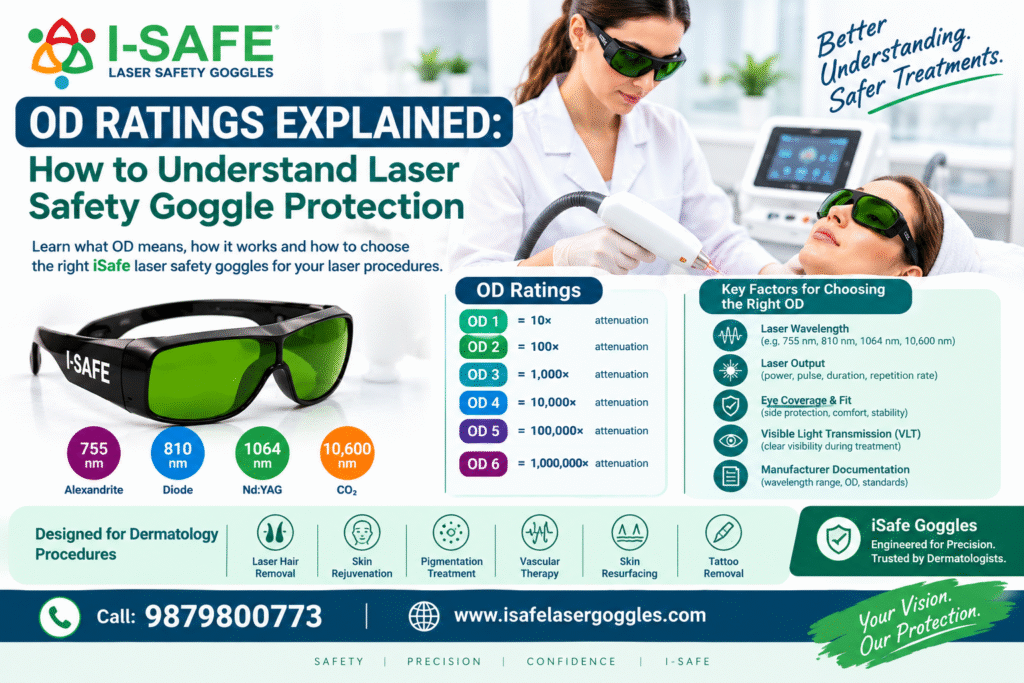
Optical density uses a logarithmic scale. Therefore, every increase of one OD represents a tenfold increase in attenuation.
For example:
| OD Rating | Approximate Attenuation | Approximate Transmission |
|---|---|---|
| OD 1 | 10× | 10% |
| OD 2 | 100× | 1% |
| OD 3 | 1,000× | 0.1% |
| OD 4 | 10,000× | 0.01% |
| OD 5 | 100,000× | 0.001% |
| OD 6 | 1,000,000× | 0.0001% |
For example, OD 3 provides approximately 1,000-fold attenuation, while OD 6 provides approximately 1,000,000-fold attenuation.
OSHA describes optical density as a logarithmic measure of attenuation and explains that the required OD depends on the anticipated exposure relative to the applicable maximum permissible exposure (MPE).
Why Optical Density Matters in Laser Safety Goggles
Laser radiation can reach hazardous exposure levels quickly, depending on the laser’s characteristics.
Therefore, laser safety goggles must reduce the exposure to an appropriate level for the specific hazard.
Optical density helps describe how much attenuation the filter provides.
However, professionals should not assume that the highest available OD automatically provides the correct protection.
Instead, the required OD depends on factors such as:
- Laser wavelength
- Laser power
- Pulse energy
- Pulse duration
- Repetition rate
- Beam size
- Exposure duration
- Direct or reflected exposure
- Maximum Permissible Exposure (MPE)
- Filter characteristics
OSHA’s laser safety guidance specifically considers wavelength, exposure time, output parameters, worst-case exposure, MPE, visible transmission, fit, and other factors when selecting protective eyewear.
How Do Laser Safety Goggles OD Ratings Work?
The basic relationship can be expressed as:
OD = log₁₀ (incident exposure / permissible exposure)
In practical terms, OD tells you how much the filter reduces the laser radiation at the relevant wavelength.
For example:
- OD 2 → 100× attenuation
- OD 3 → 1,000× attenuation
- OD 4 → 10,000× attenuation
- OD 5 → 100,000× attenuation
- OD 6 → 1,000,000× attenuation
Therefore, OD should be understood as a wavelength-specific attenuation value, not as a universal safety score.
Does a Higher OD Always Mean Better Laser Protection?
Not necessarily.
A higher OD provides greater attenuation at the specified wavelength, but that does not mean professionals should automatically select the highest possible OD.
Why?
Because excessive attenuation can reduce visible light transmission and make the treatment environment harder to see.
OSHA notes that protective eyewear should provide adequate visibility while maintaining the required optical density.
Therefore, professionals should select the OD that provides the required protection for the actual laser hazard.
The goal is:
Adequate laser attenuation + appropriate visibility + proper fit and coverage
Laser Wavelength and OD Must Be Considered Together
One of the biggest mistakes when selecting laser safety goggles OD ratings is looking at OD without checking wavelength.
A filter can provide a high OD at one wavelength while providing very different protection at another wavelength.
For example, eyewear designed for one laser wavelength should not automatically be assumed to protect against another laser wavelength.
OSHA requires laser protective goggles covered by its cited regulation to be suitable for the specific laser wavelength and have OD adequate for the energy involved. The regulation also calls for labelling that identifies intended wavelengths, OD values, and visible light transmission.
Therefore, always evaluate:
Wavelength → OD → Laser parameters → Exposure conditions
Understanding OD Ratings for Common Dermatology Laser Wavelengths
Dermatology and aesthetic clinics may use several different laser technologies.
Common examples include:
- 755 nm Alexandrite
- ~800–810 nm diode
- 1064 nm Nd: YAG
- 10,600 nm CO₂
These are examples only. The actual wavelength and operating parameters depend on the specific device.
755 nm Alexandrite Laser Goggles
Alexandrite laser systems commonly operate around 755 nm.
They are used in several aesthetic applications, including hair reduction and treatment of certain pigmented lesions.
When selecting laser safety goggles for 755 nm systems, professionals should verify:
- Wavelength coverage
- OD at 755 nm
- Laser output
- Pulse characteristics
- Manufacturer requirements
- Fit and coverage
Do not select eyewear solely because its packaging mentions “Alexandrite.”
Instead, verify the actual technical specifications.
810 nm Diode Laser Goggles
Many diode laser systems operate around the 800–810 nm range.
These systems are widely used for aesthetic procedures, including laser hair removal.
However, the required OD depends on the specific laser’s output and exposure conditions.
Therefore, professionals should evaluate the complete laser specification before choosing laser safety goggles OD ratings for a diode system.
1064 nm Nd: YAG Laser Goggles
Nd: YAG systems commonly use the 1064 nm wavelength.
Dermatology and aesthetic applications may include hair removal and vascular or pigmentation-related procedures.
For 1064 nm systems, professionals should verify that the eyewear provides documented attenuation at 1064 nm.
Most importantly, do not assume that every pair of “Nd: YAG goggles” has the same OD.
10,600 nm CO₂ Laser Goggles
CO₂ lasers commonly operate around 10,600 nm.
These lasers are used for applications such as resurfacing and tissue ablation.
Because the wavelength differs significantly from visible and near-infrared systems, the protective filter must be specifically appropriate for the relevant wavelength.
Therefore, laser safety goggles OD ratings should always be evaluated alongside wavelength specifications.
How to Read the OD Marking on Laser Safety Goggles
When inspecting laser protective eyewear, look for clear technical markings.
Depending on the product, markings may identify:
- Wavelength
- OD
- Wavelength range
- Visible Light Transmission (VLT)
- Manufacturer information
- Applicable standards or testing information
For example, a marking could indicate that a filter provides a particular OD at a specified wavelength range.
The important point is that OD without wavelength information is incomplete.
A high OD value does not tell you whether the eyewear protects against the wavelength your laser emits.
How to Choose the Correct OD for Laser Safety Goggles
Selecting the correct OD requires more than comparing numbers on product pages.
Step 1: Identify the Laser Wavelength
Start with the manufacturer’s specifications.
Record the exact wavelength or wavelengths produced by the device.
Step 2: Determine the Laser Output
Next, evaluate relevant parameters such as:
- Power
- Pulse energy
- Pulse duration
- Repetition rate
- Beam characteristics
Step 3: Determine the Exposure Scenario
Consider whether the potential exposure involves:
- Direct beam exposure
- Specular reflection
- Diffuse reflection
- Normal operation
- Alignment or maintenance
Step 4: Determine the Applicable MPE
The Maximum Permissible Exposure provides the relevant exposure limit for the eye under the applicable conditions.
Step 5: Determine the Required OD
The required OD can then be determined from the expected exposure and applicable safety criteria.
OSHA’s technical guidance demonstrates this process using worst-case exposure calculations and MPE values.
Step 6: Check the Eyewear Documentation
Finally, compare the required protection with the eyewear’s documented wavelength and OD.
iSafe Laser Safety Goggles and OD Protection
iSafe laser safety goggles can be highlighted as a professional solution for clinics that need structured laser eye protection.
When selecting an iSafe product, professionals should always match the specific product specifications to the laser system.
Important specifications to review include:
Wavelength
Verify that the iSafe filter covers the wavelength emitted by the laser.
Optical Density
Check the documented OD at the relevant wavelength.
Coverage
Evaluate whether the goggles provide suitable eye and peripheral coverage for the intended procedure.
Fit
The goggles should remain stable and comfortable during treatment.
Visibility
Consider visible light transmission so that professionals can work effectively while maintaining the required laser attenuation.
Documentation
Review available technical documentation and applicable standards or testing information.
iSafe Laser Safety Goggles — Protection matched to the laser, the procedure, and the required specifications.
Do not assume that one iSafe product is suitable for every laser. Instead, select the specific product based on its documented performance and the requirements of the laser system.
iSafe Goggles for Dermatology and Aesthetic Procedures
Dermatology clinics may use multiple laser technologies in the same treatment environment.
For example:
| Procedure | Possible Laser Technology | Example Wavelength |
|---|---|---|
| Laser Hair Removal | Alexandrite | 755 nm |
| Laser Hair Removal | Diode | ~800–810 nm |
| Hair/Pigment/Vascular Applications | Nd:YAG | 1064 nm |
| Skin Resurfacing | CO₂ | 10,600 nm |
These wavelengths are examples and do not establish a universal OD requirement.
Therefore, iSafe goggles should be selected according to the specific device’s documented wavelength and OD requirements.
Why One Pair of Laser Goggles May Not Be Enough
Some clinics operate multiple laser systems.
In that situation, one pair of goggles may not automatically provide suitable protection for every device.
For example, a filter designed for one wavelength may not provide adequate protection at another wavelength.
OSHA specifically notes that multiple laser wavelengths need to be considered and that eyewear selection should account for each relevant wavelength.
Therefore, clinics should maintain a clear eyewear-selection chart.
Example:
| Laser | Wavelength | Required OD | Selected Goggles |
|---|---|---|---|
| Alexandrite | 755 nm | Device-specific | Verify documentation |
| Diode | ~800–810 nm | Device-specific | Verify documentation |
| Nd:YAG | 1064 nm | Device-specific | Verify documentation |
| CO₂ | 10,600 nm | Device-specific | Verify documentation |
This approach reduces the risk of selecting eyewear based only on the laser’s brand or treatment category.
Optical Density vs Visible Light Transmission
OD and VLT describe different characteristics.
Optical Density describes attenuation at the relevant laser wavelength.
Visible Light Transmission (VLT) describes how much visible light passes through the eyewear.
Both characteristics matter.
For example, a filter may provide strong attenuation at a laser wavelength while transmitting enough visible light for the user to see the treatment area.
OSHA identifies visible light transmission as an important eyewear consideration and requires specified labeling under the cited regulation.
Therefore, professionals should not evaluate laser goggles based on darkness alone.
Why Lens Colour Does Not Tell You the OD Rating
A darker lens does not automatically mean higher laser protection.
Similarly, a lighter-looking filter does not automatically mean inadequate protection.
The FDA warns that the apparent brightness or colour of a laser beam is not a reliable indicator of its power or eye hazard.
The same principle applies when evaluating protective eyewear visually.
Instead of judging a pair of goggles by appearance, check:
- Wavelength
- OD
- VLT
- Product markings
- Technical documentation
Laser Safety Goggles OD Ratings: Common Mistakes
Choosing the Highest OD Available
Higher OD is not automatically the correct choice.
The OD should match the required attenuation.
Ignoring Wavelength
OD must be considered at the relevant laser wavelength.
Choosing Goggles by Lens Colour
Colour does not provide enough information to establish protection.
Using Generic Safety Glasses
Regular safety glasses may protect against impact or debris but do not automatically provide wavelength-specific laser protection.
Ignoring Product Markings
Always check the wavelength and OD information.
Using Damaged Goggles
Scratches, cracks, pits, or damaged filters can compromise the intended performance of protective eyewear.
How to Inspect Laser Safety Goggles
Before using laser safety goggles, inspect them carefully.
Check for:
- Scratches
- Cracks
- Pitting
- Crazing
- Damaged filters
- Loose frames
- Poor fit
- Light leaks
- Missing markings
OSHA technical guidance recommends periodic inspection of protective eyewear, including checking the filter and frame for damage and integrity.
If the eyewear becomes damaged or its protective performance becomes uncertain, remove it from service until it has been evaluated appropriately.
Frequently Asked Questions About Laser Safety Goggles OD Ratings
What does OD mean on laser safety goggles?
OD means Optical Density. It describes the logarithmic attenuation provided by the protective filter at a specified wavelength.
Is OD 5 better than OD 3?
OD 5 provides greater attenuation than OD 3 at the relevant wavelength. However, that does not mean OD 5 is automatically the correct choice for every laser. The required OD depends on the actual laser and exposure conditions.
What does OD 3 mean?
OD 3 corresponds to approximately 1,000-fold attenuation, or about 0.1% transmission, at the specified wavelength.
What does OD 6 mean?
OD 6 corresponds to approximately 1,000,000-fold attenuation, or about 0.0001% transmission, at the specified wavelength.
Does a high OD protect against all lasers?
No.
OD is wavelength-dependent. A high OD at one wavelength does not automatically mean that the eyewear provides adequate protection at another wavelength.
How do I know which OD my laser goggles need?
Determine the laser’s wavelength and relevant output/exposure parameters, then use the applicable laser safety criteria to determine the required OD. Compare that requirement with the eyewear’s documented specifications.
Can I use one pair of iSafe goggles for multiple lasers?
Only if the specific iSafe product’s documented wavelength coverage and OD values meet the requirements for all relevant lasers.
Do not assume that one product protects against every laser.
Does a darker lens mean a higher OD?
No.
Lens appearance alone cannot establish the OD or wavelength-specific protection.
Conclusion
Understanding laser safety goggles OD ratings is essential when selecting protective eyewear for laser procedures.
Optical density tells you how strongly a filter attenuates laser radiation at a specified wavelength. However, OD should never be evaluated in isolation.
The correct selection process considers:
Wavelength + OD + Laser Output + Exposure Conditions + Fit + Coverage + Visibility + Documentation
Therefore, dermatologists, aesthetic professionals, and laser technicians should select protective eyewear based on the actual laser hazard rather than simply choosing the darkest or highest-OD goggles available.
iSafe laser safety goggles can be incorporated into this selection process by matching the specific iSafe product’s documented wavelength and OD performance to the requirements of the laser system.
Remember:
The right OD is not simply the highest OD. It is the OD appropriate for the specific laser exposure.
Visit our store: https://isafelasergoggles.com/shop-2/
Follow us on Instagram: https://www.instagram.com/alphasurgicals?igsh=cTdjYWNtaXkxazlr
Visit us for all dermatology instruments: https://alphasurgicals.com/store/