Lasers and intense pulsed light (IPL) systems have become valuable tools in modern dermatology and aesthetic medicine. They are used for laser hair removal, skin rejuvenation, pigmentation concerns, vascular treatments, acne and scar procedures, and other cosmetic applications. However, these devices produce intense optical radiation, so appropriate eye protection is an essential part of a well-managed treatment environment.
Laser safety goggles are specifically designed to reduce exposure to potentially hazardous laser radiation at specified wavelengths. Unlike ordinary protective glasses or sunglasses, laser eyewear must be selected according to the laser system, wavelength, optical density (OD), and intended application.
Therefore, choosing the correct laser safety goggles is not simply a matter of comfort or appearance. It is an important component of laser safety.
In this article, we explain why laser safety goggles are essential, what specifications professionals should check, and how iSafe laser safety goggles can support professional dermatology and aesthetic practices.
Why Are Laser Safety Goggles Important?
Laser energy can be hazardous to the eyes because ocular tissues can absorb optical radiation. Depending on the wavelength and exposure conditions, the cornea, lens, or retina may be affected.
During a procedure, exposure can potentially occur through:
- Direct laser radiation
- Reflected radiation
- Scattered radiation
- Accidental exposure during equipment operation
For this reason, appropriate laser eye protection should be incorporated into the clinic’s laser safety procedures whenever required by the laser system and applicable safety practices.
Laser safety goggles provide wavelength-specific attenuation, helping reduce the amount of laser radiation that reaches the eyes.
However, goggles are only one part of laser safety. Engineering controls, administrative controls, training, controlled treatment areas, appropriate signage, and safe operating procedures should also be considered.
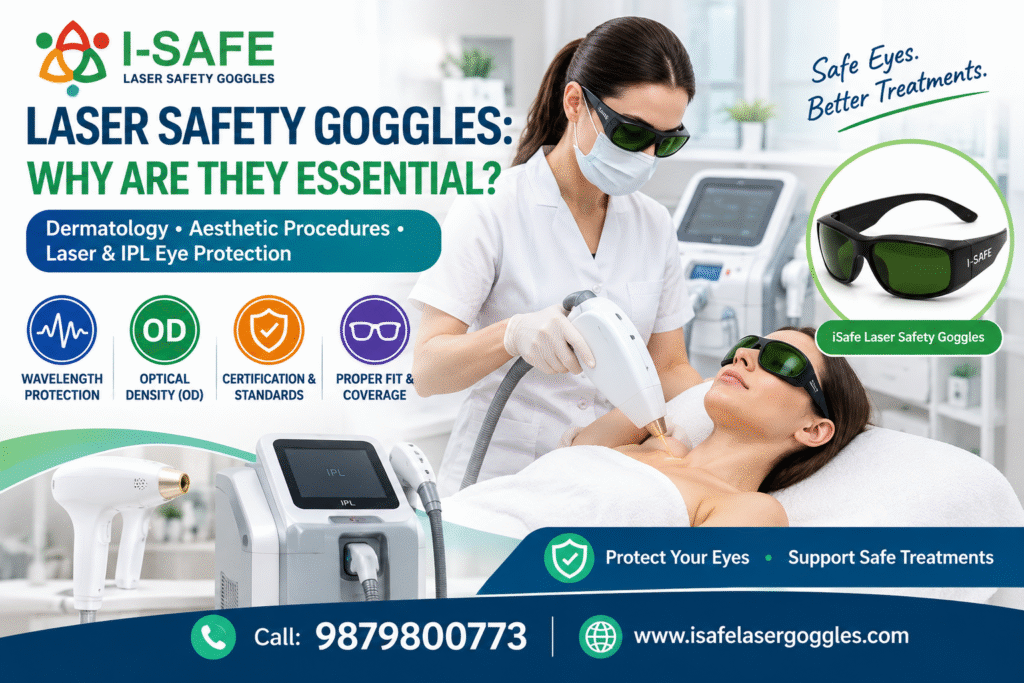
Laser Safety Goggles in Dermatology
Dermatology practices use several types of laser technology. Different devices operate at different wavelengths, and therefore different laser safety goggles may be required.
Common applications include:
Laser Hair Removal
Laser hair removal systems may use technologies such as Alexandrite, Diode, or Nd:YAG lasers. Because these systems operate at different wavelengths, the protective eyewear must be matched to the relevant laser specifications.
Pigmentation Treatments
Certain laser systems are used for pigmentation-related procedures. Appropriate eye protection should be selected according to the device’s wavelength and required optical density.
Vascular Treatments
Laser systems used for vascular applications can also produce significant optical radiation. Appropriate protective eyewear should be selected according to the equipment specifications.
Skin Resurfacing
Laser resurfacing procedures can involve high-energy laser systems. Therefore, appropriate protective measures are particularly important for both operators and other personnel who may be exposed within the treatment area.
Laser Safety Goggles for Aesthetic Procedures
Aesthetic clinics frequently use lasers and IPL systems for cosmetic treatments.
Common applications include:
- Laser hair removal
- Skin rejuvenation
- Pigmentation treatments
- Tattoo removal
- Vascular treatments
- Acne and scar procedures
- Resurfacing procedures
Because each device can have different operating characteristics, one pair of laser safety goggles should not automatically be assumed to protect against every laser or IPL system.
Instead, professionals should check the equipment specifications and select appropriate protective eyewear.
What Should You Check When Choosing Laser Safety Goggles?
Selecting laser safety goggles requires more than checking whether the eyewear looks protective.
Professionals should review several important specifications.
1. Wavelength Protection
The wavelength is one of the most important specifications.
Laser goggles should clearly indicate the wavelength or wavelength range for which they provide protection.
For example, an aesthetic clinic may use different systems operating around wavelengths such as:
- 755 nm
- 810 nm
- 1064 nm
- 10,600 nm
These wavelengths require different protection considerations.
Always compare the laser device’s wavelength with the specifications printed or supplied with the protective eyewear.
2. Optical Density (OD)
Optical Density (OD) describes the attenuation provided by laser protective eyewear at a specified wavelength.
A higher OD generally represents greater attenuation at the specified wavelength. However, the required OD depends on the laser characteristics and the applicable safety requirements.
Therefore, don’t look at the OD value alone.
Check the complete specification:
Wavelength + Optical Density + Application
For example, eyewear may specify protection at a particular wavelength with an OD rating. That information should be compared with the laser manufacturer’s safety requirements.
3. Coverage and Fit
Correctly specified laser safety goggles should also provide appropriate coverage and fit.
Poorly fitting eyewear can create gaps around the eyes and may interfere with effective protection.
Before using protective eyewear, check whether:
- The goggles sit securely.
- The eye area is adequately covered.
- The frame remains stable during movement.
- The eyewear is compatible with other required PPE.
- The practitioner can work comfortably.
- The lenses and frame are free from damage.
Comfort matters too, because protective eyewear is more likely to be used consistently when it fits comfortably and allows practitioners to perform their work effectively.
4. Certification and Standards
Professionals should also review the manufacturer’s compliance and testing documentation.
Depending on the product and market, laser protective eyewear may be designed and tested according to recognized standards such as EN 207 and related requirements.
However, don’t rely solely on a certification logo printed on packaging.
Instead, verify the available product documentation, including:
- Manufacturer information
- Wavelength range
- OD rating
- Applicable standard
- Product identification
- Intended application
- Testing or certification documentation
This information helps professionals make a more informed decision when selecting laser protective eyewear.
What Makes iSafe Laser Safety Goggles a Professional Choice?
iSafe laser safety goggles are developed for professional laser and IPL environments where appropriate eye protection, wavelength coverage, optical density, fit, and usability are important considerations.
When selecting iSafe goggles, professionals can review the relevant product specifications to determine whether a particular model is appropriate for their laser or IPL application.
Key considerations include:
- Wavelength-specific protection
- Optical Density (OD)
- Appropriate eye coverage
- Professional fit
- Product specifications
- Applicable standards and documentation
- Suitability for the intended laser application
The most important point is that iSafe goggles should be selected according to the specifications of the laser or IPL device being used.
Important: No laser safety goggle should be considered universally suitable for every laser. Always verify the product specifications against the laser manufacturer’s requirements and your organization’s applicable laser safety procedures.
Laser Safety Goggles for Laser Hair Removal
Laser hair removal is one of the most common aesthetic laser applications.
However, laser hair removal devices can use different technologies and wavelengths. Consequently, the appropriate laser hair removal goggles must be selected according to the specific device.
For example, a clinic using an Alexandrite laser should not automatically assume that eyewear intended for a different wavelength provides suitable protection.
The selection process should therefore be:
Identify the laser → Check the wavelength → Determine required OD → Select compatible goggles → Check fit and coverage
This simple process can help clinics establish a more consistent approach to laser eye protection.
What About IPL Eye Protection?
IPL systems differ from conventional single-wavelength lasers because they produce a broad spectrum of light.
Therefore, IPL eye protection should be selected specifically for the IPL system and according to the manufacturer’s safety requirements.
Don’t assume that goggles designed for one laser wavelength are automatically suitable for IPL.
Instead, review the IPL device documentation and select protective eyewear designed for the relevant application.
Protecting More Than the Practitioner
Eye protection may be relevant not only to the person operating the laser.
Depending on the procedure and treatment environment, other personnel in the controlled area may also require appropriate protection.
For example:
- Laser operators
- Doctors
- Nurses
- Laser technicians
- Assistants
- Other authorized personnel in the treatment area
Patients may also require appropriate ocular protection when the procedure and equipment require it.
The correct approach depends on the laser system, procedure, treatment area, and applicable safety protocols.
Laser Safety Is More Than Wearing Goggles
Although laser safety goggles are important, goggles alone do not create a complete laser safety program.
A professional laser environment should also consider:
Engineering Controls
Where applicable, equipment safeguards and interlocks should be maintained and used correctly.
Administrative Controls
Clinics should establish appropriate operating procedures and restrict access to controlled treatment areas when necessary.
Training
Personnel should understand the laser system, potential hazards, protective equipment, and emergency procedures.
Signage
Appropriate warning signs can help identify controlled laser areas and communicate potential hazards.
Personal Protective Equipment
When required, appropriate laser protective eyewear should be provided and used correctly.
Together, these measures create a more comprehensive approach to laser safety.
How to Inspect Your Laser Safety Goggles
Before each use, professionals should visually inspect protective eyewear.
Check for:
- Cracks
- Scratches
- Damaged lenses
- Damaged frames
- Loose components
- Poor fit
- Unclear markings
- Missing product information
If the protective eyewear is damaged or its specifications cannot be verified, it should not be relied upon as suitable protective equipment.
Furthermore, goggles should be cleaned, stored, maintained, and replaced according to the manufacturer’s instructions.
Benefits of Using Appropriate Laser Safety Goggles
Using correctly selected laser safety goggles can support a safer and more professional treatment environment.
1. Helps Reduce Eye Exposure
Appropriately specified eyewear attenuates laser radiation at its intended wavelength.
2. Supports Professional Safety Practices
Proper eye protection forms an important part of a broader laser safety program.
3. Supports Practitioner Confidence
Comfortable, properly fitted protective eyewear allows professionals to focus on the procedure while following appropriate safety practices.
4. Supports Consistent Clinic Procedures
Clearly specified eyewear can make it easier for clinics to establish consistent PPE selection and inspection procedures.
Why Choose iSafe Laser Safety Goggles?
At iSafe, the focus is on providing professional laser safety eyewear for medical, dermatology, aesthetic, laser hair removal, and IPL environments.
iSafe laser safety goggles can help professionals evaluate protective eyewear based on important factors such as:
Wavelength | Optical Density | Coverage | Fit | Application | Documentation
Before purchasing, professionals should identify their laser or IPL device and confirm that the selected iSafe product meets the required specifications.
Looking for Professional Laser Eye Protection?
Choose protection based on technical specifications—not appearance alone.
For information about iSafe laser safety goggles, contact:
📞 Call: 9879800773
🌐 Visit: isafelasergoggles.com
Frequently Asked Questions
Are laser safety goggles necessary for dermatology procedures?
When a procedure involves potentially hazardous laser radiation, appropriate protective measures are important. The required eye protection depends on the laser system, procedure, exposure conditions, and applicable safety requirements.
Can I use the same laser safety goggles for every laser?
No. Laser goggles are not universally interchangeable. Always check the wavelength and OD specifications against the laser manufacturer’s requirements.
What is OD in laser safety goggles?
OD stands for Optical Density. It indicates the attenuation provided by protective eyewear at a specified wavelength.
Are laser goggles suitable for IPL?
Not necessarily. IPL produces a broad spectrum of light, so protective eyewear should be selected according to the IPL device manufacturer’s requirements and the eyewear’s specified protection range.
What should I check before buying laser goggles?
Check the wavelength, optical density, applicable standards/documentation, coverage, fit, intended application, and product condition.
Why are iSafe goggles useful for aesthetic clinics?
iSafe laser safety goggles are designed for professional laser and IPL environments. However, the appropriate iSafe model should always be selected according to the specifications of the particular laser or IPL device.
Conclusion
Laser safety goggles are an essential consideration in professional dermatology and aesthetic laser environments. They help reduce exposure to potentially hazardous optical radiation when the eyewear is correctly specified and used as part of an appropriate laser safety program.
Before choosing laser safety goggles, always check the wavelength, Optical Density (OD), applicable standards or documentation, coverage, fit, and intended application.
Most importantly, match the protective eyewear to the specific laser or IPL system rather than selecting goggles based only on appearance or a generic protection claim.
For professional laser and IPL eye protection, explore the available iSafe laser safety goggles and verify the product specifications for your application.
iSafe — Your Vision. Our Protection.
Visit our store: https://isafelasergoggles.com/shop-2/
Follow us on Instagram: https://www.instagram.com/alphasurgicals?igsh=cTdjYWNtaXkxazlr
Visit us for all dermatology instruments: https://alphasurgicals.com/store/