Introduction
Choosing the right laser safety goggles is essential for protecting your eyes during laser procedures, industrial operations, and research activities. However, selecting suitable eyewear involves more than checking its appearance or lens colour. You must understand the information printed on the frame or filter.
Laser Safety Eyewear Markings help identify the wavelengths the filter protects against, its Optical Density (OD), and, where applicable, its laser operating-mode protection classification. These details help you determine whether the eyewear is appropriate for your laser application.
In this guide, we explain how to read laser safety eyewear markings, understand common specifications, and check important details before purchasing. We also explain how to evaluate iSafe Laser Safety Goggles as part of your laser protection requirements.
Why Are Laser Safety Eyewear Markings Important?
Laser radiation can cause serious eye injuries when the exposure exceeds safe limits. The risk depends on factors such as wavelength, laser power, pulse duration, exposure time, and beam characteristics.
Therefore, laser protective eyewear must match the actual laser system. Its markings provide important information that helps users and safety professionals verify the filter’s intended protection.
According to OSHA guidance, laser protective eyewear should clearly identify the optical density and wavelengths for which protection is provided.
1. Check the Wavelength Range
The wavelength marking tells you which part of the light spectrum the eyewear is designed to protect against. Manufacturers usually express wavelength in nanometres (nm).
For example:
- 532 nm – Common green DPSS laser wavelength
- 755 nm – Common Alexandrite laser wavelength
- 800–810 nm – Common diode laser wavelength range
- 1064 nm – Common Nd:YAG laser wavelength
- 10,600 nm – Common CO₂ laser wavelength
These are examples of laser wavelengths, not universal eyewear specifications.
Example of a wavelength marking
Suppose the eyewear label displays:
800–1100 nm
This indicates that the stated protection specification applies within that wavelength range. However, you must also check the corresponding OD or protection level.
A filter that protects against 1064 nm does not automatically protect against 532 nm. Always match the marked range to the actual laser output.
2. Understand the Optical Density (OD) Rating
Optical Density (OD) indicates how strongly a filter attenuates laser radiation at a specified wavelength.
The higher the OD, the lower the transmission at that wavelength.
The formula is:
OD = log₁₀ (1 ÷ T)
Here, T represents the fraction of light transmitted through the filter.
Common OD examples
| OD rating | Approximate transmission | Approximate attenuation |
|---|---|---|
| OD 2 | 1% | 99% |
| OD 3 | 0.1% | 99.9% |
| OD 4 | 0.01% | 99.99% |
| OD 5 | 0.001% | 99.999% |
| OD 6 | 0.0001% | 99.9999% |
For example, a marking of OD 5 at 1064 nm indicates approximately one-hundred-thousandth transmission at that wavelength under the stated measurement conditions.
However, a higher OD does not automatically mean that the eyewear is suitable for every laser. The required OD must be determined from the laser’s exposure conditions and a proper safety assessment.
3. Learn the EN 207 Laser Protection Markings
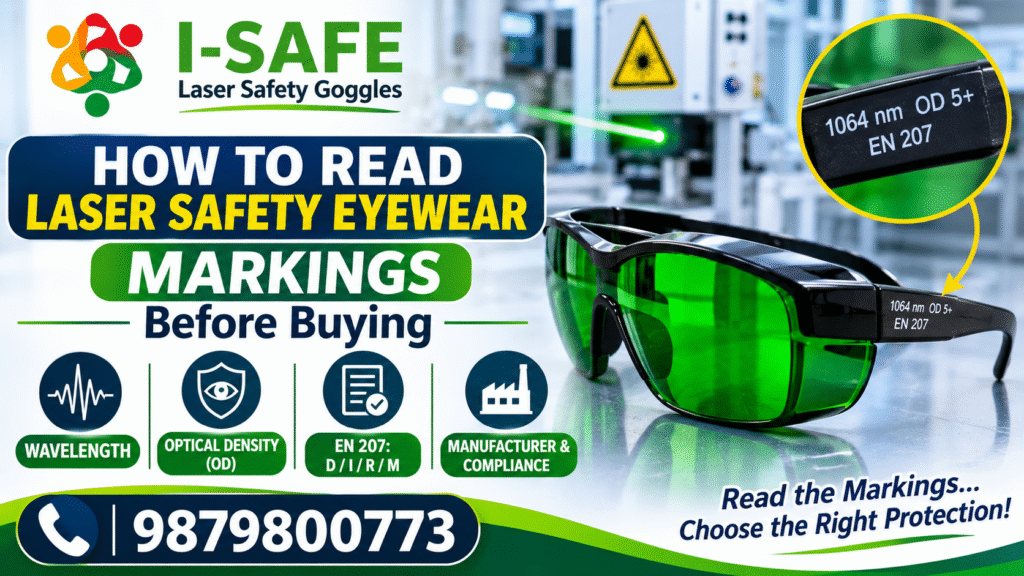
Laser protective eyewear manufactured to the European EN 207 standard uses a marking system that includes wavelength, operating mode, and protection level.
A simplified example is:
1064 D LB5
The marking contains three important parts:
- 1064: The wavelength in nanometres.
- D: The operating-mode test condition.
- LB5: The protection level under the applicable standard.
What do D, I, R, and M mean?
The letters identify different laser operating or pulse-duration test conditions under EN 207.
| Letter | General meaning |
|---|---|
| D | Continuous-wave laser |
| I | Long-pulse laser |
| R | Giant-pulse or shorter pulsed laser |
| M | Mode-locked or ultrashort-pulse laser |
The exact pulse-duration ranges and test requirements are defined by the applicable edition of EN 207. Do not interpret these letters as interchangeable or assume that one rating covers every pulse type.
What does LB mean?
LB identifies the protection scale level used in the EN 207 marking system.
For example, LB5 identifies a specific protection level under the standard’s test criteria. It is not simply another way of writing OD 5.
Therefore, do not compare an LB value and an OD value as if they were identical. Check the relevant standard and the manufacturer’s documentation.
4. Check the Manufacturer’s Identification
Laser safety eyewear may display a manufacturer name, logo, or identification code.
This information helps you trace the product and request technical documentation. Before purchasing, check whether the manufacturer or supplier can provide:
- Product identification and model number
- Wavelength and OD specifications
- Applicable protection standard
Visit our store: https://isafelasergoggles.com/shop-2/
Follow us on Instagram: https://www.instagram.com/alphasurgicals?igsh=cTdjYWNtaXkxazl
Visit us for all dermatology instruments: https://alphasurgicals.com/store/