Choosing the right laser safety goggles for multiple laser machines is essential for protecting the eyes of doctors, dermatologists, aesthetic professionals, technicians, and patients. However, when a clinic uses several laser devices, one important question arises: can the same pair of laser safety goggles provide adequate protection for every machine?
The answer is yes, in some cases—but not always. A single pair of goggles may suit multiple laser systems only when its documented wavelength coverage, optical density (OD), protection performance, and intended use meet the requirements of every relevant device and exposure condition.
At iSafe, we encourage professionals to check product specifications carefully before selecting laser protective eyewear. In this guide, you will learn when one pair may work across multiple laser machines, what specifications to check, and how to evaluate iSafe laser safety goggles for your clinic.
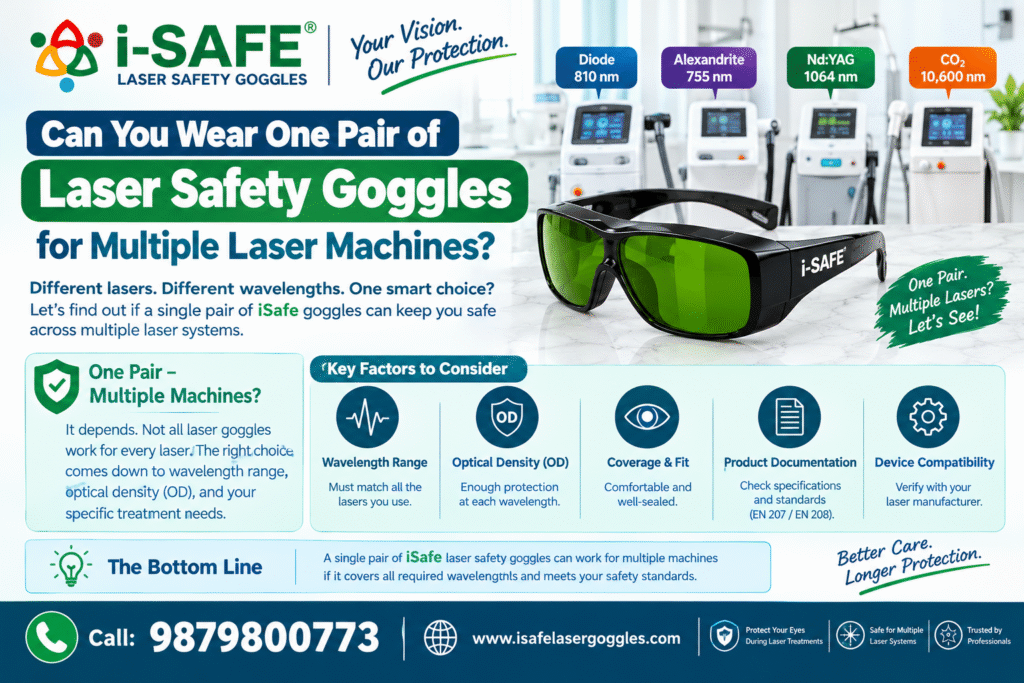
Can You Wear One Pair of Laser Safety Goggles for Multiple Laser Machines?
Yes, one pair of laser safety goggles can sometimes protect against multiple laser machines. However, the goggles must be specifically rated for all the relevant wavelengths and meet the required protection levels for each machine.
For example, a dermatology clinic might use diode, Alexandrite, Nd, and CO₂ laser systems. Although these machines may serve different treatment purposes, they can emit very different wavelengths. So goggles suitable for one machine may not work for another.
Before using the same eyewear across several devices, verify:
- The wavelength or wavelengths covered by the goggles.
- The documented optical density at each relevant wavelength.
- The required protection performance for each laser’s output and exposure conditions.
- The product’s intended application and limitations.
- The manufacturer’s instructions and supporting technical documentation.
Remember: Never assume that a pair of laser safety goggles protects against every machine simply because the lenses look dark or the supplier describes them as multi-wavelength eyewear.
Why Do Different Laser Machines Need Different Eye Protection?
Different laser machines emit radiation at different wavelengths and may operate under different conditions. Consequently, protective eyewear must match the hazards associated with the specific device.
Consider these common examples:
- Alexandrite lasers — around 755 nm: Used in some hair-removal and dermatological applications.
- Diode lasers — around 810 nm: Commonly used for laser hair removal.
- Nd lasers — 1064 nm: Used in a range of medical and aesthetic applications.
- CO₂ lasers — around 10,600 nm: Used for selected resurfacing and surgical procedures.
These wavelengths are examples only. Actual specifications vary by device, so always confirm the exact wavelength or wavelengths in the laser manufacturer’s documentation.
A filter that provides suitable protection at 755 nm does not automatically provide suitable protection at 1064 nm or 10,600 nm. Therefore, check the eyewear’s documented protection across the full range required by your equipment.
When evaluating iSafe laser safety goggles, compare the specifications of the exact model with the requirements of each laser machine you plan to operate.
1. Check the Wavelength Range of Your Laser Safety Goggles
Wavelength compatibility is one of the first things to verify when choosing laser safety goggles for multiple laser machines.
Every laser produces radiation within a particular wavelength range. However, protective filters do not necessarily provide equal protection across all wavelengths.
For example, if your clinic uses both a 755 nm Alexandrite laser and a 1064 nm Nd laser, you must confirm that the selected goggles provide suitable, documented protection at both wavelengths.
Before purchasing iSafe laser safety goggles, check the following:
- The exact wavelength range listed in the product specifications.
- Whether every wavelength emitted by your devices falls within the stated coverage.
- Whether the required protection level applies at each wavelength.
- Whether the manufacturer identifies any limitations on use.
A broad advertised wavelength range alone is not enough. You must also confirm that the eyewear meets the required protection performance for each laser and its exposure conditions.
2. Verify Optical Density (OD) at Every Relevant Wavelength
Optical density, commonly called OD, indicates how strongly a filter attenuates light at a specified wavelength.
However, the OD required for laser safety goggles depends on several factors, including wavelength, output power or pulse energy, operating mode, exposure conditions, and applicable safety limits.
Therefore, a single pair of goggles may cover several wavelengths but still fail to meet the required protection level for one of your machines.
When checking iSafe laser safety goggles, look for documentation showing:
- The OD rating at each relevant wavelength.
- The wavelength range over which each rating applies.
- The relevant protection classification or performance information.
- Any limitations for the intended application.
Do not select goggles based on the highest OD number alone. Optical attenuation is only one part of the assessment; the eyewear must also be suitable for the expected exposure hazard.
If you are unsure about the required OD, consult the laser manufacturer and a qualified laser safety professional.
3. Confirm the Eyewear’s Protection Performance and Intended Use
Wavelength and OD are essential, but they do not tell the whole story.
Laser protective eyewear may need to meet additional performance requirements, depending on the type of laser, its output, and the exposure scenario. For instance, the filter and frame must be appropriate for the anticipated hazard, not merely provide a particular level of attenuation.
When evaluating goggles for several machines, review:
- The product’s intended use.
- Relevant protection classifications and testing documentation.
- The manufacturer’s stated limitations.
- The applicable safety standards and requirements.
- Whether the eyewear is suitable for the actual operating conditions.
Do not assume that every pair of multi-wavelength goggles meets EN 207, EN 208, or another particular standard. Instead, verify any compliance claim against the documentation for the exact model.
iSafe laser safety goggles should be assessed in the same way: review the specific product specifications and confirm that they match your equipment and application before use.
4. Consider Fit, Coverage, and Comfort
Even when the filter specifications are suitable, the eyewear must fit the intended wearer and provide appropriate coverage.
Poorly fitting goggles can shift during a procedure or leave areas around the eyes exposed. Moreover, uncomfortable eyewear may tempt users to adjust or remove it during treatment.
When selecting goggles for your clinic, consider:
- Secure fit: The frame should remain in position during normal working movements.
- Eye-area coverage: The design should provide suitable coverage for the expected exposure conditions.
- Side protection: Consider potential exposure from relevant directions, including hazardous reflections.
- Prescription compatibility: Check whether the goggles can be worn appropriately with corrective eyewear.
- Patient requirements: Confirm the eye-protection method required by the laser manufacturer for each procedure.
In addition, consider whether the same model is appropriate for both the operator and patient. Do not assume that one design meets every user’s requirements.
When comparing iSafe laser safety goggles, review the model’s fit, coverage, and intended wearer alongside its technical specifications.
5. Check Manufacturer Documentation and Applicable Standards
Before using one pair of goggles across multiple laser machines, obtain and review the relevant product documentation.
The documentation should allow you to establish whether the eyewear is suitable for each device. Depending on the product, this may include technical specifications, test reports, conformity information, and care instructions.
Check for:
- Wavelength coverage and corresponding OD ratings.
- Relevant protection performance and classifications.
- Product identification and required markings.
- Intended use and stated limitations.
- Applicable standards and supporting documentation.
- Inspection, cleaning, storage, and replacement instructions.
For additional background, consult the OSHA Technical Manual on laser safety, which discusses laser hazards and protective eyewear selection.
Remember that a marketing statement such as “universal laser goggles” does not establish suitability for every device. Always verify the exact model’s specifications and compliance claims.
6. What About IPL and Other Light-Based Machines?
Clinics often use a combination of laser and intense pulsed light (IPL) systems. However, IPL requires separate consideration because it produces broad-spectrum light rather than radiation at one single laser wavelength.
As a result, you should not assume that goggles suitable for a particular laser will automatically protect against an IPL device.
Before sharing eyewear between laser and IPL systems:
- Review the IPL manufacturer’s eye-protection instructions.
- Confirm that the eyewear is suitable for the device’s output and exposure conditions.
- Check the relevant technical specifications and documentation.
- Follow the applicable risk assessment and safety procedures.
The same principle applies when adding a new machine to your clinic. Reassess the eyewear before using it with the new device rather than relying on its previous approval for another system.
7. How to Choose iSafe Laser Safety Goggles for Multiple Machines
When evaluating iSafe laser safety goggles, begin by listing every laser machine you use and the protection requirements for each one.
Then compare those requirements against the specifications of the exact iSafe model you are considering.
Use this checklist:
- List your machines: Record the make, model, and relevant wavelength information.
- Verify wavelength coverage: Confirm that the goggles cover every relevant wavelength.
- Check OD ratings: Review the documented OD at each wavelength.
- Confirm protection performance: Verify suitability for the expected output and exposure conditions.
- Review standards and documentation: Check any applicable compliance claims for the specific model.
- Assess fit and coverage: Ensure that the eyewear suits the intended wearer and procedure.
- Follow manufacturer instructions: Confirm the permitted applications and maintenance requirements.
If any important specification is missing or unclear, request clarification before using the goggles.
For product information, visit www.isafelasergoggles.com or call 9879800773. When enquiring about iSafe laser safety goggles, share the details of your laser machines so the relevant product specifications can be reviewed.
Common Mistakes to Avoid
When choosing laser safety goggles for multiple laser machines, avoid these common mistakes:
- Assuming one pair protects against every laser: Multi-wavelength suitability must be verified.
- Checking wavelength but ignoring OD: Both wavelength compatibility and adequate protection are important.
- Choosing by lens colour: Appearance does not prove laser protection.
- Relying on a general product claim: Check the specifications of the exact model.
- Ignoring IPL requirements: IPL devices require their own assessment.
- Using the same goggles for every person without checking fit: Operator and patient requirements may differ.
- Failing to reassess new equipment: A new laser machine may require different eyewear.
By checking these details before use, your clinic can make a more informed decision about whether a single pair is suitable for multiple systems.
Frequently Asked Questions
Can one pair of laser safety goggles protect against different wavelengths?
Yes, some goggles are designed to protect against multiple wavelengths. However, you must verify the documented wavelength coverage, OD, and required protection performance for every relevant laser.
Can I use the same laser goggles for a diode and Nd laser?
Possibly, but not automatically. Check the exact wavelengths and operating requirements of both devices, then compare them with the eyewear’s documented specifications. If the goggles do not meet the requirements of either machine, do not use them for that application.
Are multi-wavelength laser safety goggles always better?
No. Multi-wavelength goggles can be convenient when their documented specifications meet the requirements of the intended machines. However, the number of wavelengths covered does not by itself establish whether the eyewear provides suitable protection.
Can I use laser safety goggles for both laser and IPL machines?
Do not assume so. IPL produces broad-spectrum light and requires a separate assessment based on the device manufacturer’s instructions and applicable safety requirements.
How do I know if iSafe laser safety goggles are suitable for my machines?
Check the exact iSafe model’s wavelength coverage, OD ratings, protection performance, intended use, and supporting documentation. Compare these specifications with the requirements of every machine you plan to use.
Should every clinic keep separate goggles for each laser machine?
Not necessarily. A clinic may use one pair for several machines if the eyewear is documented as suitable for every relevant application and the required protection is maintained. If suitability cannot be confirmed, use appropriate eyewear specified for each application.
Conclusion: Choose Laser Safety Goggles Based on Specifications
So, can you wear one pair of laser safety goggles for multiple laser machines? Yes, but only when the goggles are documented as suitable for every relevant wavelength, protection level, and exposure condition.
Do not rely on lens colour, a high OD rating alone, or a general multi-wavelength claim. Instead, check wavelength compatibility, OD, protection performance, fit, intended use, and manufacturer documentation before sharing eyewear between devices.
When evaluating iSafe laser safety goggles, compare the exact model’s specifications with your clinic’s equipment requirements. This helps you make an informed choice about suitable eye protection for your laser applications.
Need help evaluating laser safety goggles for your clinic?
Visit our store: https://isafelasergoggles.com/shop-2/
Follow us on Instagram: https://www.instagram.com/alphasurgicals?igsh=cTdjYWNtaXkxazl
Visit us for all dermatology instruments: https://alphasurgicals.com/store/