Writing
Laser Safety Standards: Understanding EN 207, EN 208 and Laser Protection
Laser safety is an essential part of protecting the eyes of professionals, technicians, and patients during laser procedures. However, choosing suitable laser safety goggles involves more than checking the lens colour or optical density (OD). You must also understand the relevant safety standards and determine whether the eyewear is suitable for your specific laser application.
Two European standards often discussed in laser protective eyewear are EN 207 and EN 208. Although both address laser eye protection, they have different intended applications. Therefore, understanding their differences can help you ask the right questions when evaluating protective eyewear.
At iSafe, we encourage customers to review the technical specifications and documentation for the exact eyewear model they intend to use. In this guide, we explain EN 207 and EN 208 laser safety standards, their key differences, important eyewear markings, and the factors to check before selecting iSafe laser safety goggles.
What Are EN 207 and EN 208 Laser Safety Standards?
EN 207 and EN 208 are European standards associated with specific types of laser protective eyewear.
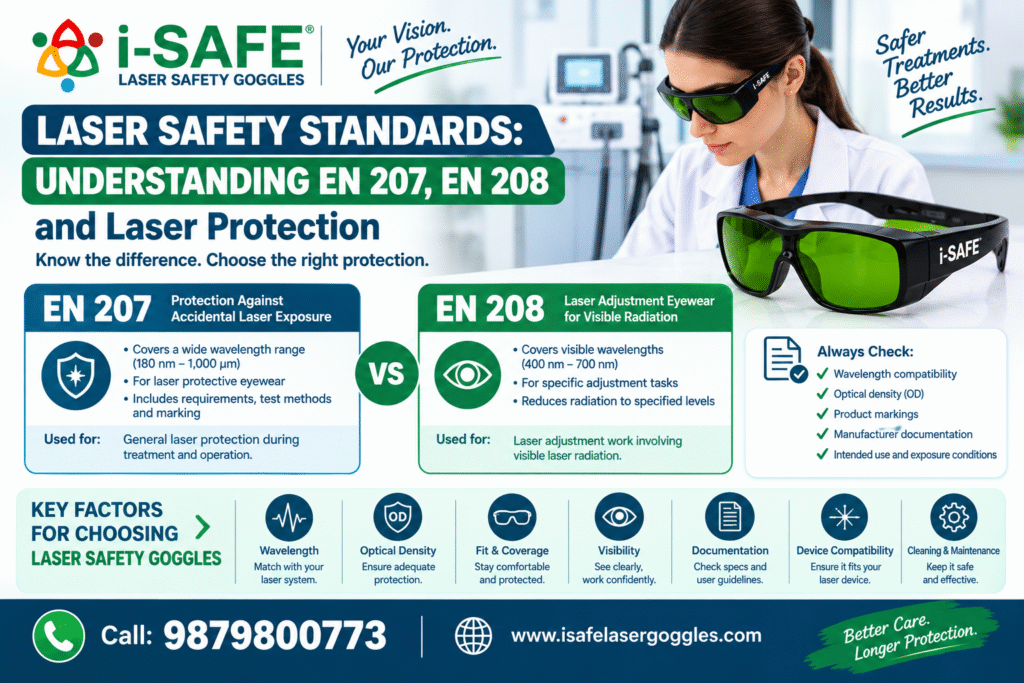
EN 207 addresses laser filters and eye protectors intended to protect against accidental exposure to laser radiation. It includes requirements, test methods, and marking provisions for the eyewear within its scope. The published EN 207:2017 standard covers a stated spectral range of 180 nm to 1,000 μm and calls for a risk assessment before selecting protection.
EN 208, by contrast, addresses laser adjustment filters and eye protectors for certain adjustment tasks involving visible laser radiation. The EN 208:2010 standard describes its scope as visible wavelengths from 400 nm to 700 nm, with the filters reducing the radiation to specified levels for the adjustment application.
Consequently, these standards should not be treated as interchangeable. The appropriate choice depends on the task, the laser system, the exposure hazard, and the applicable requirements.
Standards can also be revised or replaced by newer standards in particular jurisdictions. Always check the applicable edition and local requirements before purchasing or specifying eyewear.
1. Understanding EN 207: Laser Protective Eyewear
EN 207 is associated with eye protectors designed to protect against accidental exposure to laser radiation. It specifies requirements, testing methods, and marking for eyewear within its scope.
When evaluating eyewear intended for a laser application, consider the following:
- Wavelength range: Confirm that the eyewear covers the wavelength or wavelengths emitted by your laser.
- Protection level: Verify that the eyewear meets the requirements for the expected exposure conditions.
- Damage resistance: Review the relevant performance classification and documentation for the intended hazard.
- Markings: Check that the product markings identify the protection characteristics required by the applicable standard.
- Intended use: Confirm that the eyewear is suitable for the actual task and laser system.
Importantly, optical density alone does not establish whether eyewear can withstand a particular laser exposure. The filter and eyewear must meet the relevant protection requirements for the anticipated hazard.
For example, a clinic using a dermatological laser should not select eyewear simply because its advertised OD appears high. Instead, the clinic should confirm the device’s wavelength, operating parameters, and eye-protection requirements before selecting an appropriate product.
When reviewing iSafe laser safety goggles, ask for the technical specifications and conformity documentation for the exact model. Do not assume EN 207 compliance unless the supplied documentation substantiates that claim.
2. Understanding EN 208: Laser Adjustment Eyewear
EN 208 addresses a more specific application: eye protectors used during certain laser adjustment tasks involving visible laser radiation.
The EN 208:2010 scope covers visible wavelengths from 400 nm to 700 nm. It describes filters designed to reduce the radiation to specified levels for adjustment work. However, this does not mean that EN 208 eyewear is suitable for every laser operation.
In particular, adjustment eyewear should not automatically be treated as a substitute for eyewear intended to protect against accidental laser exposure under EN 207.
Before considering EN 208 eyewear, verify:
- The task involves an application covered by the standard.
- The laser wavelength falls within the relevant scope.
- The laser output and exposure conditions meet the eyewear’s limitations.
- The manufacturer provides the necessary markings and documentation.
- A suitable risk assessment supports the selection.
For example, a technician carrying out an appropriate visible-laser adjustment task may have different eyewear requirements from a clinician performing a laser treatment. Therefore, the correct choice must follow the task-specific safety assessment and equipment instructions.
If your work involves medical or aesthetic laser procedures, consult the laser manufacturer and a qualified laser safety professional before selecting adjustment eyewear.
3. EN 207 vs EN 208: What Is the Difference?
The main difference is their intended application.
| Feature | EN 207 | EN 208 |
|---|---|---|
| Primary purpose | Protection against accidental laser exposure | Protection during specified laser adjustment tasks |
| Scope | Laser protective filters and eye protectors within the standard’s scope | Adjustment filters and eye protectors for visible laser radiation within its scope |
| Wavelength scope | Published EN 207:2017 describes 180 nm to 1,000 μm | EN 208:2010 describes 400–700 nm |
| Selection considerations | Hazard assessment, wavelength, exposure, and relevant protection performance | Adjustment task, visible wavelength, output limitations, and risk assessment |
| Can they be used interchangeably? | No, not automatically | No, not automatically |
The table summarises the cited editions; it does not establish which edition or national adoption applies in every country today.
Therefore, do not select eyewear solely by the standard number printed in a brochure. Confirm the precise model, its markings, the applicable edition, and whether it is suitable for your task.
4. Why Wavelength and Optical Density Matter
Understanding EN 207 and EN 208 laser safety standards is only part of choosing suitable eyewear. You must also verify that its technical characteristics match the laser.
Wavelength compatibility
Laser systems emit radiation at particular wavelengths, and a filter that protects at one wavelength may not provide adequate protection at another.
For example, commonly used laser systems may operate at wavelengths such as:
- 755 nm for certain Alexandrite lasers.
- Approximately 810 nm for some diode lasers.
- 1064 nm for many Nd lasers.
- 10,600 nm for CO₂ lasers.
These are examples only. Always confirm the wavelength or wavelengths of the specific device you use.
Optical density (OD)
Optical density describes how strongly a filter attenuates radiation at a specified wavelength. However, the required OD depends on the laser’s output and exposure conditions, not simply on the treatment name.
Furthermore, an OD rating does not by itself prove that an eyewear filter can withstand a direct beam exposure. Other relevant performance characteristics and the manufacturer’s limitations must also be considered.
When evaluating iSafe laser safety goggles, check the stated wavelength coverage, OD at the relevant wavelengths, applicable protection classification, and supporting product documentation.
For further background, see the OSHA Technical Manual on laser safety and hazard assessment.
5. How to Read Laser Safety Eyewear Markings
Markings help users identify the protection characteristics of laser eyewear. Nevertheless, the exact marking format depends on the applicable standard and product.
When inspecting laser safety goggles, look for the information required by the relevant standard, which may include:
- Manufacturer or product identification.
- Wavelength or wavelength range.
- Optical density or applicable protection rating.
- Relevant scale number or performance classification, where applicable.
- Visible light transmission information, where required.
- Standard reference and supporting conformity information.
If the markings are missing, unclear, or inconsistent with the supplied documentation, do not guess what they mean. Ask the supplier for clarification before using the eyewear.
Likewise, do not rely on lens colour, a product photograph, or a general marketing statement as proof of compliance.
6. What Should Dermatology and Aesthetic Clinics Consider?
Dermatology clinics and aesthetic centres may use several types of laser devices. As a result, one eyewear model may not be suitable for every procedure or device.
Before choosing eyewear, identify:
- The exact make and model of the laser.
- Its wavelength or wavelengths.
- Relevant operating parameters and exposure conditions.
- The eye-protection requirements for the operator and patient.
- The applicable standard and product documentation.
- Fit, coverage, visibility, cleaning, and maintenance requirements.
IPL devices require separate consideration. Intense pulsed light is broad-spectrum light rather than a single laser wavelength. Therefore, follow the IPL manufacturer’s instructions and evaluate protection according to the device’s requirements instead of assuming that a laser eyewear standard automatically establishes suitability for IPL.
In addition, patient protection may have specific requirements depending on the procedure and treatment location. Follow the medical device manufacturer’s instructions and an appropriate risk assessment.
7. Choosing iSafe Laser Safety Goggles
When evaluating iSafe laser safety goggles, start with the laser’s documented protection requirements and compare them with the specifications of the exact iSafe model.
Use the following checklist:
- Wavelength: Does the documented range cover the laser you will use?
- OD and protection rating: Are the required values and performance characteristics documented?
- Standard compliance: Does the product documentation substantiate any EN 207, EN 208, or other conformity claim?
- Intended application: Is the eyewear suitable for the task and exposure conditions?
- Fit and coverage: Does the design suit the intended wearer and working position?
- Maintenance: Are cleaning, inspection, storage, and replacement instructions available?
Do not assume that every iSafe model complies with EN 207 or EN 208. Compliance and suitability must be verified for the particular product, applicable market, and intended use.
For product information, visit isafelasergoggles.com or contact 9879800773. Share your laser device details when enquiring so the relevant product specifications can be reviewed.
8. Common Mistakes to Avoid
Even experienced professionals can overlook important details when choosing laser protective eyewear. Avoid these common mistakes:
- Treating EN 207 and EN 208 as equivalent: Their intended applications differ.
- Choosing by OD alone: OD does not establish every aspect of laser protection.
- Ignoring wavelength compatibility: A filter may not protect against all wavelengths.
- Assuming a standard claim applies to every model: Check the actual product documentation.
- Using adjustment eyewear for an unrelated task: Confirm that the intended use falls within the product’s limitations.
- Ignoring fit and coverage: Properly rated filters must be used in suitable eyewear.
- Overlooking inspections: Damaged or questionable eyewear should be removed from service according to the manufacturer’s guidance.
Instead, document your requirements and verify the product information before putting the eyewear into service.
Frequently Asked Questions
What is EN 207 in laser safety?
EN 207 is a European standard for filters and eye protectors intended to protect against accidental exposure to laser radiation within its scope. It specifies relevant requirements, test methods, and markings.
What is EN 208 used for?
EN 208 addresses eye protectors for certain laser adjustment tasks involving visible laser radiation. It should not automatically be treated as a replacement for eyewear intended for protection against accidental exposure.
What is the difference between EN 207 and EN 208?
EN 207 addresses protection against accidental laser exposure, while EN 208 addresses specific adjustment tasks involving visible laser radiation. The correct eyewear depends on the application, wavelength, exposure conditions, and applicable requirements.
Does a high OD rating guarantee laser safety?
No. OD describes attenuation at a specified wavelength, but the required protection also depends on the laser’s output, exposure conditions, and the eyewear’s other performance characteristics. Select eyewear using a suitable risk assessment and the manufacturer’s documentation.
Are iSafe laser safety goggles EN 207 or EN 208 certified?
This depends on the specific product and its verified documentation. Check the exact iSafe model’s technical specifications and conformity documents before claiming or relying on compliance with either standard.
Can EN 208 goggles be used for laser hair removal?
Do not assume so. EN 208 is intended for specified laser adjustment tasks involving visible laser radiation. For laser hair removal, select eyewear based on the actual laser device, wavelength, exposure hazard, and manufacturer requirements.
Conclusion
Understanding EN 207 and EN 208 laser safety standards helps professionals distinguish between eyewear intended for accidental laser exposure and eyewear designed for specified adjustment tasks. However, the standard name alone does not determine whether a product is suitable for a particular laser.
Always verify wavelength compatibility, OD, relevant protection performance, product markings, intended use, and supporting documentation before selecting eyewear.
When evaluating iSafe laser safety goggles, review the exact model’s specifications against your device’s requirements. A documented, task-appropriate selection process is essential for making informed decisions about laser eye protection.
Need help evaluating laser safety goggles?
Visit our store: https://isafelasergoggles.com/shop-2/
Follow us on Instagram: https://www.instagram.com/alphasurgicals?igsh=cTdjYWNtaXkxazl
Visit us for all dermatology instruments: https://alphasurgicals.com/store/