Laser hair removal and Intense Pulsed Light (IPL) treatments have become popular in dermatology, aesthetic clinics, and cosmetic practices. These technologies use concentrated or high-intensity light to target hair follicles and skin concerns.
However, the same light energy that makes these treatments effective can also create an eye-safety risk.
So, are laser safety goggles really necessary during laser hair removal and IPL treatments?
Yes, appropriate eye protection is an important part of a laser and light-based treatment safety program. The exact protection required depends on the device, wavelength, output, treatment setup, and applicable safety procedures.
OSHA recommends laser protective eyewear that protects against the specific wavelength being used and provides sufficient optical density for the laser’s energy level.
Therefore, clinics should never select protective eyewear simply because it is labelled “laser goggles” or because the lens looks dark.
Why Is Eye Protection Important During Hair Removal?
Laser hair removal systems can deliver concentrated optical energy to the treatment area.
During a procedure, direct or reflected radiation may potentially be encountered by the operator and other people in the treatment area if appropriate safety controls are not followed.
The eyes are particularly sensitive to intense optical radiation. In some cases, eye exposure can occur without immediate pain or obvious warning.
Therefore, proper eye protection should be treated as an essential part of laser safety—not as an optional accessory.
OSHA notes that direct or reflected laser beams can cause serious eye injury and recommends appropriate laser protective eyewear for applicable laser operations.
Are Laser Safety Goggles Necessary for Laser Hair Removal?
In many professional laser hair-removal environments, appropriate laser protective eyewear is required as part of the safety controls.
However, the correct eyewear depends on the actual laser system.
For example, different hair-removal systems can operate at different wavelengths, including:
- Alexandrite: commonly 755 nm
- Diode: commonly around 808 nm, although devices vary
- Nd:YAG: commonly 1064 nm
Each wavelength interacts differently with protective filters.
As a result, laser safety goggles for hair removal must be selected according to the specific wavelength and operating conditions of the device.
It is specifically stated by OSHA that the wavelengths for which protective laser goggles are intended, along with their optical density and visible light transmission, should be identified.
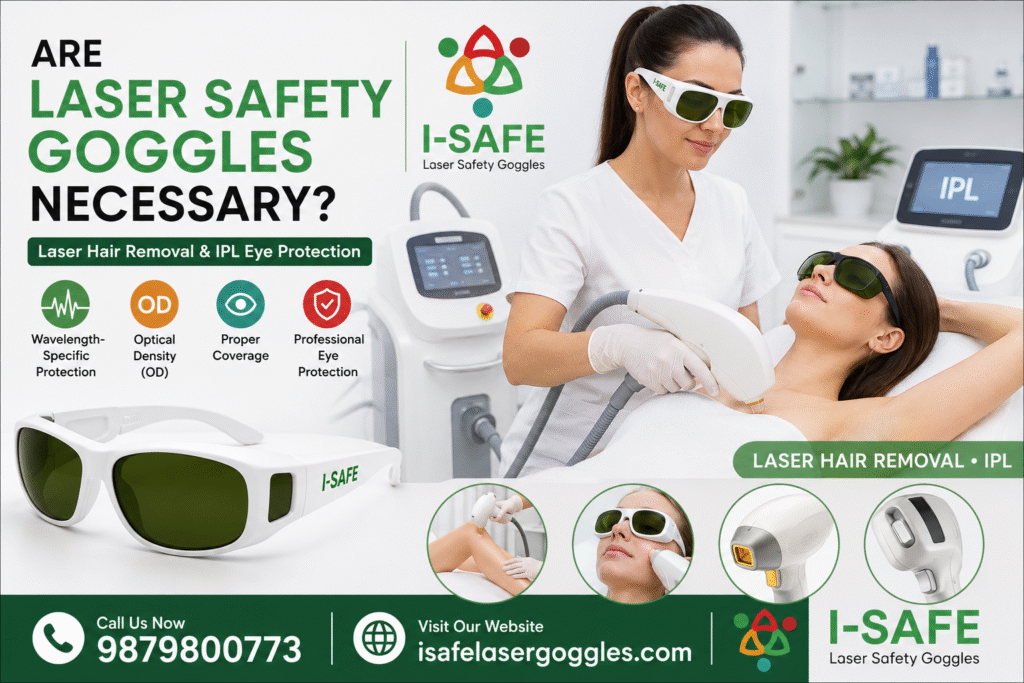
What About IPL Treatments?
IPL is different from a conventional laser.
Instead of producing one primary laser wavelength, IPL systems emit broadband light across a range of wavelengths.
Therefore, IPL eye protection should be selected according to the specific IPL device, its output characteristics, and the manufacturer’s safety requirements.
This distinction is important because laser eyewear designed for one narrow wavelength should not automatically be assumed to provide suitable protection for an IPL system.
Laser Safety Goggles vs IPL Protective Eyewear
Although people often use the terms interchangeably, laser and IPL protection should be evaluated based on the actual light source.
| Treatment Technology | Light Characteristics | Eye Protection Consideration |
|---|---|---|
| Alexandrite | Commonly 755 nm | Wavelength-specific protection |
| Diode | Device-specific | Verify exact wavelength |
| Nd:YAG | Commonly 1064 nm | Wavelength + OD |
| IPL | Broadband light | Protection suited to the IPL system |
Therefore, always check the manufacturer’s specifications before choosing protective eyewear.
What Makes Laser Safety Goggles Effective?
Not every pair of protective goggles provides the same level of protection.
When choosing laser safety goggles for hair removal, professionals should consider several technical factors.
1. Wavelength
The first step is to identify the exact wavelength produced by the laser.
For example, 755 nm, 808 nm, and 1064 nm require different wavelength-specific considerations.
Therefore, wavelength should always be checked first.
2. Optical Density
Optical Density, or OD, indicates the attenuation provided by the filter at a specified wavelength.
A suitable OD helps reduce the amount of laser radiation transmitted through the filter.
However, the required OD depends on the laser’s operating conditions.
Consequently, professionals should not choose eyewear simply because it has a high OD number.
The wavelength and exposure conditions must also be considered.
3. Laser Power and Energy
Laser power, pulse energy, pulse duration, and repetition rate can affect the required protection.
For this reason, the laser’s technical specifications should be reviewed before selecting eyewear.
4. Coverage
Protective eyewear should provide appropriate coverage for the intended procedure.
The frame should fit securely and minimize potential exposure around the eyes.
5. Visibility
Professionals need to see the treatment area clearly.
Therefore, suitable visible light transmission is also an important consideration.
OSHA guidance specifically includes visible light transmission among the information that should be identified on laser protective eyewear.
Why Dark Glasses Do Not Always Mean Better Protection
A common misconception is that darker lenses automatically provide better laser protection.
That is not necessarily true.
The visible appearance of a lens does not tell you whether it provides adequate attenuation at the wavelength of your laser.
Instead, check the technical specifications.
Look for:
- Protected wavelength
- Optical Density (OD)
- Visible Light Transmission (VLT)
- Manufacturer specifications
- Applicable safety markings
- Intended laser application
Therefore, never select laser eyewear based only on lens color.
Can One Pair of Goggles Be Used for Every Laser?
Not necessarily.
Different laser systems can operate at different wavelengths. A filter that protects one wavelength may not provide the same protection at another.
For example, goggles suitable for a 1064 nm Nd: YAG application should not automatically be considered suitable for a 755 nm Alexandrite system.
However, some multi-wavelength protective eyewear is specifically designed to cover several wavelengths.
For example, the iSafe I-TRI-SAFE is designed for compatible applications involving:
- 755 nm
- 808 nm
- 1064 nm
This can make it suitable for compatible multi-wavelength systems.
Nevertheless, professionals should always verify the product specifications against their exact laser device before use.
iSafe Laser Safety Goggles for Hair Removal
iSafe provides application-specific protective eyewear for professional laser and light-based procedures.
The iSafe range includes protective options for technologies such as:
- Alexandrite
- Diode
- Nd:YAG
- CO2
- IPL
- Pico
- Ruby
- Er:YAG
- Multi-wavelength systems
For hair-removal applications, selecting the appropriate iSafe product should begin with the laser’s exact wavelength and operating specifications.
iSafe I-TRI-SAFE
The iSafe I-TRI-SAFE protects for compatible:
755 nm + 808 nm + 1064 nm
Therefore, it can be an option for compatible Alexandrite, Diode, and Nd: YAG multi-wavelength applications.
iSafe I-DIODE-SAFE
The iSafe I-DIODE-SAFE is available for compatible Diode laser applications.
Because Diode systems can operate at different wavelengths, professionals should verify compatibility with their particular device.
iSafe I-IPL-SAFE
The iSafe I-IPL-SAFE is available for compatible IPL applications.
Importantly, IPL systems produce broadband light, so professionals should confirm that the eyewear is suitable for their specific IPL system.
Explore iSafe Laser Safety Goggles
What About Patient Eye Protection?
Eye protection is not only a consideration for the practitioner.
Patients may also require appropriate eye protection, depending on the treatment area, device, wavelength, treatment protocol, and manufacturer’s instructions.
For example, treatment around the face requires careful consideration because the eyes may be closer to the treatment area.
Therefore, patient protection should be assessed separately from practitioner eyewear.
The appropriate patient protection may vary by procedure. Clinics should follow the device manufacturer’s instructions and their established laser safety protocols.
How to Choose Laser Safety Goggles for Hair Removal
Follow these steps before purchasing protective eyewear.
Step 1: Identify the Device
Record the manufacturer, model, and type of laser or IPL system.
Step 2: Confirm the Wavelength
Check the exact wavelength or wavelength range.
Step 3: Determine the Required OD
Review the required optical density based on the laser’s output and exposure conditions.
Step 4: Check Pulse Characteristics
For pulsed systems, consider pulse duration, pulse energy, and repetition rate.
Step 5: Check the Eyewear Specifications
Confirm the wavelength range and OD provided by the eyewear.
Step 6: Check Fit and Coverage
Make sure the goggles fit properly and provide appropriate coverage.
Step 7: Follow Manufacturer Guidance
Finally, compare the eyewear specifications with the laser or IPL manufacturer’s safety recommendations.
As a result, professionals can select protective eyewear based on actual safety requirements rather than appearance.
Common Mistakes During Laser Hair Removal
Using Generic Safety Glasses
Ordinary safety glasses should not be assumed to provide protection against laser radiation.
Instead, use protective eyewear specifically rated for the applicable laser or light source.
Choosing Goggles Only by Color
Dark lenses do not automatically provide the required laser protection.
Ignoring Wavelength
A filter must be appropriate for the wavelength being used.
Ignoring Optical Density
Wavelength and OD should be evaluated together.
Using the Same Goggles for Every Device
Different systems can produce different wavelengths.
Therefore, always verify compatibility before switching eyewear between devices.
Forgetting Patient Protection
Practitioner protection does not automatically address patient eye protection.
Why Choose iSafe?
iSafe focuses on application-specific laser safety eyewear for professional environments.
Its range includes products designed for different wavelengths and laser technologies.
This approach allows professionals to evaluate protective eyewear based on their actual equipment.
Furthermore, iSafe offers options for single- and multi-wavelength applications, helping clinics find suitable solutions for different treatment platforms.
However, product compatibility should always be verified before use.
Visit iSafe Laser Safety Goggles
Frequently Asked Questions
Are laser safety goggles necessary for laser hair removal?
Appropriate eye protection is an important part of laser safety when there is a potential for hazardous eye exposure. The required eyewear depends on the laser system, wavelength, output, treatment setup, and applicable safety procedures.
Are goggles required for IPL?
IPL produces broadband light, so suitable protective eyewear should be selected according to the specific IPL system and its safety requirements.
Can I use regular sunglasses during laser hair removal?
No. Regular sunglasses are not a substitute for laser protective eyewear because they are not necessarily designed or rated for the specific wavelength and optical density required.
What should I check before buying laser goggles?
Check the wavelength, optical density, laser power, pulse characteristics, visible light transmission, coverage, fit, and manufacturer specifications.
Are iSafe goggles suitable for all lasers?
No single product should automatically be considered suitable for every laser. iSafe offers different products for different applications, so always verify the exact product specifications against your laser system.
Does higher OD always mean better protection?
Not necessarily. The appropriate OD depends on the wavelength and laser operating conditions. A suitable filter must match the actual application.
Final Thoughts
So, are laser safety goggles really necessary during laser hair removal and IPL treatments?
In professional treatment environments, appropriate eye protection is a critical part of a comprehensive laser safety program when hazardous exposure is possible.
However, choosing the right eyewear requires more than selecting a dark pair of goggles.
Professionals should consider:
- Wavelength
- Optical Density
- Laser power
- Pulse characteristics
- Treatment conditions
- Coverage
- Visibility
- Fit
- Manufacturer recommendations
Therefore, laser safety goggles for hair removal should always be selected according to the actual laser system and its operating conditions.
With application-specific options for laser and IPL technologies, iSafe Laser Safety Goggles can help dermatology and aesthetic professionals evaluate suitable eye-protection solutions for their equipment.
Protect your vision. Choose wavelength-appropriate protection.
Visit our store: https://isafelasergoggles.com/shop-2/
Follow us on Instagram: https://www.instagram.com/alphasurgicals?igsh=cTdjYWNtaXkxazlr
Visit us for all dermatology instruments: https://alphasurgicals.com/store/