Introduction
Choosing the right laser goggles for dermatology clinics is not a purchasing decision—it is a clinical safety obligation. Every dermatology and aesthetic practice today relies on high-powered lasers for hair removal, pigmentation, vascular lesions, resurfacing, and scar revision. While these technologies deliver transformative results, they also expose practitioners, assistants, and patients to invisible but potentially irreversible ocular hazardt At end it matters is Choosing the Right Laser Goggles for Dermatology Clinics.
Laser-induced eye injuries remain one of the most underreported yet preventable risks in dermatology clinics. Retinal burns, corneal damage, and cumulative photochemical injury can occur within milliseconds of accidental exposure. Unfortunately, many clinics still rely on generic, uncertified, or wavelength-mismatched eyewear, assuming “any laser goggles will do.”
That assumption can cost vision, credibility, and compliance.
This educational safety guide explains how to evaluate, select, and implement medical-grade laser eye protection—so your clinic remains safe, compliant, and professionally trusted. Most importantly, it establishes why I-SAFE Laser Goggles have become the benchmark for laser protection for dermatology worldwide.
About I-SAFE Laser Goggles
I-SAFE Laser Goggles is a Germany-engineered laser eye protection brand built on uncompromising safety standards and clinical precision. Designed with German optical engineering expertise and managed through globally coordinated operations from India, I-SAFE delivers certified laser safety solutions to clinics, hospitals, research labs, and medical institutions worldwide.
What defines I-SAFE is not just protection—but verified protection. Each goggle is engineered to provide certified shielding against harmful laser radiation across specific wavelengths commonly used in dermatology and aesthetic medicine. This ensures predictable, compliant, and reproducible safety outcomes for both operators and patients.
Key pillars of the I-SAFE philosophy include:
- German engineering precision for optical accuracy and reliability
- ISO-certified safety eyewear that meets international compliance standards
- Advanced optical filtration technology for wavelength-specific protection
- Ergonomic, long-wear comfort designed for extended clinical procedures
- Global accessibility without compromising safety, supported by Indian operations
From solo dermatology practices to high-volume aesthetic centers, I-SAFE Laser Goggles are trusted as precision medical safety equipment—where vision protection is non-negotiable.
Why Choosing the Right Laser Goggles for Dermatology Clinics Matters ?
Laser systems used in dermatology emit concentrated energy that can permanently damage ocular tissues. Even scattered or reflected beams can cause injury.
Common laser-related eye risks in clinics
- Retinal burns from near-infrared lasers (Nd:YAG, Diode)
- Corneal injury from CO₂ and Er:YAG lasers
- Photochemical damage from IPL and broadband systems
- Cumulative exposure during repeated procedures
Choosing the right laser goggles for dermatology clinics ensures these risks are effectively mitigated—without compromising clinical visibility or procedural accuracy.
Understand Laser Wavelengths Before Selecting Goggles
Laser goggles are not universal. Protection is wavelength-specific.
Dermatology clinics typically use:
- 532 nm (KTP lasers)
- 755 nm (Alexandrite)
- 808–810 nm (Diode)
- 1064 nm (Nd:YAG)
- 10,600 nm (CO₂ lasers)
- IPL (500–1200 nm spectrum)
Medical laser eye protection must clearly specify Optical Density (OD) values for each wavelength used. Using mismatched goggles creates a false sense of safety.
I-SAFE laser goggles products are clearly labeled with wavelength ranges and OD ratings—eliminating guesswork and risk.
Optical Density (OD) – The Core of Laser Protection
Optical Density determines how much laser energy is blocked before reaching the eye.
- OD 4 blocks 99.99% of laser energy
- OD 6 blocks 99.9999%
- Higher-power lasers require higher OD values
Choosing the right laser goggles for dermatology clinics means matching OD levels to the maximum output power of your laser devices—not just the wavelength.
I-SAFE designs its goggles to exceed minimum OD requirements, providing a higher margin of safety during real-world clinical use.
Certifications Are Not Optional—They Are Mandatory
Uncertified eyewear is one of the biggest safety failures in dermatology clinics.
Always look for:
- ISO-certified safety eyewear compliance
- CE marking for medical safety
- EN 207 / EN 208 laser safety standards
- Manufacturer traceability and testing documentation
I-SAFE Laser Goggles undergo rigorous optical testing and certification, ensuring they meet international healthcare safety solutions standards.
Cheap online goggles often lack verified testing—and may fail catastrophically under real laser exposure.
Ergonomics and Comfort Directly Affect Compliance
Uncomfortable goggles lead to:
- Improper fit
- Frequent removal during procedures
- Increased exposure risk
Dermatology procedures can last 30–90 minutes. Goggles must remain stable, lightweight, and pressure-free throughout.
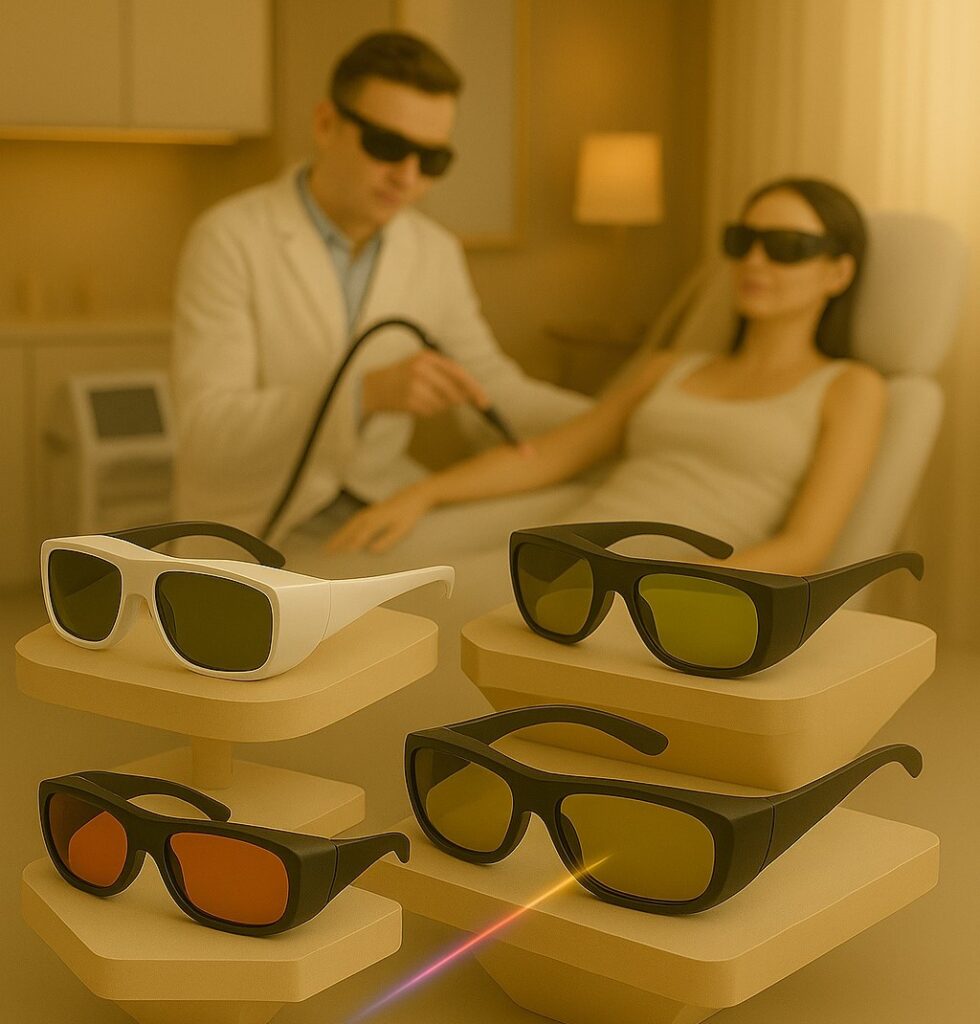
Ergonomic protective goggles from I-SAFE are engineered with:
- Balanced weight distribution
- Soft, medical-grade contact surfaces
- Anti-fog optical coatings
- Compatibility with prescription glasses
Comfort is not a luxury—it is a safety requirement.
Practitioner Visibility and Color Recognition
Poor-quality filters distort color perception, making it harder to:
- Identify tissue endpoints
- Monitor erythema or blanching
- Maintain procedural accuracy
Advanced optical technology in I-SAFE goggles preserves visual clarity while maintaining full laser protection—supporting precision dermatology.
Comparison: Certified Goggles vs Unsafe Alternatives
| Feature | I-SAFE Laser Goggles | Generic Online Goggles |
|---|---|---|
| 🛡️ Certified OD Ratings | ✅ Yes | ❌ Often missing |
| 🔬 ISO / CE Compliance | ✅ Verified | ❌ Unverified |
| 👁️ Optical Clarity | ✅ High precision | ❌ Distorted |
| 😌 Ergonomic Comfort | ✅ Long-wear design | ❌ Poor fit |
| 🌍 Clinical Trust | ✅ Global usage | ❌ No traceability |
Visual Enhancements (Suggested)
- Dermatologist performing laser procedure wearing I-SAFE goggles
Alt text: Choosing the right laser goggles for dermatology clinics during treatment - Close-up of certified OD labeling on goggles
Alt text: ISO-certified medical laser eye protection goggles - Comparison image: certified vs non-certified goggles
Alt text: Laser protection for dermatology safety comparison - Ergonomic design highlight
Alt text: Ergonomic protective goggles for long dermatology procedures
Conclusion
Choosing the right laser goggles for dermatology clinics is one of the most critical safety decisions a practitioner can make. Laser technology will continue to evolve, but the vulnerability of the human eye remains unchanged. Certified protection is not optional—it is foundational to ethical, compliant, and successful clinical practice.
By prioritizing wavelength-specific filtration, verified optical density, international certifications, and ergonomic design, clinics protect not just eyesight—but reputation, trust, and professional longevity.
I-SAFE Laser Goggles represent the gold standard in medical laser eye protection—combining German engineering precision, advanced optical technology, and global healthcare safety solutions. When safety matters most, compromise is not an option.
Protect your vision. Protect your practice. Choose safety that is proven.
Frequently Asked Questions (FAQs)
1. Are laser goggles mandatory in dermatology clinics?
Yes. International laser safety standards mandate certified eye protection for all personnel and patients exposed to laser radiation. Non-compliance increases risk of injury and legal liability.
2. Can one laser goggle be used for multiple devices?
Only if the goggle is certified for all wavelengths and power levels used. Always verify OD ratings. I-SAFE offers multi-wavelength certified options for advanced clinics.
3. How often should laser goggles be replaced?
Replace immediately if lenses are scratched, cracked, or visibly damaged. Regular inspection is essential, as compromised filters may fail without warning.
4. Are I-SAFE Laser Goggles suitable for IPL systems?
Yes. I-SAFE designs goggles specifically for IPL and broadband light systems, ensuring safe spectral coverage and visual clarity.
5. Do certified goggles affect visibility during procedures?
High-quality goggles like I-SAFE preserve color accuracy and clarity while blocking harmful radiation, supporting precise dermatological outcomes.
6. Why avoid cheap online laser goggles?
Uncertified goggles may lack verified OD protection, distort vision, and fail under real laser exposure—placing eyes at serious risk.
I-SAFE Laser Goggles
German-engineered safety. Certified protection. Trusted worldwide.Follow us at : https://www.instagram.com/alphasurgicals?igsh=cTdjYWNtaXkxazlr
Visit us at : https://isafelasergoggles.com/